Showing posts with label autobiography. Show all posts

Wednesday, April 20, 2022

In the Noble Name of My Father

Following is a message from me on the 44th Anniversary of the passing of Pita-ji.

In Punjabi:

ਪੂਜਨੀਕ ਪਿਆਰੇ ਪਿਤਾਜੀ ਕੇ ਨੇਕ ਨਾਮ  

In English:

In the Noble Name of my Father


*      *      *

Friday, January 07, 2022

Meri Jivan Yatra, Smriti di Saraswati

Available in Amazon at 
https://tinyurl.com/4brn44rd

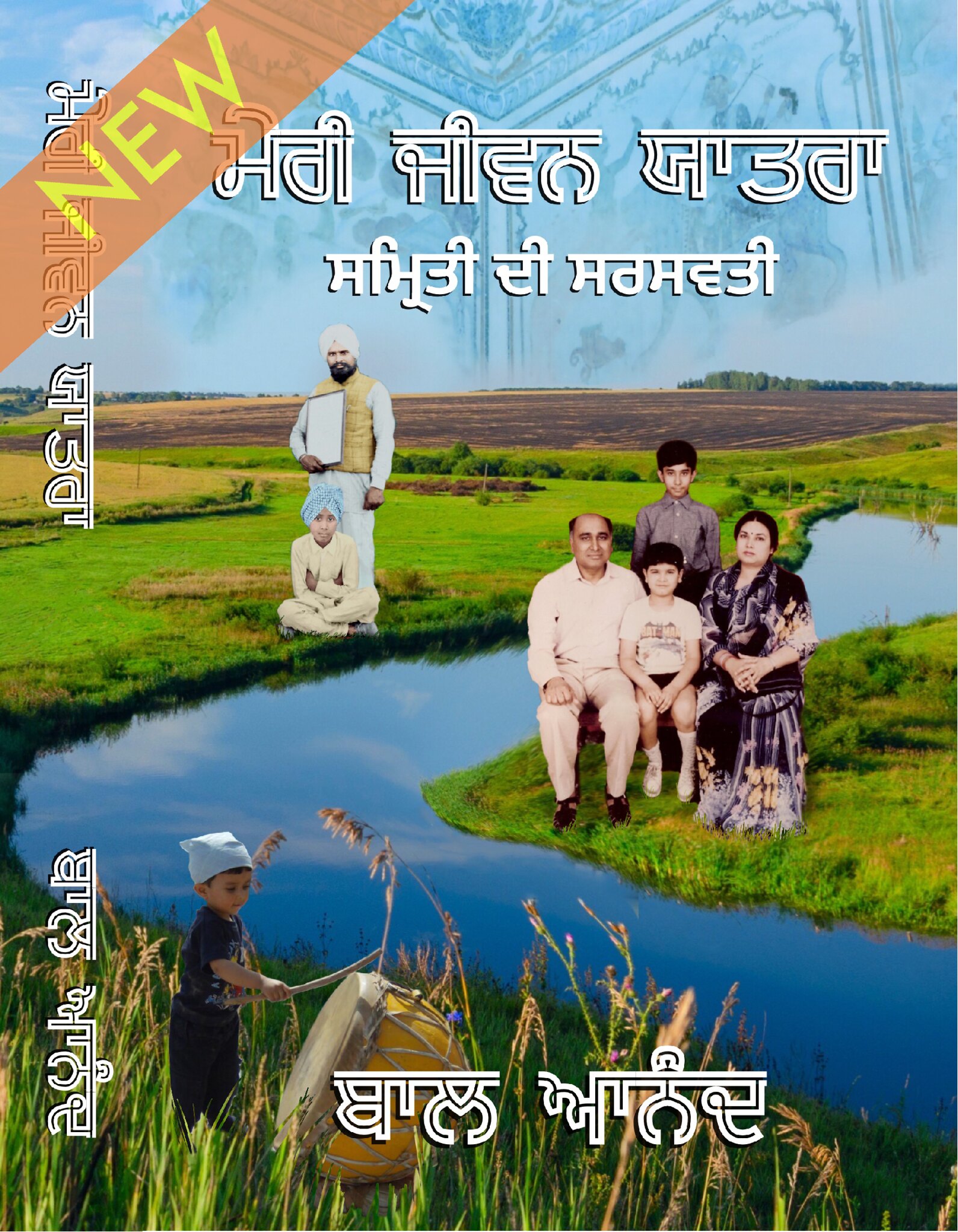
I present here my latest book, my autobiography, in Punjabi language

ਮੇਰੀ ਜੀਵਨ ਯਾਤਰਾ: ਸਮ੍ਰਿਤੀ ਦੀ ਸਰਸਵਤੀ

Meri Jivan Yatra: Smriti di Saraswati

Pilgrimage of My Life: A River of Reminiscences

Described in Amazon as

'Meri Jivan Yatra: Smriti di Sraswati - Pilgrimage of My Life: A River of Reminiscences'; 436 Pages and 24 pages of 96 rare photos.

This extraordinary narration, in Punjabi, by Ambassador Bal Anand (Born 1943) chronicles his marathon journey from a small village school to nine different capitals across the continents to represent India in 14 countries.

This amazing tale of many an unexpected twists in author's life has been told in a gently flowing poetic prose - with ripples of humor here and there. The reader is diligently taken along to travel to various interesting places and meet many talented people and also the eminent global personalities. Author also shares with the reader his trips to famous institutions, monuments and wonderful beauties of nature in the far off locations. The author has dwelt at length on the historic background of his family of saints and classical scholars and has paid rich tributes to his inspirational teachers. He has also referred to the his pleasant personal encounters with many famous personalities in politics, literature, arts, sports, etc.

This autobiography - the first ever in Punjabi by an Indian Foreign Service Ambassador - is lit up on each page with anecdotes and notes of hope and cheer. The book is indeed a must read for all the Punjabi knowing persons for an enlightened overview of the cross currents of developments in India during the 75 years of Independence and even beyond.

Video Trailer of Author's Introduction to his Book

Youtube link: https://youtu.be/z9-_DPP7sQA

Please note: The complete video is still in post-production, and will be posted here shortly.


*      *      *

Wednesday, September 16, 2020

Swami Agnivesh - An Amazing Indian Life

Interestingly and intriguingly, 2020 had begun for me with an affectionate meeting at the Sahmat Cultural function on 1st Jan. with my favourite Swami ji, Swami Agnivesh.

author with Swami Agnivesh
Author with Swami Agnivesh at Sahmat Cultural function
(1 January 2020)

Coming from a liberal family of saints / scholars, I feel instinctively quite at ease with open minded Sadhus ... Fakirs. I had first seen Swami ji in 2005, presiding over an Arya Samaj meeting in Delhi. I recall how he had proposed that Nepal should be greeted on becoming a secular state. There was a loud unanimous "No, No!" by all those present and Swami ji had quietly shelved his suggestion.

Swami was a crusader for the poor and oppressed and called a spade, a spade... about all religious rituals... like Amarnath Yatra. To end the old blood feud, he had even proposed that 'derogatory' about Guru Nanak in Satayarth Prakash could be deleted... again vehemently opposed by other Arya Samajis.

Further links and information

*    *    *

Tuesday, June 23, 2020

The Great Memories of Great-Grandfather

This article was contributed to the prominent diaspora website in the USA, "India of the Past" in 2019

IT WAS October 2018. I realised - as if in a flash - on the night of 18th October that the next day was the 71st anniversary of passing away of my most beloved and esteemed great-grandfather – a unique Guru, a tactful teacher, a versatile scholar and renowned Vaidya of his time, Shri Pramatmanand ji.

L to R: Pardadee Bhua Chetan Kaur Ji, Author, Nanee Jee
Bishan Kaur & Dadee Ji Dhann Kaur. c.1956

As a child of about 4 years at that time, I have rather very vague - बहुत धुंदली सी - but distinct memories of the day. I had lost my mother about a year earlier and, therefore, used to spend more time in the loving care of my Naanee (maternal grandmother) Bishan Kaur, though my two great-grandfathers - Giatanand ji and Pramatmanand ji, not to speak of the grandparents - Dwarkanand ji & Dadee-maan Dhan Kaur, and the two paternal / grand paternal aunts simply adored me.

Father, reflecting a serious demeanour and seen mostly busy doing this or that work, seemed somewhat of a distant and forbidding figure. Perhaps, in those times, young fathers in large joint families, were also treated by the elders at home more in terms of grown up children! And they, in turn, might also have felt a bit shy or were not yet accustomed to be openly affectionate towards their own children, more particularly when there were several seniors always lurking around to do so! I was, as I have been told, a very healthy, playful and well adorned child-ever ready to ‘play’ with anyone who was imaginative enough to attract my attention and interest.


Author visiting the Baithak of his elders,
first time since childhood. 17 December 2006

Baba ji Pramatmanand ji would often like to have me by his side in his Baithak - an all-purpose larger room serving as pustkalaya (library); lekhanalya (room for writing books); aushdhalya (room with open Almirahs with lines of bottles of medicines); shishyalya (teaching room), sangityalya (with musical instruments lying around) and above all, the play-corner of his most beloved great-grandson, i.e., me – the first born of the 7th generation of the known history of the family! I was reputed to be the apple of his eyes – the fulfilment of his prayer; reputed to have been named by him even before my birth, after the name of a legendary saint scholar of a historic seminary of Amritsar! What an ironically tragic twist of destiny that it had taken me more than sixty years to cross the threshold of and enter this most pious premises, once the hallowed seat of imparting knowledge and wisdom by Vaid Bhushan Param Sant Pramatmanand Ji, my revered great grandfather !!!

Falaund Kalan
Shrine of Author's Ancestor - Baba Gajjan Shah Ji

On the fateful day of his passing away, I had been, perhaps, specially fetched – carried mostly on shoulders during the journey on foot by my maternal uncle, Jawala Singh from village Jandali, of my recently deceased mother, Malkit Kaur. It was located near the historic town of Payal, on Sirhind Canal, 7 Koh i.e., about 17 km from my parental village, Falaund Kalan. I recall that the Bawan – decorated bier for funeral procession – bedecked with flowers and buntings had in front the group of Band-baja musicians – Muslims professionals called from the nearby city of Malerkotla. The silently grieving women were moving behind the men folk. I, the Jyeshath - first born-great-grandson, was carried on his broad shoulders by my well-built maternal uncle Jawala Singh. I was waving ritually the Chaur – fly whisk – over the bier. This funeral procession, in a solemn tradition but not in overly sorrowful atmosphere, was symbolic of the expression of completion of a life of fulfilment of the most respected and distinguished elder of the family.

Baba Gajjan Shah Ji

The bier had been brought into the exclusive family cremation ground near the more than hundred-year-old Samadhi - mausoleum - of family patriarch Baba Gajjan Shah. My father was being given instructions to light the pyre. Pramatmanand Ji’s had no child and my father, Haridialnand, was his adopted grandson and the brightest shishya (pupil). He had been rigorously groomed since childhood by his Guru-grandfather to be the true inheritor of his mantle of all the multifarious scholarship and spiritual learning.

Minutes before my father was all set to light the pyre as per the ritualistic ceremonies, an army official, Ram Singh, belonging to our extended family, happened to arrive unannounced on his long awaited vacation after World War II. He was last known to have served in Italy. He had been able to bring with him a camera – something quite rare in those days in any village. He had immediately rushed to our exclusive cremation place. He politely interrupted the Agni-dah - lighting the fire - ceremony for a while, and clicked a photo of the group standing by the side of the mortal remains of the departed noble soul. I could discover the copy this small size photo in one of the family books when browsing through them after the death of my father in April 1978. Though not very clear in details, the enlarged photo has been indeed a rare monumental image capturing the moment – just before the mortal remains of the great soul were consigned to flames of fire.
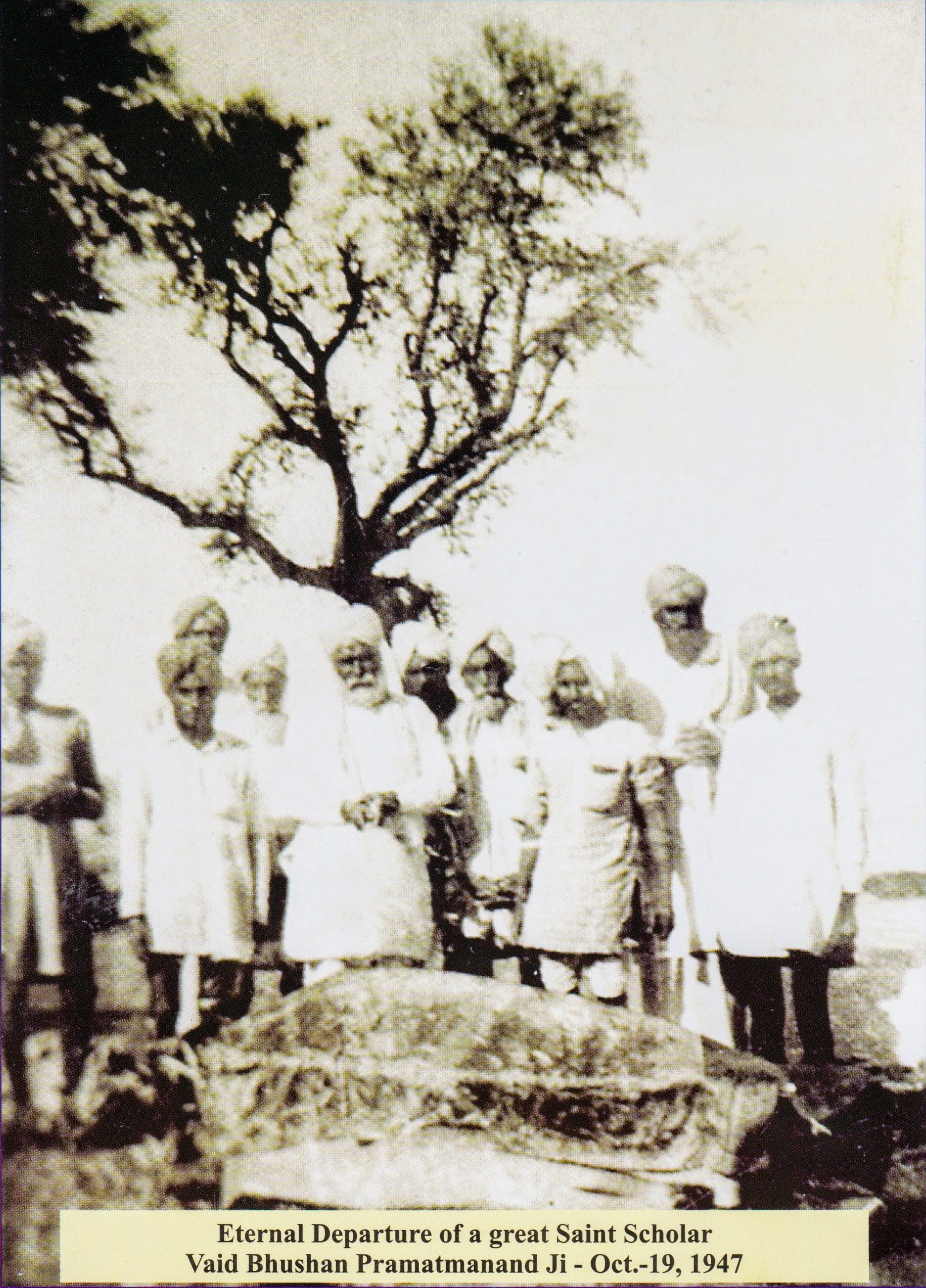
Among the ten persons in the photo, I have been able to recognise eight of them. Standing left to right- the second is Lakhmananand, a dear real nephew, then about twenty years old, who had been born posthumously; Narain Darya, another elderly distant nephew; village headman & a distant grandson, Basant Narain; Tara Singh, again a distant grandson; Shyamanand, an elderly real nephew; Haridialnand, adopted grandson and chosen heir; Mahinder Dass, a distant grandson and a learned disciple; Krishnanand, a distant grandson and a young disciple. I had known Shri Basant Narain and Krishnanand quite well and was recipient of their great affection and blessings.

I have some deeply distant recollections of the largely attended get together at the Antim Ardaas – the last Prayer function on 9th November 1947 – marking the completion of Shri Akhand Path, he uninterrupted 48 - hour recitation Shri Guru Granth Sahib. The people of the Punjab were still under spell of great gloom over the barbaric violence in the wake of Partition of India. Our village was part of the area of Muslim state of Malerkotla, and the rulers called ‘Nawabs’, had been held in high esteem by the people. The Sikhs recalled with admiration and gratitude the historic bold stand taken by Nawab Sher Mohammad Khan (1672-1712) when the two innocent young sons of Guru Gobind Singh were bricked alive by the governor of Sirhind in 1705. The territory of Malerkotla had remained comparatively quiet during the worst killings of Muslims in East Punjab. Sadly, the last Nawab Ahmed Ali Khan had passed away on 18th October 1947. I think that I had heard people talking to suggest that noble people like Nawab Sahib and Pramatmanand Ji were departing this world because such noble souls cannot withstand the barbarity, inhumanity and utter cruelty of the time!

Entry in 'Red book' of ceremonial records

In September 2019, I was able to retrieve the old family ‘red-book’ of ceremonial records and the various traditional financial dealings. My father had been tutored to cultivate a habit of recording most meticulously the minutest details of the various social and religious ceremonies. He did the same after the passing away of Pramatmanand Ji, including the mention of the exact amounts of various expenditures involved. He has, among many other details, recorded, “The Most Pious 108 Sant Baba Pramatmanand Ji breathed his last at 8p.m. on Saturday, 18th October and Biwan dwara agni sanskar was performed at 4p.m. Sunday, 19th October.” The Community Feast had been arranged on 4th November. The Function of the completion of Recitation of Granth Sahib had taken place on 9th November. The Musicians of the band for funeral part had been paid Rupees 15 - a significant sum in those days; cost of wood for the pyre was Rupees 23, and 64 coins of double Paisas - large sized copper coins - were thrown around during the journey of the funeral procession! The family Guru – a dignified Bedi Sikh, a presumed to a direct descendant of family of Guru Nanak Dev Ji - had been given a ‘Dakshina’ of Rupees 11!

Then in October 2019, I also came across revealing references in Haridwar in the records of the family Purohit - Pandits including the signatures of many elders who had gone there to immerse the ashes of the members of the family. In 2009, we had discovered a copy of a long letter, more than 2000 words, penned sometime in 1945 by Pramatmanand ji to his young nephew who had joined the Army. It was about the conflict of litigation over family lands by his maternal grandfather, and it amply revealed his anguish over the unnecessary family feud. I have been keen to highlight his legacy of multidimensional scholarship Pramatmanand Ji, particularly his original hand written works, in Gurmukhi script, of Ayurveda and commentaries on the sacred texts Hindu-Sikh spiritual tradition. One big book, called ‘Moattam Sahib’, contains thousands formulations of ingredients of very special Ayurveda medicines, considered strict secrets like - present day patents. I am glad that Gajjan Bilas, the biography the family patriarch authored by him in Brij-Bhasha, has been long last published.

I have been speaking to the elderly persons in the village - not many survive now - who had personally known Pramatmanand ji. A very senior cousin who was the first in the area to do Masters in English in 1950 - and had then joined the Indian Revenue Service - had told me several interesting anecdotes about the scholarly Baba Ji. When asked about his education, Baba Ji was fond of saying that he had studied in the University of Himalaya Parbat. Similarly, when as a high school student he had once angrily spoken to Baba ji, ‘There is no Rabb-God… all talk about Him rubbish.’ According to him, Baba Ji affectionately drew him closer to his bosom and spoke very softly and sweetly, ”Son, first of all, one should not be full of any anger when trying to understand any deeper and complicated problem!”

It was my destiny to go around the world as the representative of India and have the privilege to meet the most magnificent personalities in various fields. In an inexplicably mysterious way, I feel that my pilgrimage on the path of particular point of view of life had indeed begun very early - in the most ennobling lap of my great grandfather, an extraordinary saint scholar who had devoted every second of his earthly sojourn in the love of learning the art and science of healing- of the human mind, body and spirit!

*   *   *

Sunday, January 28, 2018

Gajnesh Sandesh - January 2018

This is Punjabi-English magazine was published on January 2018

A publication of:
Sant Pramatmanand Academy of Creative Excellence (SPACE)
Sant Pramatmanand Rachnatmic Sreshta Sansthan

Cover of magazine
Cover Page of Magazine

Download PDF copy here

Contents
ਸੰਪਾਦਕੀ ਚਿੰਤਨ : ਪ੍ਰੇਰਣਾ ਸਰੋਤ ਤੇ ਮੂਲ ਮੰਤਵ ਬਾਲ ਆਨੰਦ 2
ਇੱਕ ਇਤਿਹਾਸਕ-ਪਰਿਵਾਰਿਕ ਪੱਤਰ ਵੈਦ ਭੂਸ਼ਨ ਪ੍ਰਮਾਤਮਾਨੰਦ ਜੀ 3
ਪੜੋਤ੍ਰੇ ਵੱਲੌੰ ਉੱਤਰ-63 ਸਾਲ ਬਾਅਦ ਬਾਲ ਆਨੰਦ 5
ਮੇਰਾ ਪਿੰਡ 'ਫਲੌੰਡ' ਤੇ ਮੇਲਾ ਲੋਹੜੀ ਦਾ ਬਾਲ ਆਨੰਦ 6
ਮਾਲ 2000 ਦੀ ਹਾਰਦਿਕ ਵਧਾਇ ਸ਼ੰਕਰਾਨੰਦ 7
ਗਾਂਧੀ ਸਕੂਲ ਦੇ ਮੇਰੇ ਅਧਿਆਪਕ ਡਾ. ਹਰਨੇਕ ਸਿੰਘ ਕੈਲੇ 8
ਸ਼ੁਭ ਕਾਮਨਾ ਸੁਮਨ ਮਾਲਾ ਪ੍ਰੋ. ਕੇ. ਐਲ. ਰਤਨ 9
ਸ਼ੰਕਰਾਨੰਦ ਜੀ ਦੀ ਕਾਵਿ ਪ੍ਰਤਿਭਾ 10
ਦੋ ਗ਼ਜ਼ਲਾਂ ਅਮਰਜੀਤ ਸਿੰਘ ਸਿੱਧੂ 10
ਸੁਥ-ਸੁਨੇਹੇ - ਪੁਸਤਕ ਰੀਵਿਊ ਬਲਬੀਰ ਮਾਧੋਪੁਰੀ 11
ਬੀਤੇ ਨੂੰ ਆਵਾਸ਼ਾਂ - ਕ੍ਰਿਸ਼ਨ ਅਸ਼ਾਂਤ ਬਾਲ ਆਨੰਦ 12
ਹਨੇਰੇ ਥਿ਼ਲਾ਼ਢ ਲੜਦਾ ਸ਼ਖ਼ਸ : ਐੱਸ.ਤਰਸੇਮ ਕੇ.ਐਲ. ਗਰਗ 14
ਓਲੰਪੀਅਨ ਡਾ. ਅਜਮੇਰ ਸਿੰਘ ਜਗਮੀਤ ਸਿੰਘ ਪੰਧੇਰ 15
I Love My 'Un-Partitioned' India Rashid Latif Ansari 17
The Journey of My Life Dr. Yogendra Pal Anand 19
Independence in My School Dr. Jaswant Singh 21
Ahmedgarh - Story of a Grain Market Town A.L. Jain 22
My Career as a Doctor Dr. D.K. Batta 23
Expressions of Freedom - Introduction Bal Anand 24
Revisiting School - Five Decades Later Bal Anand 25
My Childhood in Ahmedgarh Dr. K.K. Chexal 27
A Short Profile Bal Anand 28

Download PDF copy here

* * *

Tuesday, January 09, 2018

A Tribute to a Teachers' Teacher

Prof. Pritam Singh Ji
As a life long industrious student of the various disciplines of humanities with particular focus on world literature as my post graduation; spirituality in humanity as family heritage and International Relations as my profession, I have always deemed myself as one of the most privileged disciples of Professor Pritam Singh Ji (Jan. 11, 1918 - Nov. 25, 2008), without ever attending his formal class! He had indeed become the tall human tower - a light house in Patiala - as an  eminent teacher and an extraordinary, an encyclopedic, scholar of not only Punjabi language and literature but the entire range of the composite cultural and literary heritage of humanity.

Prof. Pritam Singh had been an inspiration for generations of students of Punjabi literature till he breathed his last. He was one of the stalwarts among teachers who had been a witness, as a bright student with the most meager means, to the best of the 'un-partitioned' - of the Five Rivers - Punjab. For me, he signified an era - that is no more - of the most enlightening literary pursuits in Punjabi. He had come to personify a rare dedication to bring alive the glory of Punjabi, cutting across all the narrow divides of the dangerous mix of religion and politics with the mother tongue of the brave Punjabis. I was indeed  singularly fortunate to be in his close contact-in the ancient Guru-Shishya tradition. He remained a 'Pole Star' of guidance for me in the matters of our deeply shared mutual interests in the global contexts of languages, literature and all the myriad faiths of the people.

I vividly recall how, as a student of B.A. in the D.A.V. College Jalandhar - some time around November, 1962 - I had the first Darshan - a face to face glimps - of Professor Pritam Singh. He was presiding over an important meeting of the Kendriya Punjabi Lekhak Sabha. The meeting had soon degenerated into an uproar of noisy shouts with even the signs of clenched fists for physical fighting- between the dominant progressive writers led by the veteran Marxist S.S. Sekhon and the silver-tongued orator Comrade Jagjit Singh Anand on the one side and the promising upcoming exponents of the new-wave-experimental Poetry including Jasbir Singh Ahluwalia and Sukhpalvir Singh Hasrat. Professor Pritam Singh, impressively attired in black achkan and chooridar, reprimanded them all in chaste Punjabi, using even typically strong phrases like 'Kanwarauli, kanjarkhana, kuttekhani', etc.  The eloquence, tactfulness and firmness displayed by the Professor from Patiala had the desired effect and it turned out to be a memorable session of lively discussions interspersed with sparkling and learned interventions of wit and humour by the Chair. I, an undergraduate student, had become an anonymous life long admirer of this Professor from Patiala for his radiant charm, scholarship and unshakeable belief in order and discipline.

It was, however,  as a student of M.A. (English) in the Government College - with no needless S.C.D. prefix then - Ludhiana, perhaps, in October 1964, that I read Balwant Gargi's pen-portrait of Professor Pritam Singh in Aarsi, then a popular Punjabi monthly, alas, has ceased publication since May, 2000. Gargi, in his inimitable style laced with subtle satire and humour, had referred to the rare qualities of Professor Pritam Singh as an 'obsessed' researcher of the old manuscripts of the Punjabi language and the evolution of the Gurmukhi script. Around the same time; Professor Pritam Singh had been transferred to the College as Head of the Punjabi Department.

Prof. Pritam had been assigned by Principal K.S. Thapar, interestingly, to deliver lectures for all the students of the College, in the main lecture hall now named after old student Sahir, on the themes of National Integration, introduced under a scheme of Government of India in the wake of war with China. Again, Professor Pritam Singh was at his best both in oration and the subject matter. One day, I gathered enough courage to speak to him requesting him to visit my home to meet my father and have a look at various hand written old books in Gurmukhi in our family.  He indeed gracefully agreed and visited our home in Ahmedgarh on Jan. 24, 1964. He had an engaging exchange of views with my father, an Ayurved practitioner and a scholar of Sanskrit and classical literature. I also arranged his meeting with my school teacher Shri Ashni Kumar, a Lahore educated reputed learned man. Professor Pritam Singh wrote to me a post-card, in English, thanking me for arranging the visit and praised my teacher as a person of, 'deep scholarship and disarming courtesy' - the last phrase was indeed an ever lasting lesson for me and made me his dedicated disciple for life.

The time rolled on, I passed my M.A. in English and was delighted to achieve my dream of becoming a lecturer, first in DAV College, Jalandhar and later on Govt. College, Bathinda. It was as a lecturer in Bathinda that my contact was re-established with Professor Pritam Singh. I had to accompany another respected scholarly personality, Professor Harmandar Singh, an eminent teacher of Political Science, who had also been transferred to Bathinda, for his meeting with Professor Pritam Singh, then Principal of Government College, Faridkot. It was in November, 1968 and the time of elections to the Punjab University Senate / Syndicate. Professor Harmander Singh was upset that Principal Pritam Singh had switched to the constituency of Registered Graduates instead of the Principals, making a clash between the two great old friends inevitable. It was a mix of tension and learning for me to be a listener to the arguments between the two of my most respected Professors. After lengthy discussions, Professor Pritam Singh appeared to have convinced Professor Harmander Singh that there was sufficient space for victory for both of them in the larger constituency of the Registered Graduates. While walking with us to the Railway Station to see us off, in the 'rush of the continued arguments', he also decided to accompany us to Bathinda. We had to speak to the Guard that, in a hurry, we could not buy the tickets. Reaching Bathinda, I went to the guard to pay him the amount of tickets. Professor Pritam Singh, with a twinkle of an eye and a trade mark smile, said to the guard, "Badshaho, Eh Jhoote Tan Hoon Tohadi Bakshish 'ch hi aouon dio – let this swing-ride be under your kingly generosity!" The guard also laughed heartily and we came out thanking him. Around the time of the dinner, I requested Professor Pritam Singh that we should go to the nearby restaurant. He replied that he had his dinner in train when he was eating the 'Chholia', i.e., the green-peas of grams, taken directly from the plants!

There was again a long interruption in our correspondence after I joined the Indian Foreign Service in 1971 and moved to Delhi and many postings abroad. It was during my posting as the Deputy High Commissioner in the neighbouring Pakistan (September, 1992 - November, 1994) that we could resume our intense interaction, particularly in the context of the preparation Punjabi Lekhak Kosh – Directory of Punjabi Writers. I could contact several Punjabi writers and activists in Lahore and Islamabad to collate information for inclusion in the Directory. Prof. Pritam Singh was gracious to mention my name in the list of the persons who helped him in compiling the book which was published in 2003. Prof. Pritam Singh always replied at length to my letters regarding my observations on the shared heritage of the Punjabis and how the bond of language could be strengthened in the face of evolving complex and challenging circumstances. He had a large circle of friends and admirers in Pakistan and his deep knowledge of Persian and Urdu languages proved an immense asset as a bridge between the two Punjabs and the national and international forums..

It was after reading my long letter, in Punjabi, 'Battan Beete Vareh dian - Matters of the Year that is past', circulated in December, 1995 to my close circle of friends that he specifically directed me that I should seriously plan to write about my experiences, in Punjabi, when I am free from the burden and worries of the Service. In view of his failing eye sight, the correspondence got restricted and confined to brief and urgent e-mails. After my retirement in 2004, I availed the privilege of speaking to him more often  whenever there was some matter of mutual interest. He would again remind me of the promise I had made with him to write in Punjabi. I once said, 'Sir, there is so of much high quality writings available to read, it becomes difficult to discipline oneself and find a time to write'. He smiled and retorted, 'that is the tragedy of Punjabi, Bal Anand Ji... those who should be writing, say they have no time from reading; but those who should be reading more, go on writing more and more!'

Meeting on Jan. 11, 1999 - 81st Birthday of Prof. Pritam Singh

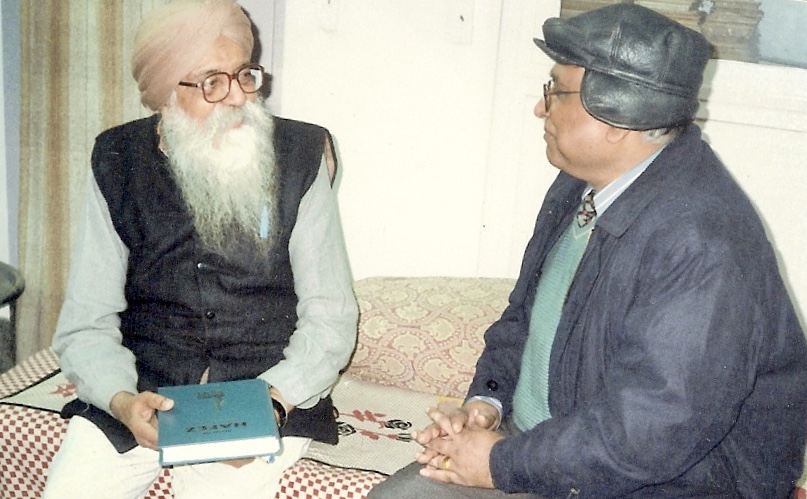
My last meeting with Professor Pritam Singh took place in the late evening of 1st October, 2008. He appeared some what frail and time - worn but his profundity of expression, smile and laughter were indeed as intact as ever. I had presented to him 'Diwan-e-Hafiz' brought from Iran - the 'Blue book' in the picture and my write-up in Punjabi on the popular 'Chhapar Fair of Punjab' and my recent columns on Urdu poets and scholar A.J. Zaidi and Ahmad Faraz. We touched upon the current educational and cultural scene in Punjab and in the country. When I took leave of him, he persisted in walking with me the up to the main gate. I mentioned to him - at the door step - that Panth must think of establishing a museum of letters, with name, 'Zafar Namah Sahib Bhawan', inviting Punjabis all over the world to donate letters on the themes of literature and culture of Punjab - to be scientifically preserved there.

I penned my last letter to Professor Pritam Singh, on 24th of October, a day before his joining the company of the immortals, sending it care of his daughter Doctor Harshinder Kaur so that she might read it out to him. The Destiny of this letter was fated  to be different - reaching him on the address far, far beyond his earthly abode! I salute this angel of a Teacher on his birth centenary - he indeed radiated knowledge and nobility with every word spoken by him!

*     *     *


Friday, March 24, 2017

Ek Sham - Ahmedgarh ke Naam


Dear Friends,

As you know, Ahmedgarh has been my beloved place of school education - May 1951-March 1959 and my home town upto July  1971...

It was Master Ashni Kumar Ji (1916-1999) - my unique Guru-teacher - who was my anchor of life in Ahmedgarh till he breathed his last - on Saturday, Feb 16, 1999.

I had been myself so stressed and always short of time till I setlled down in retirement in 2004... after spending more than 26 years abroad - 21 of them were consecutive, from 1982-2003!

I have tried to make the best of the sun set years of life by returning - full time - to my books, rediscovering good old friends - and my love for pen and paper - rather the modern age wonder, Shriman computer-Ji!

I know how the dear friends in the tri-city beautiful have been dreaming of an evening devoted to the golden memories of childhood in our beloved Mandi... a brand new town which had sprung up from no where - in the wake Rail Revolution of India in the early twentieth century.

I am heartily grateful to the dream team of friends - Jawahar ji & Janak in particular - who conceptualized the event of the evening of Friday, 24th March to recreate the genuine spirit of love, innocence and affection dedicated to our beloved town. The inimitable Mootki - Rakesh Bhai - is indeed blessed with an abundant artistic talent and the most infectious joy in bringing to pulsating life all the beautiful memories of the sweet past...

Prof. Anu Jain was the perfect compere of the event ... the memories of his most wonderful Tayas - Amrit ji  Madan Faryadi ji - have been my most precious wealth.

I was so glad to meet many new friends and younger friends of the new generation - nasal nau - who all swear by the love of Ahmedgarh!

Brig JJ Singh Jagdev's family - we met after more than fifty years - is closely related to mine for four generations - it was his grandfather who was instrumental in persuading my family to shift to Ahmedgarh.

Sh Gobind Thukral ji has been a dear friend, philosopher and guide since we met in my retirement... 13 years ago; Dear Ashwani Gupta put in a lot of effort in managing the event in Western Court...

My sincerest thanks to all the ladies who had graced the occasion as equal & active participants... I promise to be accompanied by my 'better half' when the next such get together happens.

With my greetings & best wishes to all the dear friends,

Affectionately,
Bal Anand

PS - I am sharing three photos of the event..
Hope you would share more photos/visuals of the most joyful evening


Friday, July 01, 2016

My Lessons of History in School

I consider myself singularly lucky and blessed that the lessons in history - and poetry- started for me much earlier in life than for most people. I was myself, however, innocently unaware about all this at that time.

To begin with, take the case of the date of my birth. It was determined as 15th November, 1943 - perhaps, a year less - at the time of my admission, in October 1949, in the District Board (soon changed to be ‘Government') Primary School of the neighboring village, located in what was still called the Angrezi Ilaqa (British Territory). It was a school with one kutcha (made of mud) room; a small court yard which had low (less than three feet high) mud wall around it; two teachers and four classes. The school had about forty students from the surrounding villages.

The name of the village is Sohian, near the old town of Malaudh, about 30 Km from Ludhiana. I do recollect that the senior teacher Pandit Lachhman Dass Ji had asked my father whether he had thought for me a plan of higher education or putting me in some job soon after my matriculation. My father had replied, in a very polite but deeply determined voice, that he would like me to go for the highest possible education.

I was to come to know 55 years later - a few years after my own retirement at age of 60 - that this popular but strict disciplinarian teacher who had commanded deep respect among generations of students had served in the same school for his entire teaching career!

It was in this school, I had heard the couplets of the first folk poem by a senior student, Jagga Singh, praising Mahatma Gandhi to be clever enough to ‘outwit' the foxy white rulers!

The white Kothi (mini-palace) with high walls and surrounded by the thick lines of tall trees of a Sardar (petty chief, feudal lord) called Kaka Ji of Sohian was visible from the school. It was, however, more a like a mysterious fort for us, the young students- something like the complex buildings I was to see later in the horror films. I had, however, come to know that the Young Sardar-Kaka Ji has been recruited as a Poolas Kaptan (Police Superintendent) by the Government of Independent India. Later in life, my efforts to meet the then octogenarian, Sardar Narinder Singh Phulka, IPS (Retd.), could not bear fruit, in spite of the fact that one of his sons-in-laws, now retired in anonymity from the IAS, had been a friend from my college days.

The next historic turning point for me came in May 1951 when I was admitted in the third grade in the High School in Ahmedgarh, the nearby town. The family took some more time to shift there from the village. I felt quite at ease being exposed to a refreshing atmosphere of freedom, patriotism and nationalism surcharging this school named, soon after Independence, from Public High School to 'Mahatma Gandhi Memorial National (MGMN) High School'.

The eight years of the continuous studies in the school provided me with ample opportunities to look all around far beyond the lessons in the class rooms. I must thank Master Ashni Kumar, a senior teacher of English and Social Studies who had started mentoring me right from my sixth class.

The town of Ahmedgarh (named after Nawab Ahmed Ali of the tiny state of Malerkotla (1881-1947) had been founded in 1905 in the wake of the construction of the revolutionizing rail link connecting Ludhiana to the southern-eastern belt of Dhuri-Jakhal and beyond. The new look town regularly witnessed, as if it were a typical Greek city state, debates and dramas in the school which were often joined by the chaudhris (elders) of the town too.

The local wings of political parties - Congress, Socialists and Jan Sangh in particular - seemed to be vigorously competing to bring their national leaders to address the people in the Gandhi Chowk, in the miniature Connaught Place of the town, proclaimed to have been planned after Montgomery! The location of the town on the cross-borders of adjacent Riyasati (Princely) and Angrezi (British) pockets of territories had made it a favorite and strategic meeting place for freedom fighters playing grim games of hide and seek after daring protests and acts of defiance including an act of loot - at gun point - of the government funds in a train robbery between Ahmedgarh and Malerkotla!

In terms of history, I must refer to the tragically maddening times in the wake of Partition. My great grandfather Param Sant Vaid Bhushan Pramatma Nand Ji had passed away on October 19, 1947, a day after the death of Nawab Ahmad Ali of Malerkotla. I can vividly recall how the mourners at the Bhog ­- the last prayer - were cursing the kaliyuga (Evil Epoch) for the calamities befalling the nation and her noble people. I could later notice that many houses had been burnt down in my mother's village - apparently belonging to Muslims. The mosque had been quickly converted into a Gurdwara!

I was luckier as a child to be spared the trauma of witnessing the scenes of murders and violence. But what about the feelings of a ten-year-old boy who was witness to his father getting critically wounded when he fell down trying to board an over packed vehicle leaving Sialkot for India? He had been left behind as dead on the road. The boy turned out to be a brilliant student and rose to the highest professional position for an engineer in India. But how would the pain of losing a father in that cruelest way ever go away - even though in retirement, he became Director of Gandhi Museum, opposite the Raj Ghat!

I do remember that I was able to broadly read, when I was in the fifth class, the Golden History of India by Vishva Nath, M. A., B.T., and Jagan Nath Grover B.A., B.T., senior teachers of History, Arya High School, Ludhiana. It was a popular text book for high classes and belonged to my uncle appearing for matriculation.

I remember vividly how among brief sketches of the contemporary historical personalities: Winston Churchill was described as the plain and blunt speaker; Joseph Stalin was the son of a cobbler of Georgia; De Valera was a great revolutionary freedom fighter, and so on.

Among the teachers of history at school, Master Ram Kishore - in his typical Poadhi dialect of Punjabi - would become deeply emotional in praising Chanakaya, the great teacher and his gifted disciple Chandra Gupta Maurya. Then, he would blame all the current ills of the country on the lack of respect for the teachers! Kishori Lal Sahir would quote couplets of Persian and would turn the lesson into play - assigning the students roles of characters of history, e.g., showing Hemu getting wounded with an arrow in the eye by covering the eye of a student with the corner piece of his turban!

Giani Romesh, known for punishing students with Bhrind - painful pinches, would often use the idiom, Dushmanan de Dand Khatte kar Ditte (leave a sour taste in your enemy's mouth).  It was not by making them eat tamarind, but putting up a brave fight.

The most reputed teacher of history / Geography and English in our school was, however, Master Ashni Kumar, a skeleton-thin person known for his razor sharp intellect and sharp satirical remarks. I was destined to be his favorite student and remain so for more than four decades till he breathed his last at a ripe old age in 1999.

In the tranquility of the years of my retirement, I have endeavored to reinvigorate my interest in the history of the select historical personalities and places-particularly in the more intimate region of the Punjab. My childhood interest in Sirhind was strongly reinforced when, during my posting to Pakistan in 1993, I had to facilitate the visit for a pilgrimage to the city by Prof. S Mojaddid, a former President of the Interim Govt. of Afghanistan after the Soviet withdrawal - the family claims 14 generations to have been buried there! The city with a significant strategic location has the most fascinating and absorbing history of the rise and fall of its rulers. The Ambala-Ludhiana-Sirhind section of the Delhi-Lahore railway line was opened on Oct.1, 1869.

Sirhind has turned a new page in its history with the recent establishment of excellent institutions of higher education including the Shri Guru Granth Sahib World University. A sort of personal history was made for me when, on 8th of November, 2011, the Acting Vice Chancellor, Dr Gurnek Singh, welcomed me to the University with a very special personal warmth and affection. He surprised me by telling me that he was my student in 1968 when I was a lecturer in the Govt. Rajindra College, Bhatinda. After the privilege of crisscrossing the continents representing India in distant alien lands, it is a very special soulful delight to rediscover the deeper eternal roots of friendship and love in the soils nearer home!

The learning - and teaching - of the History of India with a balanced and dispassionate approach is a great challenge. The average individual in society rightly seems to consider the past dead and gone; and the future all day dreaming! It is, therefore, all in the present and near future which is relevant for thought and action. But our battles in the present are often fought over the different versions the past and visions of the future. When I remember the school books and the teachers, so many live images flash before my mind's eye. Alexander, the great, impressed us as students as the most mesmerizing figure of the earlier era. Ashok and Akbar seemed to define the essence of India. Whatever may his later day critics say, for most of my generation Jawaharlal Nehru certainly qualifies to be called the architect of modern India.

Epilogue

The history is continuously in the process of being re-evaluated; the state-craft is such a gigantic entity ­- the search for the total and un-alloyed truth in the affairs of the state would remain a noble pursuit. The pursuit of power and the greed for riches would seem to know no limits - the truth for the cash loads for votes in the Parliament House gets more and more mysterious! The Right to Information has been emerging as an interesting search-light to illuminate deeply hidden dark spots in the files of current history.

Let us hope for better times ahead in terms of truthful history.

References to this article


  • This article was included in the collection "India of the Past, Preserving memories of India and Indians"


Saturday, October 11, 2014

My Father - An Essay in an Autobiography

Pita Ji Writing... Another Har Dyal - Born to be
an Extraordinary Scholar-Physician. About 1954.
He was born, according to an authentic written record in the family, on Monday, August 30, 1920. He was the first born - the Jayeshatha Saputtar - of his parents. The various conversations among the elders of the family which included my two most loving great grandfathers and an adorably talkative great grand-aunt, called Bhua Ji by the entire village, often innocently overheard by me as a child of four-five years, had confirmed this to me. They mentioned that his father Dwarka Nand and his grandfather Giata Nand were also the first born of their parents. And So Am I - his son, now 71+ years according to the date of birth in the Matriculation Certificate, and so are our eldest son, Aditya and our six year old grandson, Antariksh!

Pray, don’t misread this opening statement in any overtone of machismo or a parade of any gender bias - it is but a humble mention of the facts of my family tree. My father was named Har Dayal Nand by his Guru-grandfather Vaidya Bhushan, Kaviraj Pramatma Nand Ji (d. October 19, 1947), the most renowned scholar and Ayurvedic physician of his era. The name might have been inspired by the popular perception prevailing in those years of Har Dayal (Later famous with the prefix ‘Lala’, though he was a ‘Mathur’), the legendary scholarly genius with a miraculous memory. According to the lore in the family, Baba Pramatma Nand Ji had also selected my name, even before my birth! That story could wait till the time when I write about myself! This piece of narration is dedicated solely to the sublime, sweet and sour memories of my father, “Shri Haridial Nand alias Haridial Singh Vaid, Ayurved Rattan, Ayurved Manishi, Gold Medallist, Proprietor, Shri Gajnesh Ayurvedic Aushdhalaya, Ahmedgarh.” A uniquely engaging conversationalist with all the old world wonderful charm of a philosopher-physician, he was destined to fade away, like many extraordinarily gifted persons, including his name sake Har Dayal, in despair and deprivation on April 19, 1978 - at the age of 57 years, 7 months and 19 days! I had sent him my first - and fatefully the last - birth day greetings card from Tehran promising to ‘fulfil all your dreams and expectations of Me!’ I am reminded of the soulful moment in 1955 in my school when he had, pointing at the youthful Deputy Commissioner S.D. Bhambri (I.A.S. 1950) of Sangrur, that, “in independent India now such young persons who are bright in studies and succeed in competitive examinations will the real rulers of the country!” A dream had been planted in my mind and soul!   

L to R: Channa (Major Charanjit Singh Jagdev), Pita Ji, Jangi (Brigadier Jagjit Singh Jagdev) Children are sons of Pita ji's friend Air Force Official Randhir Singh who had taken this photo. About 1954.
It will be noted that my Father, if alive, would have been 94 this month. I feel uniquely luckier to meet Ambassador V.M.M. Nair, going fine at 95+ years and the I.C.S. batch of 1942, during the walk-and-talk in our residential complex. Ashwani Kumar I.P., the film-hero-type-super-Cop and for many years Mr Hockey of India, is exactly of the age of my father. Kumar is known to be fully alert and moves around actively, though confined to a wheel chair. I feel quite convinced that my father had all the ability to qualify for the I.C.S. if the family had the right exposure and guidance to educate him in the British system of education. He was, however, tutored totally at home in all the traditional learning of Sanskrit classics, Ayurveda, Kavya Shastra - Prosody, Sangit Shastra - Musicology interpretative religious studies, including the modern ideologies of Gurmat, Arya Samaj and new wave ideas of Swami Shivananda and Sri Aurobindo. He was trained to be a good horse rider - I remember once riding behind him on a journey to my mother’s village - and also a champion chess player!

Father was most rigorously trained, in the Gurukul-style dawn to dusk routine, for more than two decades to be a perfect calligrapher in both Gurmukhi and Devanagri scripts. Professor Bachittar Singh I.R.S., his 12 years junior beloved nephew who had become the first Post-Graduate in English in the area in 1950, confirmed to me, “Chacha Ji was known to be very bright but was equally naughty too… Baba Ji (Pramatma Nand) used to tie a rope to his one leg so that he did not stray away during the day long lessons!” No Wonder, that no scholar could discern any shade of difference in the ‘pearls-like’ handwritings of Guru Pramatma Nand and disciple Har Dayal Nand in the various voluminous works ‘penned’ jointly by them! Well versed in music, he had become the most sought after Pathi - reciter - of Granth Sahib - in the far and wide area. The circle of his influential Sikh admirers persuaded him to become an Amritdhari - baptised Sikh - on July 26, 1947. I vaguely remember how he had suddenly stopped sharing ‘hookah’ with grand-father Giata Nand Ji and had also adopted an attire of the Sikh tradition. 

As per the custom and practice of the time, Father’s marriage had been arranged at an age of about twenty years. There is, however, no written reference in the family of the date and year of marriage. The conversations in the family have revealed that my mother, though not formally educated, was a very talented and hardworking lady. She had a great passion for all type of knitting including making the large size carpets and durries, many of which had remained in use for decades since her passing away. Though I have never been clearly told about it, She is understood to have died sometime in early 1946 due to complications after a delivery. It has been further understood that my father was deeply depressed over her demise and had tried to seek solace for some time wandering in the guise of a sadhu. My grandmother, a deeply pious lady with prayers on her lips all the time, was the most worried soul in the family about the remarriage of her son who had become a widower at the age of less than 26 years. And strangely at the same time, she would often narrate to me the stories of ‘Dhroon-Dhruv’ Bhakat, Pooran Bhakat and other noble children who had been maltreated by their step-mothers! Finally, after many efforts and a go-between role by a highly respected relation, Babu Ji Patram Singh, the second marriage of my father was solemnised on March 9, 1953 in the village of Pawala, near Rajpura in a large family of ex-service men. 

It must be mentioned that Father had been pushed to take up many responsibilities at a much younger age in the multi-generation joint family because of a long drawn civil litigation over the properties. The deaths of the saintly elders - Pramatma Nand ji on Oct 19, 1947 and Giata Nand Ji on August 20, 1951 - altogether altered the circumstances of the larger clan - khandaan. The family had started shifting to Ahmedgarh, initially for the education of my uncle - and I also joined the school there in May 1951 in the 3rd grade. Father, making a break from the family tradition, set up there “Shri Gajnesh Ayurvedic & Unani Aushdhalaya”, to begin with, in partnership with Shri Lal Chand Jai, a friend and registered Hakim of the Unani System. Soon Father started his independent practice and was able to rent a shop and a residence located in close proximity - at a rent of Rs. Ten for each of the two! Ch. Vivekanand Koshal, a well to do and progressive minded land lord, was very kind and respectful towards my Father for his learning and wisdom.

Pitaji as Pradhan Mantri i.e., General Secretary of the PEPSU Vaid Mandal. Holding the welcome address at the state level conference, March 9, 1952. Behind - Police Inspector Dharam Chand, City In charge Ahmedgarh.
Having not studied in any formal school system, Father was extra keen to obtain the recognised qualifications as an Ayurvedic practitioner. He, therefore appeared privately for the examination conducted Ayurved Vidyapeeth, Allahabad. To his great surprise, he was declared ‘Pratham, Sarv Pratham - First Class, First’’ in the ‘Ayurved Bhishak Examination’ held in 1952. He was awarded a Gold Medal by the Govt. of the PEPSU, then headed by S. Gian Singh Rarewala, declaring, “A Sikh Tops the Examination of Sanskrit.” He had actively involved himself in organising the Vaid Mandal movement in the state and worked tirelessly for the registration of Vaidyas under the new legislation.  On the basis of his newly obtained qualifications, he was able him to get a job in 1955 as Vaidya in Govt. Ayurvedic Dispensaries and served on a small salary of those days for more than a decade. Then he resigned to resume his practice in the wake of deterioration in his father’s health. He started contributing articles, with references from the handwritten books of the family like the one interestingly named ‘Mohtam Sahib’ and the rare works in the Gurmukhi script, to the prestigious journals of Ayurveda including ‘Dhanvantri’, ‘Sachittar Ayurved’, ‘Ayurved Mahasammelam Patrika’, etc. He participated regularly in the national Conferences on Ayurveda; I witnessed one such ‘Sammelan’ at Vithal Bhai Patel Bhawan in New Delhi in December 1974.  

Father, apart from his multifarious scholarship, had remarkable abilities for organisational matters and dealing with the governmental machinery. He enjoyed genuine friendships with activists of all political parties. He was at his best in the company of ‘Sants and Mahants - saints and abbots’ of great spiritual learning who were also quite wealthy and socially influential. It was a great privilege for me to enjoy listening discretely to their learned discourses. Father was quite clear and keen that I must excel in modern education. He seemed, of course, intuitively aware that I had my own path to traverse and avail the new opportunities in independent India. There was, to admit honestly, an unavoidable and unbridgeable generational gap between us; the back-breaking burdens of the family accumulated from his second marriage vitiated and soured the emotional bond between us. His health, with early signs of high blood pressure, had started deteriorating sharply with heart and diabetic conditions. He must have been fully aware of all his ailments and had started looking much older at the age fifty.

Author's Father and Father-in-law
at his wedding, Aug 12, 1973
I think that the occasion of my marriage in August 1973 was the most fulfilling moment for him. The Akhand-path to celebrate the birth of his grandson on the Lohri of 1975 with Tikka Kuldeep Singh Bedi, a descendant of the Sikh Gurus, reciting the Granth Sahib was his greatest - and sadly the last - moment of celebration. He and my father-in-law Shri Nand Lal Ramdasia, had become very close friends and the latter’s sudden death in a suspicious medical accident-reaction to penicillin injection - on December 4, 1977 left my father completely shattered person. His own demise within a period of less than five months was a big double shock for me but it was no surprise. While taking leave of him at the railway station of Ahmedgarh on 17th January, 1978, I had an eerie and foreboding feeling that it was, perhaps, my last glimpse of him. I could piercingly fathom from his face and foresee in his eyes that light of his life might be fading fast.   


Shrine of Author's Ancestor - Baba Gajjan Shah Ji
On the 19th of April this year - the 36th death anniversary of Father - I chose to make a pilgrimage to the more than 170 year old shrine of the family patriarch Baba Gajjan Shah Ji in in our native village of Falaund Kalan. After prayers, I spent some time with Manohar, a childhood play-mate who had lost his eyesight at the age of five years in an attack small pox. I requested Manohar to recite again my favourite Kabbit - fast rhymed poem with profuse alliteration - of Sant Gulab Das - and I have noted it this time. Then I chanced to come across there an older person; walked across to him and introduced myself in the name of my ‘Vaid’ Father. He immediately extended his arms and embraced me tightly saying, “I am Shah Nawaz Khan and I am now more than eighty years old. Your father Vaid Har Dayal Ji had saved my life sixty years ago when I was almost dying of persistent dysentery… he was the best Vaid of his time in the area!” I surprised him by telling him that I do remember having seen his father, Rattu Khan, a tall fellow who used to graze the goats of the village! And standing a few steps away from the sacred soil of the cremation of six generations of forefathers, I could not control the incessant and profuse flow of the tears of pride in my eyes, in the most pious memory my Father! 

References to this article

  • This article was included in the collection "India of the Past, Preserving memories of India and Indians"


Monday, June 09, 2014

Kabir - the Visionary poet and Revolutionary Reformer

This article was first published in the monthly magazine Identity, in the June 2014 issue.

Kabir - the low caste Julaha, weaver - a bona fide ‘Korie’ voter in the current context of the mythological Brahmanical city of Benares a.k.a. Varanasi - has indeed witnessed a remarkable up-gradation of his stature during the last century. He has been hailed as a valiant saint-poet, a distinctly rebellious voice of a social reformer and a Messianic icon for the oppressed people of his epoch. He has been increasingly recognised as ‘a dare devil spiritual ideologue’ for displaying a rare courage of convictions and as an all-embracing poetic genius in hitting as hard as he could at the hypocritical, irrational and unjust practices of both the moribund Hinduism and aggressive Islam. Kabir has been hailed for his masterly magisterial pronouncements employing the most effective instrument of poetic satire. He certainly lifted the level of his saintly sermons to a refreshingly redefined realm - far beyond the prevalent traditions of Bhakti-Sufi School of Nirguna - Formless, Monotheistic - devotional movement.

The exact details relating to the life of Kabir have remained shrouded in uncertainties, as per the splendid ancient Indian traditions of ‘Smiriti/Shruti - remembered/received’, implying mainly the orally transmitted accounts. Kabir’s hymns had, of course, started getting transcribed more than a hundred year after his passing away. It has now been broadly agreed upon by the Kabirian scholars that this most extraordinary saint-poet had his earthly sojourn sometime around 1440 to 1518 A.D. The earliest account of Kabir has been recorded in a poetic work called Bhaktamal - ‘A Garland of Devotees’ compiled in C.1585 by Nabhadas who refers to him in a single stanza,

“Never did Kabir accept /
Distinction of caste ... Religion devoid of love /
is heresy, he declared.”

Many of the compiler-commentators and Kabir’s sectarian followers called Kabir-panthies have been busy weaving a halo around him that has gradually obliterated the original lustre and subtly distorted his pristine precepts leading again into ritualistic Brahmanic folds. Anantdas in Parichai - an introduction (C.1595); Priyadas in his commentary on Bhakatamal and Mukund Kavi in Kabir Chrit (1645) reconfirm him as a Muslim weaver living in Kashi but without any comment on stories about his birth. Saint Guru Ravidas, a contemporary of Kabir, according to some sources says,

“He whose ancestors slaughtered cows ... attained such height that he is revered in all three worlds” - Adi Granth, Malar, p.1203. 

As an inquisitive and compassionate child of his loving parents, Kabir is alluded to be keenly inclined towards learning at an early age. But how could a poor and low caste fellow fulfil his yearning for knowledge in a hierarchical society driven by the scripturally ordained caste system of the Hindus? There is a strong traditional evidence suggesting that Ramanand, a relatively liberal Vaishnavite saint, had grudgingly taken Kabir under his wings and the two together sought to realise the higher Truth. The single hymn of Ramanand included in the Adi Granth proclaims,

“Where need I go, for within my home I have been dyed in the divine hue... The Lord pervades all, says Ramanand...” - Raag Basant, p.1195.

The incorporation of Kabir’s 532 verses in 16 Ragas - melodies - the third largest in number after the compiler Guru Arjan (2312 verses in 30 melodies) and the Guru Nanak (869 verses in 17 melodies) in the Adi Granth, compiled in 1604 A.D., was indeed the most significant authentication with far reaching spiritual consequences for positioning of Kabir. The tradition confirms that Guru Nanak had met Kabir on several occasions for detailed spiritual discourses. It is further believed that Guru Nanak could have been the first to get Kabir’s verses transcribed and passed on the manuscripts to his successors. According to Giani Gurdit Singh, Kabir’s contribution as an inspired saint poet indeed stands apart not only in terms of the output but also for the versatility of themes indicating his own inner development with the excruciating experiences of his long life. 

There are anecdotal references that Kabir had to face the wrath Delhi ruler Sikandar Lodi (1489-1517) in the wake of complaints against him by the Muslim Qazis and the Brahmin priests. Kabir’s poetry, therefore, appear to be directly addressed to listeners - of any religion or caste - with the trade mark, Kahai Kabir, suno Bhai sadhu - Kabir says, “Listen, O brother monk!” The passion packed and cryptic couplets engage the audience to wake up and peek within - “Kabir pounds away with questions, prods with riddles, stirs with challenges, shocks with insults, disorients with feints.” Kabir is indeed unique among the Bhakti poets in overwhelming us with his mastery of the vocative - “Pandit... let me know how to destroy transiency... You, Mr Qazi, who told you to swing the knife?” The impact of Kabir’s pithy poetic sayings must have been profound on the people crushed as they were in the crude formalism of the two competing mainstream religious divides. To quote Kshiti Mohan Sen, a scholar of Bengali Renaissance, “Kabir’s superior spiritual achievements came to have a sovereign influence on the people... his influence, direct or indirect, on all liberal movements that occurred in medieval times after him is uncommonly deep.” Since the last quarter of the eighteenth century, the western scholars, in their pursuit of study of Indian religious traditions and spiritual literature, had started taking a serious notice of Kabir’s remarkable hold on the common folk of the land; they hailed him as one of the greatest mystics and religious reformers in India. Swami Dayanand, however, remained adamantly hostile to all the leading lights of the liberal Bhakti movement describing Kabir - and Nanak too - as illiterate commoner, “Pandits refused to teach Sanskrit to this low caste weaver... Tab oot pattaang bhasha bana kar julahe aadi neech logon ko samjhane laga - then he started teaching low caste weavers, using crude and unbecoming language...” - Satyarath Prakash, 60th Edition, July 2005. 

Rabinder Nath Tagore’s anthology of the translation of 100 hymns of Kabir, published in 1917, with a comprehensive introduction by eminent Irish mystic-pacifist Evelyn Underhill (1875-1941), opened the flood gates of Kabirian studies in the major vernaculars and European languages. The foreign scholars – cum missionaries were ‘clean bowled’ by the weaver-poet from Kashi and, in their enthusiasm, hailed him as ‘the Indian Luther’. The work in English of scholars like G.H. Westcott - Kabir and Kabir Panth, 1907 and the French researcher charlotte Vaudeville stating, “Kabir prefigured Tyagraja and Tagore and could even be considered the Gandhi of medieval times”, resulted in inspiring many more to undertake in depth studies on Kabir. Among the publications in Hindi, mention must be made of the monumental Kabir Granthavali series edited by Shyam Sundar Dass, Mataprasad Gupta, Parasnath Tiwari and many other eminent scholars. There were several editions published under the Bijak title. As regards the recent classic literary studies of Kabir, the writings of Dr Gobind Trugunayat, Acharya Hazari Prasad Dwivedi, Acharya Parshuram Chaturvedi and Dr Ram Kumar Verma have indeed made path breaking contribution. 

The more recent interpretative studies of Kabir’s life and writings have dwelt more emphatically on his seminal relevance as poet-thinker-fighter for social justice; freedom of conscience; secular values in life; peace, understanding  and welfare of all. Kabir’s sublime couplets underlining the nobility of character; kind behaviour; honest living and fellow feeling effortlessly pierce deeper into the soul. Kabir’s frontal attack on the most callous caste system has make him an icon of the new age Dalit assertion. The writers and artists with progressive outlook and activists of secular forums have been amazingly innovative in rediscovering and reclaiming Kabir. We are also witnessing fiercely scholarly debates among outstanding Kabirians like Dr Purushottam Agarwal and Dr Dharamveer. Meanwhile the galaxy of the uniquely talented artists like theatre actor Shekhar Sen with mesmerising musical mono-act play; film-maker-singer Shabnam Virmani with her folk troupe of Prahlad Singh Tipanya and classical masters like Kumar Gandhrav - not to speak of so many popular singers including legends like Lata and Jagjit - have all made Kabir ‘a very, very cool guy’ for the 21st century among the young and old not only in India but globally. 

I was indeed the most blessed as a child to be amply introduced to the Dohe - couplets of ‘Kabir Julaha’ - and many an interesting anecdotes about him - by my grandmother even before I joined the school. And then it was in the summer of 1956: I had just been promoted to sixth class. The film Bhagat Kabir ‘arrived’ in our tiny market town of Ahmedgarh - to be screened in the make-shift small Sundar Theatre. I sought my grandmother’s permission to go to cinema to see this film about Kabir - her idol saint. I assured her that I had my own savings to buy the ticket - costing a few annas. “Cinema, film, no, not at all!” was the firmly reply by my grandma. “But, Dadee Ji, it is about Bhagat Kabir... you have been teaching me his Bani and telling his stories?” She remained unmoved, “No, no; these film makers must have made it something quite different containing dirty and vulgar things - ‘gandi aur Kharab baaten’ - about the saint and adding their own strange songs and dances - ‘Bure naach, gaane.’ I had no choice - how could I ever dare to defy my most loving and pious grandmother! 

To conclude: just to check references about Kabir in the google search, I put the subject, ‘Films and documentaries on Kabir’ - and, look, behold... there are 34,70, 000 results in 62 seconds!  The weaver poet of Benares has indeed gone global - and soul of my grandma would seem to approve and applaud it!!

I do earnestly hope and pray that people of Kabir’s own land would be heartily attuned with his soulful hymns of fraternity of humanity! He was never so compellingly relevant for India of Today, Tomorrow and the Day After!!!

*   *   *

Song from the movie Mahatma Kabir (1954)


Friday, February 21, 2014

Celebrating Sunshine: Spirit of Punjabiyat

This article was published in the monthly magazine Identity, in the February 2014 issue. 

In an honest endeavour to ‘rediscover’ India and ‘regain’ my deeply umbilical roots with Punjab in the silver years of retirement since 2004, after spending 26 summers abroad, I have been assiduously making efforts to attune myself with the manifestations of literature and culture in my adopted home city of Delhi. The mythological and historic heart of Hindustan - from Indraprasatha to Lutyen’s New Delhi - could be interpreted as both an aggregation of hundreds of typically ancient villages and also a fast evolving cosmopolitan metropolis. Always keen to nourish my most cherished memories of early childhood enjoyed in smaller villages and education in a national school in a newly founded (in 1905) grain market town and later moving to Ludhiana, Jalandhar and Bathinda for education and short stint as lecturer in College, I remain in heart, soul and mind a quintessential Punjabi who has been luckier to live in Pakistani Punjab too. This strongly surcharged ‘Punjabi Identity’ - so apparent but also often elusive like a mirage - well harmonised with the happier citizenship of the world, has indeed found for me a partial but substantial fulfilment in my association with two staunchly secular and forward looking Punjabi literary and cultural forums in Delhi - Bhai Vir Singh Sahit Sadan and Punjabi Sahit Sabha.

It was my childhood poet-hero Pandit Krishan Ashant who had firstly told me in 2005 about an annual open get together of writers and enthusiasts of Punjabi literature. Christened as ‘Dupp di Mehfil - A Merriment under the Sunshine’, the function was conceived and imaginatively implemented by the grand old gentleman of Punjabi printing and publishing, ‘Bhapa Ji’ Pritam Singh. The day chosen was to be Sunday falling after Lohri - the typical Punjabi folk festival heralding the beginning of the end of the severity of cold winter and an astronomical ascendance of Sun on its journey of the northern hemisphere. Bhapa Ji, gracious as ever for any cause of promoting Punjabi, offered his Navyug farm house in Mehroli to be the venue for this unique experience. Started in 1994, the event has been acquiring more and more popularity, participation and prestige, thanks to the dedicated team of office bearers of Punjabi Sahit Sabha and soulful commitment of Dr Renuka Singh, academician daughter of Bhapa ji. 

Adoringly addressed as ‘Bhapa Ji’ - dear elder brother - by generations of budding as well as established authors of Punjabi and his large circle of admirers including cultivated readers, Pritam Singh (b.1914 d.2005), was a remarkable self-made perfect gentleman who remained synonymous for five decades with the high quality Punjabi printing and publishing house - Navyug Prakashan - located in Chandani Chowk, the heart of historic Delhi. Amarjit Chandan has rightly said, “His life is arguably the history of Punjabi printing, journalism and publishing in the twentieth century.” Aarsee - Looking Glass - the literary monthly in Punjabi started by him in April 1958 indeed faithfully reflected his cherished ideals of beauty in nobility of creative writing till he decided to call it a day after issue of June 2000 when he might have felt, at the age of 86, that he could not physically cope with keeping up the high standards he had set for himself. The humility, sweetness, discipline and determination characterised this gentle colossus who indeed played a sterling role in ushering in a new era - Navyug - in Punjabi literary renaissance and thereby dressing and healing the devastating wounds inflicted by the catastrophe of the Partition of Punjab.

Dr Jaspal Singh, VC Punjabi University releasing Sukh Sunehe,

Dhupp di Mehfil - 2014 on 19th January indeed turned out to be the most well attended and the sunniest in atmosphere - Surya Devta played to be so kind and munificent on just that one day. Interestingly, the year happens to be the birth centenary of Janak - god father - of this festival - the beloved Bhapa Ji. President of Sahit Sabha, Gulzar Singh Sandhu, conducted the function in his authoritatively disciplinarian tone to ensure that program clicks according to clock. It opened with the old honey folk songs, including one on Pooran Bhagat, by the group led by Ninder Ghungianvi. Ashok Arora, a lawyer turned motivational speaker, seemed at a loss for words in Punjabi. He distributed a video CD of a documentary film dealing with the turmoil in the minds of the youth in the wake of the ‘Nirbhay’ tragedy in the capital. Dr Bhagwan Josh, a distinguished academic in the JNU, spoke about the angelic character of Bhapa Ji as brought out in his book, recently released by the National Book Trust. It were the scenes - with direction and songs, in his deeply melodious voice, by eminent theatre professional Wariam Mast - from Balwant Gargi’s celebrated play Kanak di Balli which impressed and mesmerised the large audience. My generation has strong reason to feel nostalgic about that golden era of Punjabi literature in the fifties of last century - before petty and vicious politics in Punjab on the false pretext of language resulted in further tearing apart and blowing away Punjabiyat. 

Veteran journalist Kuldip Nayar being honoured with a special award

The function was utilised to honour six Punjabis for the valuable contribution by each of them to the cause of Punjabi language and Punjabiyat. It comprised an impressive plaque of the Sahit Sabha and cheque for ₹50,000. Shri Kuldip Nayar, the nonagenarian journalist and crusader-commentator on problems of Punjab who has recently penned his maiden novel in Punjabi, received a big applause. The list of others who were honoured included eminent poet scholar Dr JS Neki; Secretary of Punjabi Academy, Delhi, Dr Ravel Singh; historian Dr HS Chawla; Dr Baldev Singh Badhan of National Book Trust and UK based Punjabi author and activist Ranjit Dheer. Dr Renuka Singh, chairperson of the Sabha was honoured with mementos of Baba Farid and the long services of Piara Singh (b.1923) to Sabha were also recognised. Howsoever deserving such awards might be, the peculiarity of all the prizes and honours bestowed on writers and activists of Punjabi have also their share of side effects. A number of books published in 2014 were also released by the VC Punjabi University, Patiala Dr Jaspal Singh who gracefully presided over the function without inflicting any speech on the audience, apparently interested more in meeting new and old friends, all knit by the deeper but often neglected bond of mother tongue.

Dr Jaspal Singh releasing the book by eminent theatre artist Wariam Mast

‘Dhupp di Mehfil’ has certainly carved a place of its own in the calendar of the Punjabi literary community not only in the capital city but also globally. It is indeed astonishing how a white-Khadi clad simple person with devotion to the tongue of his mother could single handedly do so much for it. I am reminded of the prophetic and spontaneous dialogue with novelist Nanak Singh recorded by Balraj Sahni soon after the formation of ‘little Punjab’ with ‘officially’ proclaimed Punjabi language, “Balraj Bhapa, two evils are sucking our society like leeches - one is communalism and second is petty politics… 'sooba-prasati' - provincialism is a deadly new evil… we had better a stronger and larger Punjab… till there was no exclusive Punjabi speaking state, Punjabi was faring much better… Punjabi was never promoted by political leaders, it were persons like Varis Shah, Qadir Yaar, Bhai Vir Singh…” I may emphatically add, “A person like Bhapa Ji Pritam Singh”

Our world is witnessing an unprecedented epochal era - a revolution as never before - in the domain of human communication. All human expressions are being subjected to mightily challenging situation - presenting both the vast opportunities and posing serious dangers. The Punjabis have been the greatest survivors; they have risen again and again from dire adversity to great prosperity. As one them who was indeed luckier in this life to be taught and groomed by the best of ‘the un-partitioned’ minds of Punjab and having seen this wider world, I do hope that Punjabis would seek their destiny beyond the narrow confines and divides of creed, caste and community - as so nobly and beautifully enunciated by Baba Nanak, more than half a millennium ago!