Showing posts with label education. Show all posts

Tuesday, January 09, 2018

A Tribute to a Teachers' Teacher

Prof. Pritam Singh Ji
As a life long industrious student of the various disciplines of humanities with particular focus on world literature as my post graduation; spirituality in humanity as family heritage and International Relations as my profession, I have always deemed myself as one of the most privileged disciples of Professor Pritam Singh Ji (Jan. 11, 1918 - Nov. 25, 2008), without ever attending his formal class! He had indeed become the tall human tower - a light house in Patiala - as an  eminent teacher and an extraordinary, an encyclopedic, scholar of not only Punjabi language and literature but the entire range of the composite cultural and literary heritage of humanity.

Prof. Pritam Singh had been an inspiration for generations of students of Punjabi literature till he breathed his last. He was one of the stalwarts among teachers who had been a witness, as a bright student with the most meager means, to the best of the 'un-partitioned' - of the Five Rivers - Punjab. For me, he signified an era - that is no more - of the most enlightening literary pursuits in Punjabi. He had come to personify a rare dedication to bring alive the glory of Punjabi, cutting across all the narrow divides of the dangerous mix of religion and politics with the mother tongue of the brave Punjabis. I was indeed  singularly fortunate to be in his close contact-in the ancient Guru-Shishya tradition. He remained a 'Pole Star' of guidance for me in the matters of our deeply shared mutual interests in the global contexts of languages, literature and all the myriad faiths of the people.

I vividly recall how, as a student of B.A. in the D.A.V. College Jalandhar - some time around November, 1962 - I had the first Darshan - a face to face glimps - of Professor Pritam Singh. He was presiding over an important meeting of the Kendriya Punjabi Lekhak Sabha. The meeting had soon degenerated into an uproar of noisy shouts with even the signs of clenched fists for physical fighting- between the dominant progressive writers led by the veteran Marxist S.S. Sekhon and the silver-tongued orator Comrade Jagjit Singh Anand on the one side and the promising upcoming exponents of the new-wave-experimental Poetry including Jasbir Singh Ahluwalia and Sukhpalvir Singh Hasrat. Professor Pritam Singh, impressively attired in black achkan and chooridar, reprimanded them all in chaste Punjabi, using even typically strong phrases like 'Kanwarauli, kanjarkhana, kuttekhani', etc.  The eloquence, tactfulness and firmness displayed by the Professor from Patiala had the desired effect and it turned out to be a memorable session of lively discussions interspersed with sparkling and learned interventions of wit and humour by the Chair. I, an undergraduate student, had become an anonymous life long admirer of this Professor from Patiala for his radiant charm, scholarship and unshakeable belief in order and discipline.

It was, however,  as a student of M.A. (English) in the Government College - with no needless S.C.D. prefix then - Ludhiana, perhaps, in October 1964, that I read Balwant Gargi's pen-portrait of Professor Pritam Singh in Aarsi, then a popular Punjabi monthly, alas, has ceased publication since May, 2000. Gargi, in his inimitable style laced with subtle satire and humour, had referred to the rare qualities of Professor Pritam Singh as an 'obsessed' researcher of the old manuscripts of the Punjabi language and the evolution of the Gurmukhi script. Around the same time; Professor Pritam Singh had been transferred to the College as Head of the Punjabi Department.

Prof. Pritam had been assigned by Principal K.S. Thapar, interestingly, to deliver lectures for all the students of the College, in the main lecture hall now named after old student Sahir, on the themes of National Integration, introduced under a scheme of Government of India in the wake of war with China. Again, Professor Pritam Singh was at his best both in oration and the subject matter. One day, I gathered enough courage to speak to him requesting him to visit my home to meet my father and have a look at various hand written old books in Gurmukhi in our family.  He indeed gracefully agreed and visited our home in Ahmedgarh on Jan. 24, 1964. He had an engaging exchange of views with my father, an Ayurved practitioner and a scholar of Sanskrit and classical literature. I also arranged his meeting with my school teacher Shri Ashni Kumar, a Lahore educated reputed learned man. Professor Pritam Singh wrote to me a post-card, in English, thanking me for arranging the visit and praised my teacher as a person of, 'deep scholarship and disarming courtesy' - the last phrase was indeed an ever lasting lesson for me and made me his dedicated disciple for life.

The time rolled on, I passed my M.A. in English and was delighted to achieve my dream of becoming a lecturer, first in DAV College, Jalandhar and later on Govt. College, Bathinda. It was as a lecturer in Bathinda that my contact was re-established with Professor Pritam Singh. I had to accompany another respected scholarly personality, Professor Harmandar Singh, an eminent teacher of Political Science, who had also been transferred to Bathinda, for his meeting with Professor Pritam Singh, then Principal of Government College, Faridkot. It was in November, 1968 and the time of elections to the Punjab University Senate / Syndicate. Professor Harmander Singh was upset that Principal Pritam Singh had switched to the constituency of Registered Graduates instead of the Principals, making a clash between the two great old friends inevitable. It was a mix of tension and learning for me to be a listener to the arguments between the two of my most respected Professors. After lengthy discussions, Professor Pritam Singh appeared to have convinced Professor Harmander Singh that there was sufficient space for victory for both of them in the larger constituency of the Registered Graduates. While walking with us to the Railway Station to see us off, in the 'rush of the continued arguments', he also decided to accompany us to Bathinda. We had to speak to the Guard that, in a hurry, we could not buy the tickets. Reaching Bathinda, I went to the guard to pay him the amount of tickets. Professor Pritam Singh, with a twinkle of an eye and a trade mark smile, said to the guard, "Badshaho, Eh Jhoote Tan Hoon Tohadi Bakshish 'ch hi aouon dio – let this swing-ride be under your kingly generosity!" The guard also laughed heartily and we came out thanking him. Around the time of the dinner, I requested Professor Pritam Singh that we should go to the nearby restaurant. He replied that he had his dinner in train when he was eating the 'Chholia', i.e., the green-peas of grams, taken directly from the plants!

There was again a long interruption in our correspondence after I joined the Indian Foreign Service in 1971 and moved to Delhi and many postings abroad. It was during my posting as the Deputy High Commissioner in the neighbouring Pakistan (September, 1992 - November, 1994) that we could resume our intense interaction, particularly in the context of the preparation Punjabi Lekhak Kosh – Directory of Punjabi Writers. I could contact several Punjabi writers and activists in Lahore and Islamabad to collate information for inclusion in the Directory. Prof. Pritam Singh was gracious to mention my name in the list of the persons who helped him in compiling the book which was published in 2003. Prof. Pritam Singh always replied at length to my letters regarding my observations on the shared heritage of the Punjabis and how the bond of language could be strengthened in the face of evolving complex and challenging circumstances. He had a large circle of friends and admirers in Pakistan and his deep knowledge of Persian and Urdu languages proved an immense asset as a bridge between the two Punjabs and the national and international forums..

It was after reading my long letter, in Punjabi, 'Battan Beete Vareh dian - Matters of the Year that is past', circulated in December, 1995 to my close circle of friends that he specifically directed me that I should seriously plan to write about my experiences, in Punjabi, when I am free from the burden and worries of the Service. In view of his failing eye sight, the correspondence got restricted and confined to brief and urgent e-mails. After my retirement in 2004, I availed the privilege of speaking to him more often  whenever there was some matter of mutual interest. He would again remind me of the promise I had made with him to write in Punjabi. I once said, 'Sir, there is so of much high quality writings available to read, it becomes difficult to discipline oneself and find a time to write'. He smiled and retorted, 'that is the tragedy of Punjabi, Bal Anand Ji... those who should be writing, say they have no time from reading; but those who should be reading more, go on writing more and more!'
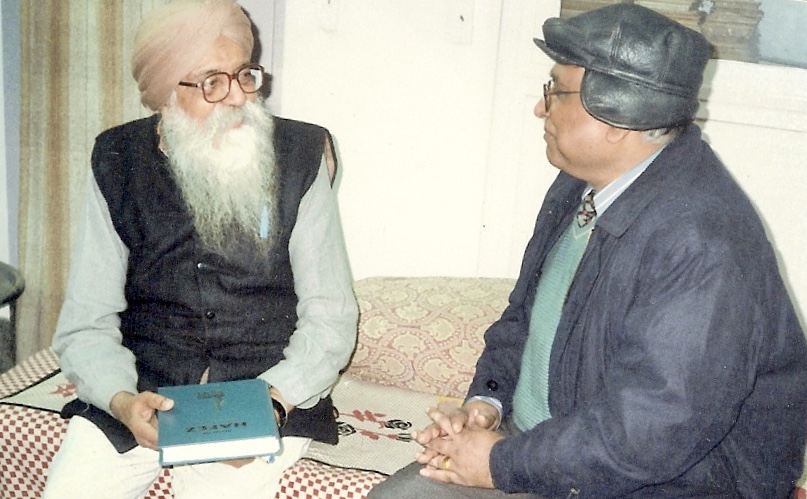
Meeting on Jan. 11, 1999 - 81st Birthday of Prof. Pritam Singh

My last meeting with Professor Pritam Singh took place in the late evening of 1st October, 2008. He appeared some what frail and time - worn but his profundity of expression, smile and laughter were indeed as intact as ever. I had presented to him 'Diwan-e-Hafiz' brought from Iran - the 'Blue book' in the picture and my write-up in Punjabi on the popular 'Chhapar Fair of Punjab' and my recent columns on Urdu poets and scholar A.J. Zaidi and Ahmad Faraz. We touched upon the current educational and cultural scene in Punjab and in the country. When I took leave of him, he persisted in walking with me the up to the main gate. I mentioned to him - at the door step - that Panth must think of establishing a museum of letters, with name, 'Zafar Namah Sahib Bhawan', inviting Punjabis all over the world to donate letters on the themes of literature and culture of Punjab - to be scientifically preserved there.

I penned my last letter to Professor Pritam Singh, on 24th of October, a day before his joining the company of the immortals, sending it care of his daughter Doctor Harshinder Kaur so that she might read it out to him. The Destiny of this letter was fated  to be different - reaching him on the address far, far beyond his earthly abode! I salute this angel of a Teacher on his birth centenary - he indeed radiated knowledge and nobility with every word spoken by him!

*     *     *


Saturday, October 11, 2014

My Father - An Essay in an Autobiography

Pita Ji Writing... Another Har Dyal - Born to be
an Extraordinary Scholar-Physician. About 1954.
He was born, according to an authentic written record in the family, on Monday, August 30, 1920. He was the first born - the Jayeshatha Saputtar - of his parents. The various conversations among the elders of the family which included my two most loving great grandfathers and an adorably talkative great grand-aunt, called Bhua Ji by the entire village, often innocently overheard by me as a child of four-five years, had confirmed this to me. They mentioned that his father Dwarka Nand and his grandfather Giata Nand were also the first born of their parents. And So Am I - his son, now 71+ years according to the date of birth in the Matriculation Certificate, and so are our eldest son, Aditya and our six year old grandson, Antariksh!

Pray, don’t misread this opening statement in any overtone of machismo or a parade of any gender bias - it is but a humble mention of the facts of my family tree. My father was named Har Dayal Nand by his Guru-grandfather Vaidya Bhushan, Kaviraj Pramatma Nand Ji (d. October 19, 1947), the most renowned scholar and Ayurvedic physician of his era. The name might have been inspired by the popular perception prevailing in those years of Har Dayal (Later famous with the prefix ‘Lala’, though he was a ‘Mathur’), the legendary scholarly genius with a miraculous memory. According to the lore in the family, Baba Pramatma Nand Ji had also selected my name, even before my birth! That story could wait till the time when I write about myself! This piece of narration is dedicated solely to the sublime, sweet and sour memories of my father, “Shri Haridial Nand alias Haridial Singh Vaid, Ayurved Rattan, Ayurved Manishi, Gold Medallist, Proprietor, Shri Gajnesh Ayurvedic Aushdhalaya, Ahmedgarh.” A uniquely engaging conversationalist with all the old world wonderful charm of a philosopher-physician, he was destined to fade away, like many extraordinarily gifted persons, including his name sake Har Dayal, in despair and deprivation on April 19, 1978 - at the age of 57 years, 7 months and 19 days! I had sent him my first - and fatefully the last - birth day greetings card from Tehran promising to ‘fulfil all your dreams and expectations of Me!’ I am reminded of the soulful moment in 1955 in my school when he had, pointing at the youthful Deputy Commissioner S.D. Bhambri (I.A.S. 1950) of Sangrur, that, “in independent India now such young persons who are bright in studies and succeed in competitive examinations will the real rulers of the country!” A dream had been planted in my mind and soul!   

L to R: Channa (Major Charanjit Singh Jagdev), Pita Ji, Jangi (Brigadier Jagjit Singh Jagdev) Children are sons of Pita ji's friend Air Force Official Randhir Singh who had taken this photo. About 1954.
It will be noted that my Father, if alive, would have been 94 this month. I feel uniquely luckier to meet Ambassador V.M.M. Nair, going fine at 95+ years and the I.C.S. batch of 1942, during the walk-and-talk in our residential complex. Ashwani Kumar I.P., the film-hero-type-super-Cop and for many years Mr Hockey of India, is exactly of the age of my father. Kumar is known to be fully alert and moves around actively, though confined to a wheel chair. I feel quite convinced that my father had all the ability to qualify for the I.C.S. if the family had the right exposure and guidance to educate him in the British system of education. He was, however, tutored totally at home in all the traditional learning of Sanskrit classics, Ayurveda, Kavya Shastra - Prosody, Sangit Shastra - Musicology interpretative religious studies, including the modern ideologies of Gurmat, Arya Samaj and new wave ideas of Swami Shivananda and Sri Aurobindo. He was trained to be a good horse rider - I remember once riding behind him on a journey to my mother’s village - and also a champion chess player!

Father was most rigorously trained, in the Gurukul-style dawn to dusk routine, for more than two decades to be a perfect calligrapher in both Gurmukhi and Devanagri scripts. Professor Bachittar Singh I.R.S., his 12 years junior beloved nephew who had become the first Post-Graduate in English in the area in 1950, confirmed to me, “Chacha Ji was known to be very bright but was equally naughty too… Baba Ji (Pramatma Nand) used to tie a rope to his one leg so that he did not stray away during the day long lessons!” No Wonder, that no scholar could discern any shade of difference in the ‘pearls-like’ handwritings of Guru Pramatma Nand and disciple Har Dayal Nand in the various voluminous works ‘penned’ jointly by them! Well versed in music, he had become the most sought after Pathi - reciter - of Granth Sahib - in the far and wide area. The circle of his influential Sikh admirers persuaded him to become an Amritdhari - baptised Sikh - on July 26, 1947. I vaguely remember how he had suddenly stopped sharing ‘hookah’ with grand-father Giata Nand Ji and had also adopted an attire of the Sikh tradition. 

As per the custom and practice of the time, Father’s marriage had been arranged at an age of about twenty years. There is, however, no written reference in the family of the date and year of marriage. The conversations in the family have revealed that my mother, though not formally educated, was a very talented and hardworking lady. She had a great passion for all type of knitting including making the large size carpets and durries, many of which had remained in use for decades since her passing away. Though I have never been clearly told about it, She is understood to have died sometime in early 1946 due to complications after a delivery. It has been further understood that my father was deeply depressed over her demise and had tried to seek solace for some time wandering in the guise of a sadhu. My grandmother, a deeply pious lady with prayers on her lips all the time, was the most worried soul in the family about the remarriage of her son who had become a widower at the age of less than 26 years. And strangely at the same time, she would often narrate to me the stories of ‘Dhroon-Dhruv’ Bhakat, Pooran Bhakat and other noble children who had been maltreated by their step-mothers! Finally, after many efforts and a go-between role by a highly respected relation, Babu Ji Patram Singh, the second marriage of my father was solemnised on March 9, 1953 in the village of Pawala, near Rajpura in a large family of ex-service men. 

It must be mentioned that Father had been pushed to take up many responsibilities at a much younger age in the multi-generation joint family because of a long drawn civil litigation over the properties. The deaths of the saintly elders - Pramatma Nand ji on Oct 19, 1947 and Giata Nand Ji on August 20, 1951 - altogether altered the circumstances of the larger clan - khandaan. The family had started shifting to Ahmedgarh, initially for the education of my uncle - and I also joined the school there in May 1951 in the 3rd grade. Father, making a break from the family tradition, set up there “Shri Gajnesh Ayurvedic & Unani Aushdhalaya”, to begin with, in partnership with Shri Lal Chand Jai, a friend and registered Hakim of the Unani System. Soon Father started his independent practice and was able to rent a shop and a residence located in close proximity - at a rent of Rs. Ten for each of the two! Ch. Vivekanand Koshal, a well to do and progressive minded land lord, was very kind and respectful towards my Father for his learning and wisdom.

Pitaji as Pradhan Mantri i.e., General Secretary of the PEPSU Vaid Mandal. Holding the welcome address at the state level conference, March 9, 1952. Behind - Police Inspector Dharam Chand, City In charge Ahmedgarh.
Having not studied in any formal school system, Father was extra keen to obtain the recognised qualifications as an Ayurvedic practitioner. He, therefore appeared privately for the examination conducted Ayurved Vidyapeeth, Allahabad. To his great surprise, he was declared ‘Pratham, Sarv Pratham - First Class, First’’ in the ‘Ayurved Bhishak Examination’ held in 1952. He was awarded a Gold Medal by the Govt. of the PEPSU, then headed by S. Gian Singh Rarewala, declaring, “A Sikh Tops the Examination of Sanskrit.” He had actively involved himself in organising the Vaid Mandal movement in the state and worked tirelessly for the registration of Vaidyas under the new legislation.  On the basis of his newly obtained qualifications, he was able him to get a job in 1955 as Vaidya in Govt. Ayurvedic Dispensaries and served on a small salary of those days for more than a decade. Then he resigned to resume his practice in the wake of deterioration in his father’s health. He started contributing articles, with references from the handwritten books of the family like the one interestingly named ‘Mohtam Sahib’ and the rare works in the Gurmukhi script, to the prestigious journals of Ayurveda including ‘Dhanvantri’, ‘Sachittar Ayurved’, ‘Ayurved Mahasammelam Patrika’, etc. He participated regularly in the national Conferences on Ayurveda; I witnessed one such ‘Sammelan’ at Vithal Bhai Patel Bhawan in New Delhi in December 1974.  

Father, apart from his multifarious scholarship, had remarkable abilities for organisational matters and dealing with the governmental machinery. He enjoyed genuine friendships with activists of all political parties. He was at his best in the company of ‘Sants and Mahants - saints and abbots’ of great spiritual learning who were also quite wealthy and socially influential. It was a great privilege for me to enjoy listening discretely to their learned discourses. Father was quite clear and keen that I must excel in modern education. He seemed, of course, intuitively aware that I had my own path to traverse and avail the new opportunities in independent India. There was, to admit honestly, an unavoidable and unbridgeable generational gap between us; the back-breaking burdens of the family accumulated from his second marriage vitiated and soured the emotional bond between us. His health, with early signs of high blood pressure, had started deteriorating sharply with heart and diabetic conditions. He must have been fully aware of all his ailments and had started looking much older at the age fifty.

Author's Father and Father-in-law
at his wedding, Aug 12, 1973
I think that the occasion of my marriage in August 1973 was the most fulfilling moment for him. The Akhand-path to celebrate the birth of his grandson on the Lohri of 1975 with Tikka Kuldeep Singh Bedi, a descendant of the Sikh Gurus, reciting the Granth Sahib was his greatest - and sadly the last - moment of celebration. He and my father-in-law Shri Nand Lal Ramdasia, had become very close friends and the latter’s sudden death in a suspicious medical accident-reaction to penicillin injection - on December 4, 1977 left my father completely shattered person. His own demise within a period of less than five months was a big double shock for me but it was no surprise. While taking leave of him at the railway station of Ahmedgarh on 17th January, 1978, I had an eerie and foreboding feeling that it was, perhaps, my last glimpse of him. I could piercingly fathom from his face and foresee in his eyes that light of his life might be fading fast.   


Shrine of Author's Ancestor - Baba Gajjan Shah Ji
On the 19th of April this year - the 36th death anniversary of Father - I chose to make a pilgrimage to the more than 170 year old shrine of the family patriarch Baba Gajjan Shah Ji in in our native village of Falaund Kalan. After prayers, I spent some time with Manohar, a childhood play-mate who had lost his eyesight at the age of five years in an attack small pox. I requested Manohar to recite again my favourite Kabbit - fast rhymed poem with profuse alliteration - of Sant Gulab Das - and I have noted it this time. Then I chanced to come across there an older person; walked across to him and introduced myself in the name of my ‘Vaid’ Father. He immediately extended his arms and embraced me tightly saying, “I am Shah Nawaz Khan and I am now more than eighty years old. Your father Vaid Har Dayal Ji had saved my life sixty years ago when I was almost dying of persistent dysentery… he was the best Vaid of his time in the area!” I surprised him by telling him that I do remember having seen his father, Rattu Khan, a tall fellow who used to graze the goats of the village! And standing a few steps away from the sacred soil of the cremation of six generations of forefathers, I could not control the incessant and profuse flow of the tears of pride in my eyes, in the most pious memory my Father! 

References to this article

  • This article was included in the collection "India of the Past, Preserving memories of India and Indians"


Wednesday, December 26, 2012

Tales of Time and the New Year


          The Persistence of Memory - Salvador Dali, 1931
In a letter of deeply personal reflections addressed to all my intimate friends to mark the New Year, penned on December 21, 1995 from Panama - the country of the miracle of a canal joining the two mighty oceans - I had said, “It is difficult to exactly pinpoint when the concept of the ‘calendar time’ pierced into my consciousness... I think it began with my entry into the elementary school… the Gregorian Calendar, perhaps, started making some sense when I was in my third grade… I, however, distinctly remember that it was in the fourth grade-perhaps, in October 1952 - that I had experienced the delight of solving the sum of the exact age of Mahatma Gandhi - 78 years, 3 months and 28 days!”

The phenomenon of the calendar year and the related run of the events-personal, in India and in the world - have, therefore, been long since an occasion on my part for an intense introspection-a sort of stock-taking conversation with the soul! Around the end of every calendar year, the most pervasive - and extraordinary - feeling has often been, ‘how quickly-and so stealthily - the Time seems to pass…’ The latest example of this perception pertains to my persistent efforts for more than one and a half year to convince all those who should be interested and his innumerable admirers that the birth centenary of former Maharaja Yadvindra Singh of Patiala - born on January 7, 2013 - deserves to be celebrated for his immense services to Punjab and the nation. The tragically-bitter reality could be well understood: If the Congress Party led by Captain Amarinder Singh had come to power in the Punjab, there would have been hundreds of historians and bards around to tell tales of the tall Maharaja!

In this context, the words of an upright Governor, NV Gadgil - he had ceased to be the Governor of his own accord when he said so - at the convocation of the Punjab University in March 1963 - still ring fresh in my ears, “They (politicians) have made wisdom a by-product of power…” Time, of course, would always be on Atlanta’s heels - my own slipping this year into the venerable group of seniors in the range of the three score plus ten came as a mixed pleasant surprise to me too!

As the count down to the year 2013 C.E. started in earnest, the ‘calendar-cognoscenti’ and ‘Time-Watchers’ had got themselves hooked to the ‘end of the bak’tun, the 5,125-year old ancient calendar of the Maya’. The media and the internet dooms-day-dreamers scattered some fear - and much more fun - that the end of the world is nigh - before the North Pole reached its position furthest from the sun on Friday, 21st December! I was strikingly reminded of 4th of February, 1962 when we - as undergraduate students in the DAV, College, Jalandhar - were witness to an amusing hysteria among many faithful Hindus in Bharat prophesying that a rare constellation of planets was all set to decimate this world, in the Mahaa Pralaya predicted in the scriptures of Jyotish Vidya!

Kaalchakra - Wheel of Time - has indeed been a serious subject for the Indian thinkers ‘who evolved, not a linear, but a cyclic theory of time made up of yugas, manvantras, and Kalpas. They were convinced that the universe is without beginning and without end - going on recurrent phases of manifestation and dissolution. According to Vishnu Purana, each yuga-Krita, Treta, Dvaapra and Kali represents a progressive decline in virtue morality, happiness and longevity…The four Yugas constitute the Mahaayuga of 4,320,000 earthly years. Further, one thousand Mahaayugas or 4,320,000,000 earthly years make a Kalpa, a day of Brahma! At the close of this day of Brahma, a collapse of the universe takes place…’At the end of (Brahama’s) night, he awakes and creates anew’!

The most fascinatingly instructive interpreter of time during the times of my generation-ranked already in the line of Newton, Einstein and Carl Sagan in the modern epoch- has been the uniquely gifted genius Stephen Hawking, born on January, 1942. The mathematician-Physicist Prof. Hawking’s, ‘A Brief (made Briefer in 2005) History of Time’ has rightfully been acclaimed as one of the most popular books of our time- particularly for ‘non-scientists’ seriously interested in scientific thinking about cosmology . Speaking-using the specially designed speech generating devices- about life of intelligent creatures on other planets, he says,” To my mathematical mind, the numbers alone make thinking about aliens rational. The real challenge is to work out what aliens might actually be like… I think human race has no future if it does not go into space”

Apart from the ‘fear and fun’ dimension of the Maya calendar which is now behind us, like the 2K terror, another aspect of similar nature about the newly born year pertains to the ‘unlucky’ number 13. The eagerly awaited prestigious annual number of The Economist, ’The World in 2013’ warns against ‘globalization of superstition’. In one if the lead articles, John Grimond explains that while,” Twenty-thirteen: for most people, another year…nothing special... the United Nations says it will be the International Year of Water Co-operation and also the International Year of Quinoa (a plant with edible seeds)” To cater to the hunger of the numerologists, Grimond dishes out that 2013 will be the first year since 1987 to have all digits different from one another.

John Grimond further points out that 20 and 13 add up to 33which numerologists– crackpots too-consider a “highly charged master number”, full of meaning. He, however, concedes that for triskaidekaphobiacs- meaning, those afraid of 13-‘the prospect of 2013 is not so much interesting as terrifying.’ Referring to the roots of the fear of 13 in the Christian and Persian historic traditions, the article also points out that ancient Egyptians, Greeks and modern Jews had myths that 13 brings good luck. It is quite clear that both the traditions share complete absence of reason behind their convictions.

While musing over the mysteries of the history of measuring the ‘immeasurable’ Time, I am transported to my years in Iran. In 1976, the Iranians awoke one morning to be in the new ‘Gahshumar-ye-Irani’ i.e. the Iranian Calendar System suddenly proclaimed Shahanshahi- Imperial’ replacing suddenly the centuries old Islamic 1355 to 2535, marking the birth of ancient emperor Cyrus as the first day instead of the migration of prophet Mohammad from Mecca to Medina. And within less 1000 days of the change of Calendar, the Shahanshahi Iran had been swept into dustbin of history by the Islamic Revolution of unprecedented global implications. I vividly remember my stroll two decades later in the balcony of a much meager bungalow in the Contadora Island in Panama-His imperial Majesty Aryamehr Mohammad Reza Pahlavi was destined to spend there a few of his last months of life –perhaps, conversing with the waves of the Pacific Ocean! The dethroned and hotly hounded by determined enemies, the once Mighty Monarch might have been wondering over the tyranny of Time-and also over tens of thousands of tyrannical deeds of the SAVAK, his dreaded secret police.

It is much gratifying to know that India has been spared any serious controversies of the Calendar kind. The calendar Reform Committee presided over by the noted astro-physicist Meghnad saha attempted to reconcile traditional practices of various ‘desi’ calendars with modern astronomical concepts. A solar month was defined as the interval required for the Sun’s apparent longitude to increase by 30 degree, corresponding to the passage of the Sun through a Zodiacal sign (rashi).The officially introduced at Chaitra 1, 1879 Saka Era on March 22, 1957 calendar has remained confined, in practice, to be legally indicated in the official documents of the Government of India. In the preface to the report of the Calendar Reforms Committee, PM Jawaharlal Nehru had said, “ Now that we have attained independence , it is only desirable that there should be a certain uniformity in the calendar for our civic, social and other purposes and this should be done in a scientific approach to this subject.” The periodic reports in media point out that Sikhism, India’s most dynamic faith, is still to put a final seal on its calendar related issues involving dates of various festivities.

Reckoning and reconciling my own calendar issues, I may interestingly state that my date of birth is only an approximate entry by a very wise school teacher. I do remember the first ever news I had listened to on Akash Vaani. It was over a ham radio set in my village contrived by a wireless technician on vacation from army that I could listen amid disturbing noise, "Ceylon ke Pradhan Mantri Senanayke ki ghorhe se gir kar mrityu ho gayee hai…” The google search has now confirmed PM Stephen Senanayke had “suffered a stroke and fell down whilst riding the police mare ’Chitra’…on the morning of 22 March 1952…” I also vividly recall the excitement and a deep sense of accomplishment when as a student of eighth grade, in October 1956, I was selected to speak on 'All India Radio' school broadcast programme. On the children Day function in School on 14th November, I was awarded Rs. 7 and Annas eight paid by the AIR for my two and half minutes speech - Rs. 3 per minute appeared indeed a kingly-mind-boggling-sum! Time, I must be telling myself, is indeed money!!

While meditating over Time - past, present and future - many, many poetic expressions criss-cross my mind: Time as the invisible but ultimate arbiter of human destiny and Time as a unit of every breath and each beat of the pulse! Time - the eternal traveler; time, the ever present; ever the same; and also never the same!! Cheer, a very happy New Year!!!

*     *     *

Wednesday, October 10, 2012

Musings on his Eightieth Birth Day

This article was published in the monthly magazine Identity, October 2012

Doctor Manmohan Singh - who is personally fond of professing that 'once a teacher, he remains a teacher' - has already established established several tantalising 'records' when he turned eighty on September 26, Wednesday, as the Prime Minister of India. The gentle giant - 'Singh is King' - is credited with the rarest distinction of creating new records for every academic exam he had appeared and had studied abroad by earning prestigious scholarships. He is now ranked after Jawaharlal Nehru for having been sworn in as Pradhan Mantri immediately after completing a full five year term. He has also dubious distinction of having never won any popular direct election to 'reach' the most coveted constitutional post in the largest and most vibrant - honestly, 'tumultuous' and 'skewed' - democracy of the world during the most, according to the political Pundits, fractious - 'coalition', state of affairs in the life of the nation since Independence.

'Doctor' might have become the 'most ill-treated prefix' these days in the political and bureaucratic circles but in Manmohan Singh's case, it is in the same 24 carat 'purest vintage' of Rajindra Prasad, B.R. Ambedkar and Zakir Husain. it is pertinently interesting to recall that his thesis for Doctorate at Cambridge was, India's Export Performance, 1951-1960, Export Prospects and Policy Implications. He might have set his sights high in academics but had surely never 'dreamt' (PM Deve Gowda, for 324 days, was reputed to be 'day-dreaming' even during the highest official confabulations); aspired (Ex Deputy PM L.K. Advani has been know to do so, 24x7 for more than a decade) or had even raised his little finger (Swaran Singh is believed to have done so only once and was sacked for-ever by 'never-forgiving and forgetting', Mrs. Big G), not to think laying any claim or fight for the office.

The 'PM-ship' was indeed most astonishingly 'bestowed' upon our good Doctor, in the wake of an unexpected victory for Congress in May 2004, by the 'self-sacrificing-saint' born in an ancient civilisation of Europe know for its traditions of political culture celebrated in the words of Cicero, Machiavelli and even our Englishman friend, William Shakespeare. Our low profile and high thinking Economist - bureaucrat turned technocrat - had been initiated, mentored and tutored in the Congress culture of politics by another 'root-and-branch-less' wonder of Indian politics and the best 'accidental' PM, P.V. Narasimhan Rao, the first non-Nehru-Gandhi to complete a full term in the august office during 1991-1996.

Professor Manmohan Singh assumed the office at the venerable age of 71 years 239 days - Morarji Desai (81 years, 23 days); Charan Singh (76 years, 217 days) and I.K. Gujral (77 years, 138 days) were older to him when they became PMs. He must be holding an all time world record for working on the regular-salaried-service of the Govt. of India and its agencies: in 2010, his monthly salary as PM was indicated to be ₹ 135,000. As for details of his assets on March 31, 2012, the value of his properties in Chandigarh, House No P-1, Sector 11, purchased in 1987 - and a residential apartment, in Vasant Kunj, New Delhi had appreciated to ₹ 4.7 Crore and ₹ 2.5 Crore respectively. A car - Maruti 800 has also been mentioned in the list of his meager other assets making a total of ₹ 10.7 Crore. Defense Minister A.K. Antony has declared his assets to be ₹ 44 lakhs only.

The simple and unassuming life of the Professor has always been professed by his party to be the greatest asset of his public life. Alas, on his eightieth birth day, he stands 'coal-tarred' and, perhaps, even perceived by a large number of people of India as 'presiding over' and 'shielding' the most corrupt Council of Ministers. Having never been inclined to play any role in the organization of the Party, he had appeared isolated in the recent past when in the firing line of the forces of the opposition. In tackling the tough policy issues which would be at variance with the populist measures, the PM and his team would seem stranded without support from elements within the ruling party not to speak the ever slippery coalition partners. Many ask why Mr. Singh never 'roars' and tries to deliver but prefers to make mousy retreat.

It is widely pointed out in the professional circles sympathetic to 'Singh' - the liberaliser and reformer - 'that he had managed to perform a reasonably good job during the first five years of his term. Then started the storms of scandals of corruption and 'incompetent governance' - 'Common wealth Games'; 'Two-G Spectrum'; the 'Choice of a tainted CVC'; the 'date of birth of the Army Chief'; the 'Lok Pal Bill' etc., etc. With the 'Coal-Gate' fracas, it became a shocking serial in the newly empowered electronic media; step by step the learned Professor has been painted in the company of crooks cutting deals to corner the precious public resources. The election reverses in important states for the Congress Party and daily in pricks by the emboldened allies with their own political calculations have caused serious structural damages to the UPA-II government. The latest rounds of  'wash out' of the monsoon session of Parliament; the final 'Didi-giri' - walk out by Mamata's TMC - in the 'rain of reforms' including the FDI in the retail sector and impending elections in a few important states including Gujarat have put interrogation marks around the direction of political path ahead for the nation. The Washington Post commentary on Singh detailing his descent from, "a scrupulously honorable, humble and intellectual technocrat to ... a dithering, ineffectual bureaucrat presiding over a deeply corrupt govt", would seem to have rubbed a raw nerve.

I had set out in the opening para to muse over and felicitate, in intimate personal terms, the 'Man' of India's Destiny, who had lost is mother at a very young age - the one whose very name means 'magician / charmer of the mind'. He is one who has all along been a role model for my type: who have 'risen' in free India proclaiming the 'bare' virtues of academic excellence and integrity in the chose profession of livelihood. Dr Manmohan Singh's name was first heard by me when, after a brilliant academic career, he had briefly taught in the Punjab Colleges / University in 1954-58. The specific mention had been made by Principal R.G. Bajpai, Manmohan's senior colleague when the latter was a young fresh lecturer. A brilliant scholar himself of Allahabad University, Bajpai was extremely fond of 'picking up' errors of English language in the books/articles by reputed authors, quoting the evidence in 'COD' - Concise Oxford Dictionary! He was full of admiration for Manmohan Singh's book - but was 'delighted' to tell me: "Look, I have found it ... this diagram here has been drawn wrongly!"

I have also heard another story. A close school class fellow friend asked Manmohan to lend him note book so that he could 'copy' the sums, fearing the Math teacher notorious for giving a 'sound-good' thrashing to those who did not complete the home work. Manmohan is quoted to have replied, "I can sit enough time with you to make you understand the difficult sums ... but cannot give the note book for copying ... cheating!" Another class fellow of Intermediate in Hindu College Amritsar told me, "Manmohan would finish the Paper and come out half an hour before the allotted time of three hours ... attempting all the seven questions... only five were required to be answered... writing at the end, 'consider any five'." There are tons of legends in Delhi how his daughters used to travel by public transport to their college/university and he would never permit the use of his official vehicle for any private work... these seem to be tales of an era, of light years ago!

I was told in New Zealand by a very serious and reliable person that there was resistance by the two families to the 'love marriage proposal' by young Manmohan to Gursharan Ji - perhaps, same Gotra issue! But both of them remained firm in their determination and the elders were graceful to reconcile themselves to the will of the young couple. They both are indeed made for each other. It is rightly said that behind every successful man and there is a woman.

I have had the privilege of looking from closer physical proximity at six of the fourteen Prime Ministers of the country and speaking to four of them including Dr Singh. On the 8th of April 2004, I just had missed being welcomed by him into the ranks of Indian National Congress, at a time when the BJP had declared its victory before the elections and no astrologer was around to console the Congress till the ultimate sovereign - the voter - gave his verdict!
A very happy birth day to you, Dr Manmohan Singh!
*   *   *
Copy of magazine article is available here


Saturday, September 25, 2010

Reflections on ‘PEPSU’ versus Punjab

The following article appeared in the online publication South Asia Post, Issue 119 Vol V, September 15, 2010

Nawab of Malerkotla, Iftikhar Ali Khan
THE title of this column might indeed bamboozle many readers except the senior citizens - more particularly, the pensioners of the government of Punjab. To decode the puzzle, PEPSU was the abbreviation of the newly carved out state - Patiala and the East Punjab States Union - in the wake of the independence of India. The ‘native’ - Princely - states which merged into the Pepsu included the four ruled by (Jatt) Sikh Rajas - Patiala, Nabha, Jind, Faridkot - while the rulers of Kapurthala were the descendants of the formidable warrior, Jassa Singh Ahluwalia (1718-1783). The Malerkotla Nawabs, Sherwani Afghans, traced their descent to Sheikh Sadruddin (1449-1508) who had received a gift of 68 villages to the south of the fast developing commercial and strategic city of Ludhiana, from Bahlol Lodhi, ruler of Delhi. Kapurthala State (with majority of population being Muslims) had two enclaves in Jalandhar district. The outlying districts of Narnaul, Dadri and Bawal lay in southern districts of East Punjab. There were islands of Patiala in the present Himachal Pradesh. The two non-salute States, Kalsia and Nalagarh, administratively affiliated with Patiala, were also incorporated into the new Union. The covenant of merger was signed on May 5, 1948 by rulers of all the eight states.

The PEPSU was formally inaugurated on July 15, 1948 by swearing in only the Rajparmukh, Maharaja Yadavendra Singh of Patiala, because the two newly emerged political groupings, Prajamandal turned Congress and the Akali Dal had failed to form a ministry. The confusion and disorder caused by terrible communal riots leading to departure / influx of Muslims/Hindus reigned supreme. The administrative culture of newly born state of Pepsu - with an area of 10,099 sq miles / 26,146 sq Km, population of 34,24,060 and annual revenue of 5 crores - was historically steeped in repressive feudal traditions. The people had been suffering from the ‘double slavery’, under idiosyncratic and pervert rulers who were themselves under the slavish subservience of the British. The caretaker government with Sardar Gyan Singh Rarewala, a high official of Patiala State and close relation of the Maharaja, as the Premier was installed under a stop-gap arrangement in August 1948. I have a vague but disturbing memory of bloody popular upsurge in Malerkotla against police repression in the wake of murder by angry mob on June 14, 1948 of Thanedar Kuldip Singh who had raped a girl when she was in his custody. This wave of lawlessness and dacoities led to the dismissal of Rarewala ministry and imposition of President’s rule.

The sharply communal overtones became pronounced rather early in the politics of Pepsu with the Akali Dal encouraged to entertain the notion that the Pepsu was the promised niche in India with the Sikh majority which must reflect their aspirations. The Congress, comprising of old Prajamandalites, did not have Sikh leaders of stature in its ranks. The Congress won 26 seats in the Assembly of 60 in the General Elections in January 1952 and Rarewala maneuvered to be CM again in April with the support of independents. The Rarewala Ministry was dismissed in March 1953 invoking for the first time provision of the failure of the Constitutional Machinery. The mid-term poll returned Congress with Majority with Col. Raghbir Singh forming ministry in March 1954. He died in Jan,’55 and was succeeded by Brish Bhan who remained in office till the reorganization of states when Pepsu was consigned to history with its merger into the new Punjab created on November 1,1956.

Having spent my early life, first in a small village at 6km from Malerkotla and then the family shifting to nearby town of Ahmedgarh, I have the most vivid memories of the regime of Pepsu - the five letters, as if, got engraved into my consciousness long before I learnt the English alphabet! The family records now confirm that my father, then 27, a scholar of classical Vedantic studies and rigorously trained to be an Ayurved practitioner - Vaidya - had embraced the order of Khalsa on July 26, 1947 with the Amritpaan ceremony costing Rs 7 and four annas.

His words, quoting Maharaja Patiala’s speech in Hindustani during public meeting in Ahmedgarh soon after, still ring in my ears - translated loosely in English, Maharaja had said, "Now India and Pakistan have become two different and independent countries … those Muslims who would opt to live in India would be provided full security of life and property … Nawab Sahib and his forefathers have enjoyed fraternal relations with us … due arrangements will be made for those who want to migrate to Pakistan … ". The Maharaja, however, warned that the Muslims staying back in India must be completely loyal to India without any secret love for Pakistan. He also criticized the Sikh leaders who raised the alarm of, ’Panth in danger’ saying, ’danger could only be to their pockets – to make fast bucks’ adding that Guru’s Panth would always march forward.

The question of my elementary school came up in 1949. I was going to be the first ever child to be sent for formal schooling in the long line of family of traditional scholars who were all taught at home. The District Board (soon to be called Goverment) Primary School in village Sohian, at a distance of about four km, but falling in the Angrezi Ilaqa was preferred over the lower middle school, Bhogiwal, about three kilometres away, located closer to Malerkotla. The widely prevailing impression was that the teaching was more systematic and effective in the schools of British territory in comparison to the Riyasati - princely state - schools. The school had two Kutcha rooms with a mud boundary wall but the classes were mostly held under the near by trees.

Pandit Lachhman Dass of nearby village Ram Pur, the senior of the two teachers, had been posted there for more than 17 years and was well known in the neighboring villages. The name of other teacher was Partap Singh, a Sikh with white beard, who also belonged to close by village, Rorian (near Malaud) - how did we children come to know that he was of Naee-barber- caste? The caste enumerators in 2011 can draw some conclusions for our Mahan Bharat! A palatial white building with tall trees around was visible from the school. We came to know that it belonged the Sardar –feudal landlord-of Sohian, called Kaka Ji who had been inducted as DSP in the Punjab Police; knew years later that his full name was Narinder Singh Phulka. On way to school amidst the fields, I remember how flocks of colorful deer and beautiful cows, called ‘Ram Gaooan’ used to roam about freely-those were the days!

It was 7th of May 1951. Leaving village in the morning, my grandfather and I waited for hours at Kup Bus stand to catch a bus for Ahmedgarh; a few buses that passed by did not stop, being too full. So we decided to walk under the hot sun to the Kup railway station at a distance of 3km.It was my first railway journey that I remember. Within a week, I joined the MGMN High School in the third class and Pepsu, Punjab, Bharat; Sansar started getting unfolded before me in my studies. My first visit to Malerkotla was as late as in Feb 1957 when I had to appear in a special middle school scholarship examination. After the last paper, I stayed back to listen to Congress President UN Dhebar. Giyani Zail Singh, dressed in black Sherwani, introduced in his eloquently impressive Punjabi the frail looking Gandhian leader, Uchhang Rao Navalshanka Dhebhar!

Ahmedgarh, though comparatively closer to Ludhiana and linked more to it for trade and other activities, has remained tied to the district of Sangrur and inter alia with the old Pepsu, I have strongly mixed emotions of love and hate with my Pepsu identity. The two years of studies, during ’59-61, in Government College, Malerkotla and the two years as a college lecturer in Bathinda in ’67-69 provided me with a wealth of contrasting experiences with my studies in DAV College, Jalandhar for graduation and Post Graduation in Government College, Ludhiana. To me, Pepsu seemed personification of feudal depravities and, rampant corruption, in its myriad hues. The peon of the Principal and the clerks in Malerkotla college; the clerical staff and even lecturers and Principals in Bathinda, I am very sorry to say, remind me of the most viciously corrupt and intriguing persons in contrast to many inspiring and most helpful functionaries I came across as student/lecturer in Jalandhar and Ludhiana.

When the Pepsu was merged into the Punjab, many like me, had hoped and prayed that values and work culture of Punjab will have a salutary influence on the Riyasati - Pepsu people. But, alas! the wheel seems to have turned the other way round: The ‘Pepsu–ization’ of Punjab seems to be full and complete; the theory of economics, ’bad money drives out good money’ rings loudly true in my beloved present Punjab. The ‘cash and carry job Super Bazaar’ going by in the name of Public Service Commission, Patiala run by some Super Sidhu should make an easy entry into the Guinness Book!

For many years, I had a mysteriously eerie feeling of journeying into ‘darkness’ when travelling towards Malerkotla and going towards ‘light’ when heading towards Ludhiana! It is now more a disturbingly depressing sense in undertaking journey in both directions - signs of slipping towards senility, sagacity or mere nostalgic non-sense … other should know better!!

Thursday, October 01, 2009

Revisiting school - Five decades later

The following article appeared in the online publication South Asia Post, Issue 95 Vol IV, September 15, 2009
 
The year 2009 has been curiously needling my mind about the days, months and years spent in my two schools. It was  full five decades ago that I passed my Matriculation Examination from Mahatma Gandhi Memorial National High School, Ahmedgarh, a grain market town situated about 20 km south of Ludhiana, Punjab. I have no hesitation in confessing that it was Master Ashni Kumar, my English & Social Studies teacher and Guru till he breathed his last in 1993, who made all the difference in life for me. I was back in my school on this 4th of September, to share the memories and impressions of my years in the same school with the present students. 
 
It is indeed so interesting to recall how an unusual happening had brought me to the attention of Ashni Kumar, a senior teacher, when I was a student of fifth class. Sohan Lal Joshi, a much younger teacher, considered bit of a maverick, had become a popular figure in our town by playing the role of Gandhi Ji in the drama staged in the school. He had awarded me 75 out of 75 in the paper of Geography in the December House Examination in 1953. This became a talk of the school because full marks were generally considered possible only in Mathematics.
 
Headmaster Hari Krishan Dutt, a staunch Gandhian and President of the Congress Party of Tehsil Malerkotla, had introduced the social service day on Saturdays for students from fifth to tenth classes along with their teachers. All used to work on a project of leveling and earth work of a 5 km stretch of a path to be linked to the main Ludhiana-Malerkotla road. It was during one of this work and fun session that my class-in-charge teacher Baldev Singh Maudgil asked Master Ashni Kumar if a student can be awarded full marks in subjects of social studies like Geography. Ashni Kumar unexpectedly asked, "But who is the student?" I was soon located and presented before this skeleton-thin bespectacled man who had a reputation in the area as a strict but most competent teacher of English & Social Studies. He asked my name and advised me to meet him later, when I would be in the sixth class, studying in the other building of the school used for higher classes.
 
As to the secret of my full score in the paper of Geography, I might explain that I had happened to read some parts of the text book of Geography belonging my uncle, a student of tenth class. The topics about the Himalayas, the ocean, sea ports, the land surface of India, forests, etc were the same as of my class. I had written my answers in greater detail than what teacher had dictated to us in the class notebooks! Ashni Kumar invited me to join the Literary Circle in the school, started by him. He guided and encouraged me to participate in the programmes of the school on Republic Day, Gandhi Jayanti, Children's Day, etc. In my eighth class, I was selected to participate in a debate in the school broadcast programme of the All India Radio, Jullundur. It was a uniquely joyful and significant experience for me. To my great surprise, I was paid Rupees 7 and 50 Paise by All India Radio for my two and a half minute participation! The amount was presented to me at school function on 14th November, 1957.
 
Ashni Kumar became my teacher of English & Social Studies for ninth & tenth classes. I was awarded Two Rupees by him for obtaining the highest marks in English in the very first test, the September Test, of ninth class. When he later asked me what did I do with the money, I told him that I had bought a book of general knowledge. He asked me to show it to him. It was a large and well bound - Gyan Sarovar (pool of knowledge) - brought out by Publication Division, Government of India. He glanced through the book, kept it, and at once gave me a note of Two Rupees saying, "You may buy another one", which I did. Later for many, many years, this book remained my favorite gift item for friends, with price continuing to soar as high as Rupees Fifty!
 
I remember how he had given special coaching to us - a group three select students - during one month of the long summer vacations. He taught us how to read 'The Tribune' newspaper; the word 'coup d'état' was added to our vocabulary on 15th July 1958 in the context of the bloody overthrow of monarchy in Iraq! He guided me, as a class monitor, to write a letter to the publisher, requesting supply of Test Papers by VPP - explaining what Value Payable Parcel implied! When in the tenth class I was selected to play for the District Cricket Team and was required to attend the ten day coaching camp, he arranged that I could appear in the December Test later at his home provided I did not 'see' the question papers - and I complied with his instruction!
 
My Matriculation Examination over in March 1959, he would call me to his home to recheck the totals, etc of the university papers of Geography that he was evaluating. He made me read a few of the best attempted papers asking if I had also written similar answers. Incidentally, I obtained 50 out of 60 in Geography, 83.3 % - quite okay by the standard of those days. Since I was never a top scorer in Math, my score of 660 marks (79.8%) was considered commendable. It required a lot of courage of conviction on my part to opt for pursuing the stream of Humanities in college. I think that Ashni Kumar, and also my father, approved knowing my over all interests - distant dream being woven around academics, and of course the Administrative Services.
 
It is interesting to recall that Arun Kumar of D.A.V. High School, Gurdaspur had topped the list of successful candidates with 751 marks out of a total of 850. Usha Anand of Alexandra High School, Amritsar had stood first among the girl candidates obtaining 724 marks. As per the result declared on Tuesday June 16 1959, the total number of candidates who appeared in the examination was 123,287, out of which 68,406 had passed. One would wonder where the two toppers are today. Kanwal Sibal and Ashok Bhan of the Punjab University Matriculation class of 1959 have respectively occupied the prestigious positions of the Foreign Secretary of India and Justice of the Supreme Court of India.
 
I should mention that I had started my schooling in September 1949 joining the District Board (soon named Goverment) Primary School in village Sohian situated in what was then still called Angrezi Ilaqa, a couple of kilometres from my native village falling in Riyasati Ilaqa of erstwhile state of Malerkotla. It was a two room kutcha-mud-structure with two teachers for the four classes, with about 60 students. At the time of my admission, the head teacher Pandit Lachhman Dass had asked my father, "Vaid Ji, do you want the boy to pursue higher education or you would prefer him to take up service sooner?" I recall distinctly that my father had politely replied, "We wish that he should go for as much higher studies as he can." The practical wisdom - or trick - perhaps, was that if someone was keen on seeking a job soon after Matriculation, his date of birth could be put in a year that would make him closer to eighteen years, the minimum age for entry into Government service!  In my case, I think that I have to be beholden to the wise head teacher of the village for bestowing an extra year of service at one of the highest levels of the Government of India!
 
I had joined M.G.M.N. High School, Ahmedgarh in May 1951 in the 3rd grade. The town seemed to me to be surcharged with an atmosphere of patriotic fervor in the wake of recently won freedom of India. The school was indeed the playground for local politicians and also the centre of cultural activities of the town. The Kavi Darbars by the local Sahit Sabha, Ram Lila, and regular discourses/Kirtans by visiting saints & Munis, etc was mostly held in the school ground. A number of new teachers were migrants from Pakistan and students found their accent of Punjabi quite alien and even funny; they would often imitate their styles. A young socialist leader, Tek Chand Diwana, had used the Gandhian weapon of fast unto death in October 1955 over his demand that the committee for managing the school should be democratically elected. The Deputy Commissioner of Sangrur, Satya Dev Bhambri - slim and in simple dress - resolved the problem by conceding the demand and offered a glass of juice to the fasting Gandhian! My father, pointing towards him, had told me that he had qualified the examination of Independent India's new top service called IAS and that his father was a small-time shopkeeper!!

When I look back in 'Wordsworthian' tranquility and reflect over memories of my magical school times, millions of, 'diyas' - tiny earthen lamps - get lit up… The morning of my IAS, etc result … my name among the successful candidates … I come home and touch the feet of my father who says, "Bal, please do go to Master Ashni Kumar Ji, before you get busy." I reply, "I have already visited Master Ji before coming home to you."… "Well done, my boy … when a tree grows taller and bigger, many would come to rest under its shade and many would appreciate its fruit … but the tree must remember the gardener who nursed and looked after it when it was a tiny plant!"
                  

Monday, August 28, 2006

A Coup D’etat in School by a Teacher Extraordinaire

The following article appeared in the online publication South Asia Post, July 31, 2006

Master Ashni Kumar, photographed 1957-58
    Master Ashni Kumar
   photographed 1957-58
IT was exactly the eve of the beginning of the summer vacation in my school way back on July 15th 1958.  I had been studying for three months in the ‘do-or-die’, 10th Grade - the final class of the MGMN (Mahatma Gandhi Memorial National) High School in a tiny town of the Southern Punjab. The School was to remain closed for two months - a period long enough to confuse the minds of young students for the vague psychological time-span. All the enormous instructions about the tons of home - tasks during the 'big' vacation had been loudly and clearly indicated - verbally and also on the black boards by the teachers of various subjects. The newly appointed and youthful Sardar Karnail Singh, B.Sc. B.T, teacher of mathematics and science underlined that those who studied regularly during the vacation would have nothing to fear about the final examination. The stern looking, the senior tough  task master of English and social studies, Ashni Kumar had prescribed the certain number of essays and letters to be written and ‘memorized’ and  ‘solving’ the entire set of the ten-year old papers of the University! The students had spread the ‘story’ that this stick-thin teacher had a weight of only 39 kg at the age of 39!  The old students used to proclaim that for the weight of his vast knowledge, he could be compared to the weight of the whole universe! But in terms of his physical frame, he might just be equal to the weight of the uniform of a Russian soldier!!

Then, as per the practice adopted for a few previous years, Ashni Kumar summoned us - the three top adjudged students of the B-section - and told us that we would be taught by him for a special one hour session for the first one month of the vacation - of course, free of any fee, as it used to be in those good old days!

So, came the 15th July and we three students reached the school in time at the indicated 0930 hours. Master Ashni Kumar - already there, coming out of the office room- directed us to fetch four chairs and a smaller table under a Neem tree in the courtyard of the school.  He joined us soon. Looking at our school bags full of books, he gave us an angry and  dirty look, saying, “You fools, did I ask you to bring all these text books during this period of holidays…  now study these books only at home!”

We started wondering what could be in store for us. The teacher soon spread out the newspaper, ‘The Tribune’, on the table. We had certainly not come prepared for all this!  I had, of course, started ‘glancing through’ The Tribune in my 7th class, mainly to read about the cricket matches. The visit of the New Zealand team in 1955-56 had been of particular interest: A.G. Kirpal Singh, of the then Madras State Team, had scored a century in his maiden test appearance at Hyderabad; the opening wicket partnership of 413 runs between Vinoo Mankad and Pankaj Roy in the 5th Test still remains a world record! How strange and mysterious a co-incidence that I was watching the first India-New Zealand Test in Wellington, Dec.12-16,  2002 i.e. 46 years later,  in the company of the great Kiwi all rounder, John Reid who was the vice-captain of the team in `55-56’!!

Coming back to the day of 15th July, 1958 in the school, the teacher asked me to read aloud the big banner headline on the first page of the Tribune which boldly proclaimed, “Coup d’etat in Iraq, King Faisel killed, Prime Minister Noori also assassinated”. The first word posed a big and serious problem – wrongly printed! Mis-spelt!!? I was simply speechless. I could feel that the teacher had also a sort of inexplicable curiosity on his face - he still insisted that I should read the headline aloud. I did obey and started reading, pronouncing ‘Coup d’etat’ with full emphasis on  letter ‘p’ sounding like, ‘koop de etatte’ in Iraq.…’  There was a small smile on the lips of the teacher and he said, "it is not your fault… it is strange… you got a word to read which is not of English but of the French language…". He started explaining patiently, “in this French word,   letter ‘p’ is not pronounced and 'd' and 't' are pronounced softly – indicating the two equivalent letters in Hindi”.   We tried to lip-imitate what the teacher pronounced a couple of time more for us. Then the teacher went on to explain the meaning of the word, “sudden violent overthrow of a Government; in Hindi, it could be ‘Hinsatamak Achanak Raj Parivartan’… ‘Hakoomat Ki khoon-Bhari Tabdeeli, etc.’ Further on, we had no difficulty in reading - and half understanding - the remaining part of the news report. We read, “The Crown Prince   also killed and his dead body hung high at the main gate of the Al-Zahoor Palace… the body of Prime Minister Noor-es-Said dragged in the streets of Baghdad... The new leader of Iraq is Brig. Abdul Karim Kassem” - The last one appeared an impressive name for my early – teen mind!

The above introduction to the French word, Coup D’etat has indeed ever since been etched in the deepest recesses of my mind.  During my career as a diplomat, I had to attend the 14th July; Reception in the Embassy of Iraq on several occasions, in several capitals - the incident at school would always flash before my eyes! I was also witness to the ‘illuminations’ in the sky in the Saudi capital, Riyadh when the Patriot missiles intercepted the Scud missiles fired during the war in Kuwait.

The  ancient land  of the Mesopotamia, with capital Baghdad as the seat of the mightiest and the wisest of the Empires, not to speak of the fairest fairies i.e. the Hoors,  seems to have its modern destiny written in blood and tears! The cycle of mindless violence seems without an end since the coup of July 14, 1958. To Saddam Hussein, born on April 28, 1937, now facing trial for horrible crimes against his own people, goes the dubious distinction in Iraq’s history - no single man has caused as much destruction to Iraq as he has done through his reign of terror and violence; three bloody wars in which hundreds and thousands of Iraqis have died and continue to die; millions are homeless in their own country and other countries of the world. In terms of its oil resources and fertile lands, Iraq has all the potentials to be a prosperous and developed country - let us pray for her people!

As for my school teacher, Ashni Kumar, he remained my ‘Unique Guru’ as long as he was alive – and he lived an active intellectual life till his last in the ripe old age: he had predicted his own long life explaining that he had got disciplined himself to all the physical ailments since early childhood! We had a long and lively exchange of views through letters on all the topics under the sun - more of all this in the columns of South Asia Post around the Teachers’ Day in September.