Showing posts with label events. Show all posts

Tuesday, January 09, 2018

A Tribute to a Teachers' Teacher

Prof. Pritam Singh Ji
As a life long industrious student of the various disciplines of humanities with particular focus on world literature as my post graduation; spirituality in humanity as family heritage and International Relations as my profession, I have always deemed myself as one of the most privileged disciples of Professor Pritam Singh Ji (Jan. 11, 1918 - Nov. 25, 2008), without ever attending his formal class! He had indeed become the tall human tower - a light house in Patiala - as an  eminent teacher and an extraordinary, an encyclopedic, scholar of not only Punjabi language and literature but the entire range of the composite cultural and literary heritage of humanity.

Prof. Pritam Singh had been an inspiration for generations of students of Punjabi literature till he breathed his last. He was one of the stalwarts among teachers who had been a witness, as a bright student with the most meager means, to the best of the 'un-partitioned' - of the Five Rivers - Punjab. For me, he signified an era - that is no more - of the most enlightening literary pursuits in Punjabi. He had come to personify a rare dedication to bring alive the glory of Punjabi, cutting across all the narrow divides of the dangerous mix of religion and politics with the mother tongue of the brave Punjabis. I was indeed  singularly fortunate to be in his close contact-in the ancient Guru-Shishya tradition. He remained a 'Pole Star' of guidance for me in the matters of our deeply shared mutual interests in the global contexts of languages, literature and all the myriad faiths of the people.

I vividly recall how, as a student of B.A. in the D.A.V. College Jalandhar - some time around November, 1962 - I had the first Darshan - a face to face glimps - of Professor Pritam Singh. He was presiding over an important meeting of the Kendriya Punjabi Lekhak Sabha. The meeting had soon degenerated into an uproar of noisy shouts with even the signs of clenched fists for physical fighting- between the dominant progressive writers led by the veteran Marxist S.S. Sekhon and the silver-tongued orator Comrade Jagjit Singh Anand on the one side and the promising upcoming exponents of the new-wave-experimental Poetry including Jasbir Singh Ahluwalia and Sukhpalvir Singh Hasrat. Professor Pritam Singh, impressively attired in black achkan and chooridar, reprimanded them all in chaste Punjabi, using even typically strong phrases like 'Kanwarauli, kanjarkhana, kuttekhani', etc.  The eloquence, tactfulness and firmness displayed by the Professor from Patiala had the desired effect and it turned out to be a memorable session of lively discussions interspersed with sparkling and learned interventions of wit and humour by the Chair. I, an undergraduate student, had become an anonymous life long admirer of this Professor from Patiala for his radiant charm, scholarship and unshakeable belief in order and discipline.

It was, however,  as a student of M.A. (English) in the Government College - with no needless S.C.D. prefix then - Ludhiana, perhaps, in October 1964, that I read Balwant Gargi's pen-portrait of Professor Pritam Singh in Aarsi, then a popular Punjabi monthly, alas, has ceased publication since May, 2000. Gargi, in his inimitable style laced with subtle satire and humour, had referred to the rare qualities of Professor Pritam Singh as an 'obsessed' researcher of the old manuscripts of the Punjabi language and the evolution of the Gurmukhi script. Around the same time; Professor Pritam Singh had been transferred to the College as Head of the Punjabi Department.

Prof. Pritam had been assigned by Principal K.S. Thapar, interestingly, to deliver lectures for all the students of the College, in the main lecture hall now named after old student Sahir, on the themes of National Integration, introduced under a scheme of Government of India in the wake of war with China. Again, Professor Pritam Singh was at his best both in oration and the subject matter. One day, I gathered enough courage to speak to him requesting him to visit my home to meet my father and have a look at various hand written old books in Gurmukhi in our family.  He indeed gracefully agreed and visited our home in Ahmedgarh on Jan. 24, 1964. He had an engaging exchange of views with my father, an Ayurved practitioner and a scholar of Sanskrit and classical literature. I also arranged his meeting with my school teacher Shri Ashni Kumar, a Lahore educated reputed learned man. Professor Pritam Singh wrote to me a post-card, in English, thanking me for arranging the visit and praised my teacher as a person of, 'deep scholarship and disarming courtesy' - the last phrase was indeed an ever lasting lesson for me and made me his dedicated disciple for life.

The time rolled on, I passed my M.A. in English and was delighted to achieve my dream of becoming a lecturer, first in DAV College, Jalandhar and later on Govt. College, Bathinda. It was as a lecturer in Bathinda that my contact was re-established with Professor Pritam Singh. I had to accompany another respected scholarly personality, Professor Harmandar Singh, an eminent teacher of Political Science, who had also been transferred to Bathinda, for his meeting with Professor Pritam Singh, then Principal of Government College, Faridkot. It was in November, 1968 and the time of elections to the Punjab University Senate / Syndicate. Professor Harmander Singh was upset that Principal Pritam Singh had switched to the constituency of Registered Graduates instead of the Principals, making a clash between the two great old friends inevitable. It was a mix of tension and learning for me to be a listener to the arguments between the two of my most respected Professors. After lengthy discussions, Professor Pritam Singh appeared to have convinced Professor Harmander Singh that there was sufficient space for victory for both of them in the larger constituency of the Registered Graduates. While walking with us to the Railway Station to see us off, in the 'rush of the continued arguments', he also decided to accompany us to Bathinda. We had to speak to the Guard that, in a hurry, we could not buy the tickets. Reaching Bathinda, I went to the guard to pay him the amount of tickets. Professor Pritam Singh, with a twinkle of an eye and a trade mark smile, said to the guard, "Badshaho, Eh Jhoote Tan Hoon Tohadi Bakshish 'ch hi aouon dio – let this swing-ride be under your kingly generosity!" The guard also laughed heartily and we came out thanking him. Around the time of the dinner, I requested Professor Pritam Singh that we should go to the nearby restaurant. He replied that he had his dinner in train when he was eating the 'Chholia', i.e., the green-peas of grams, taken directly from the plants!

There was again a long interruption in our correspondence after I joined the Indian Foreign Service in 1971 and moved to Delhi and many postings abroad. It was during my posting as the Deputy High Commissioner in the neighbouring Pakistan (September, 1992 - November, 1994) that we could resume our intense interaction, particularly in the context of the preparation Punjabi Lekhak Kosh – Directory of Punjabi Writers. I could contact several Punjabi writers and activists in Lahore and Islamabad to collate information for inclusion in the Directory. Prof. Pritam Singh was gracious to mention my name in the list of the persons who helped him in compiling the book which was published in 2003. Prof. Pritam Singh always replied at length to my letters regarding my observations on the shared heritage of the Punjabis and how the bond of language could be strengthened in the face of evolving complex and challenging circumstances. He had a large circle of friends and admirers in Pakistan and his deep knowledge of Persian and Urdu languages proved an immense asset as a bridge between the two Punjabs and the national and international forums..

It was after reading my long letter, in Punjabi, 'Battan Beete Vareh dian - Matters of the Year that is past', circulated in December, 1995 to my close circle of friends that he specifically directed me that I should seriously plan to write about my experiences, in Punjabi, when I am free from the burden and worries of the Service. In view of his failing eye sight, the correspondence got restricted and confined to brief and urgent e-mails. After my retirement in 2004, I availed the privilege of speaking to him more often  whenever there was some matter of mutual interest. He would again remind me of the promise I had made with him to write in Punjabi. I once said, 'Sir, there is so of much high quality writings available to read, it becomes difficult to discipline oneself and find a time to write'. He smiled and retorted, 'that is the tragedy of Punjabi, Bal Anand Ji... those who should be writing, say they have no time from reading; but those who should be reading more, go on writing more and more!'
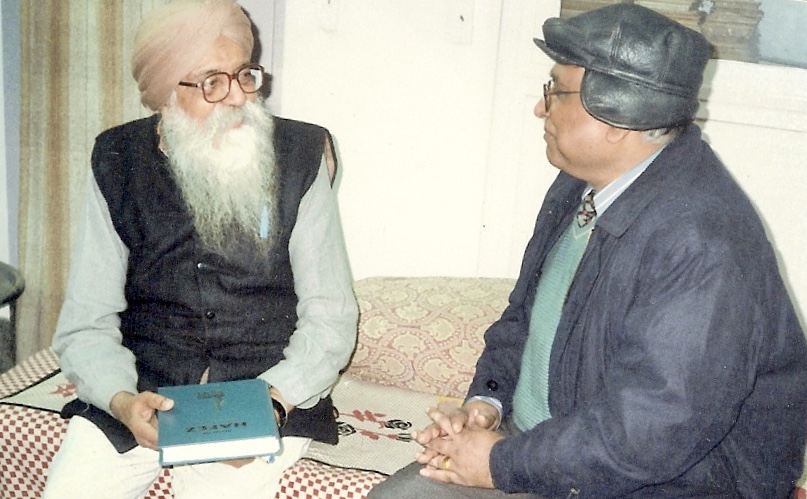
Meeting on Jan. 11, 1999 - 81st Birthday of Prof. Pritam Singh

My last meeting with Professor Pritam Singh took place in the late evening of 1st October, 2008. He appeared some what frail and time - worn but his profundity of expression, smile and laughter were indeed as intact as ever. I had presented to him 'Diwan-e-Hafiz' brought from Iran - the 'Blue book' in the picture and my write-up in Punjabi on the popular 'Chhapar Fair of Punjab' and my recent columns on Urdu poets and scholar A.J. Zaidi and Ahmad Faraz. We touched upon the current educational and cultural scene in Punjab and in the country. When I took leave of him, he persisted in walking with me the up to the main gate. I mentioned to him - at the door step - that Panth must think of establishing a museum of letters, with name, 'Zafar Namah Sahib Bhawan', inviting Punjabis all over the world to donate letters on the themes of literature and culture of Punjab - to be scientifically preserved there.

I penned my last letter to Professor Pritam Singh, on 24th of October, a day before his joining the company of the immortals, sending it care of his daughter Doctor Harshinder Kaur so that she might read it out to him. The Destiny of this letter was fated  to be different - reaching him on the address far, far beyond his earthly abode! I salute this angel of a Teacher on his birth centenary - he indeed radiated knowledge and nobility with every word spoken by him!

*     *     *


Friday, March 24, 2017

Ek Sham - Ahmedgarh ke Naam


Dear Friends,

As you know, Ahmedgarh has been my beloved place of school education - May 1951-March 1959 and my home town upto July  1971...

It was Master Ashni Kumar Ji (1916-1999) - my unique Guru-teacher - who was my anchor of life in Ahmedgarh till he breathed his last - on Saturday, Feb 16, 1999.

I had been myself so stressed and always short of time till I setlled down in retirement in 2004... after spending more than 26 years abroad - 21 of them were consecutive, from 1982-2003!

I have tried to make the best of the sun set years of life by returning - full time - to my books, rediscovering good old friends - and my love for pen and paper - rather the modern age wonder, Shriman computer-Ji!

I know how the dear friends in the tri-city beautiful have been dreaming of an evening devoted to the golden memories of childhood in our beloved Mandi... a brand new town which had sprung up from no where - in the wake Rail Revolution of India in the early twentieth century.

I am heartily grateful to the dream team of friends - Jawahar ji & Janak in particular - who conceptualized the event of the evening of Friday, 24th March to recreate the genuine spirit of love, innocence and affection dedicated to our beloved town. The inimitable Mootki - Rakesh Bhai - is indeed blessed with an abundant artistic talent and the most infectious joy in bringing to pulsating life all the beautiful memories of the sweet past...

Prof. Anu Jain was the perfect compere of the event ... the memories of his most wonderful Tayas - Amrit ji  Madan Faryadi ji - have been my most precious wealth.

I was so glad to meet many new friends and younger friends of the new generation - nasal nau - who all swear by the love of Ahmedgarh!

Brig JJ Singh Jagdev's family - we met after more than fifty years - is closely related to mine for four generations - it was his grandfather who was instrumental in persuading my family to shift to Ahmedgarh.

Sh Gobind Thukral ji has been a dear friend, philosopher and guide since we met in my retirement... 13 years ago; Dear Ashwani Gupta put in a lot of effort in managing the event in Western Court...

My sincerest thanks to all the ladies who had graced the occasion as equal & active participants... I promise to be accompanied by my 'better half' when the next such get together happens.

With my greetings & best wishes to all the dear friends,

Affectionately,
Bal Anand

PS - I am sharing three photos of the event..
Hope you would share more photos/visuals of the most joyful evening


Saturday, August 29, 2015

Megha Rajdootam - December 2002

The following magazine, Megha Rajdootam - मेघ राजदूतम् - The Cloud Envoy, Vol. 1 No. 2, was published for the High Commission of India in New Zealand in December 2002.

Cover Page of Megha Rajdootam, December 2002

Message from the High Commissioner

Opening Lines ... 'Runs' of Memories

If someone is asked, 'What is the connection between cricket and a High Commissioner?', the answer would be, 'Ambassadors are called High Commissioners in the countries where cricket is a popular sport.' A similarly intriguing question for an Indian cricket fan would be, 'Who was the English cricketer to be the High Commissioner of India to Australia and New Zealand in 1950-53?' Well, the gentleman was Prince K.S. Dilipsinhji, the nephew of legendary cricketer Ranjitsinhji of Nawanagar, who had played for England against Australia.

Looking back to my early years at school, I vividly recall how the climbing of the Everest by Sherpa Tenzing and Edmund Hillary on 29th May, 1953 had been one of the most impressionable event for me. Again, it was the visit of the New Zealand cricket team to India in 1955 which opened vistas of the great game for me. I can exactly recall the tall scores made by the legendary New Zealand opener Bert Sutcliffe and the brilliant all-rounder John Reid. The headlines in the sports columns of English and Hindi dailies flash before my eyes. I do remember how the young and old in my town used to be glued to the radio sets - the running commentary was almost inaudible due to the continuously disturbing sound similar to the thunders of the monsoon clouds! The interest in the game continued to multiply, thanks to the brilliant coverage of international cricket in the Indian press.

Cricket has been sought to be explained as a sport which is played much more intensely in the minds of the spectators and also its remarkable resemblance to human life. The five-day tests were indeed perceived to represent the whole range of agonies and ecstasies of a lifetime. There could always be a chance of a positive turn; one had to grab all the possible chances; the batsman had to treat every ball on its merit; the bowler had to be brave hearted and tactful enough to tempt the batsman to mistime a shot. Above all, it was always the team effort which brought victory. In the typical context in India, cricket proved a great social equalizer.

The one-day version of the game has imparted a new vigour, dynamism and an explosive character to cricket. The slogan, 'Hit out or get out!', by the fatigued and bored spectators of the five-day rituals has been finally accepted. Cricket has blossomed in the deserts of Dubai and more nations across the continents seem to be falling a prey to a game earlier described as, 'the British disease'.

It is indeed significant that India, with its formidable batting strength, arrives in New Zealand in time for the much needed practice before the World Cup championship in South Africa. The Indian 'tigers' have been notorious roaring more on the home turf - hope they maintain their recent form of displaying a highly competitive game. The two teams are expected to ensure the triumph of the game.

I and my family have decided to herald the New Year, 2003, watching the 3rd ODI in Christchurch. Let us hope, pray and dream that this match would be the pre-play of the World Cup final!

I may confess that it was the interest in Cricket ignited by the visit of the first ever Kiwi team to India that put a shy lad from a tiny town of India on a path that has taken him to the position of the High Commissioner of India to New Zealand.

The list of those to be thanked for their generous support for this publication is a tall score - NZ Cricket Inc. and NZ Museum for providing rare photographs; contributors of special messages; Prof. R. Guha and the prestigious Indian weeklies - India Today and Outlook - for authorising utilisation of the invaluable material/photos published earlier. M/s Thames have indeed experienced the pressure of an ODI in timely bringing out this issue of Megha Rajdootam.

Bal Anand
High Commissioner of India to New Zealand
Concurrently accredited to Samoa, Nauru and Kiribati


Table of Contents


Contents
Opening Lines... 'Runs' of Memory2
My Cricket 'Affairs' with IndiaJohn R. Reid, O.B.E.3
Cricket Encounters of the Indian KindR. Guha4-5
Maharajas of CricketR. Guha6
J.L. Nehru - A 'Complete' Cricketer7
The Spirit of CricketMartin Snedden8
The Square RectangleTimeri N. Murari9
Dev... Devil... DivinitySyed Kirmani10-11
India - New Zealand Cricket - An Overview12-13
John Wright - A 'Kiwi Dronacharya'...Don Neely, M.B.E.14-15
Tales and Travails of a Cricketer's WifeSukhi Turner16
An 'Indian-Kiwi' RemembersDipak Patel17
A Famous Kiwi VictoryAmit Paliwal18
India's Best of the Century19
India in New Zealand, 2002-0320


Sunday, March 01, 2015

A Pilgrimage in the World of Books

The most perplexing process of the biological evolution of our universe and the fascinating history of the amazing emergence of humanity as the interpreter of all its subtle complexities can now be substantially, if not wholly,  comprehended - thanks to the all the accumulated knowledge preserved in the books of the world. No wonder, the metaphor of ‘Book’ is often invoked to describe the entire gamut of our existence – yet to be completely perused and fully understood! The eminent author Jorge Luis Borges has rightly remarked that he had always imagined that Paradise would be a kind of mighty Creator’s most magnificent Library!!

The various types of book fairs in the countries of world indeed personify the noblest facet of a nation in the modern epoch. The Frankfurt Book Fair (FBF), with a claim to a more than five hundred year old tradition, has become over the recent years the largest annual global book event. It is indeed the best tribute to our largely open democratic polity since independence and the mass education as one of the top priority of the state that India has emerged as one of the largest book publishing countries, the third largest - after the USA and the UK - among the publishers in English. To quote the words of President Pranav Mukherjee at the inauguration of the New Delhi World Book Fair (NDWBF) in 2014,
“An international book fair of this magnitude is one of the best manifestations of India’s liberal, democratic, multi-lingual, multi-cultural and secular society where competing ideas and ideologies have equal space. These values constitute the essence of India... Book fairs such as this should remind us that our history and traditions have always celebrated the ‘argumentative’ Indian and not the ‘intolerant’ Indian.”

The 23rd NDWBF - 2015, held from February 14 to 22 in the popular Pragati Maidan, was inaugurated by the Minister for Human Resource Development, Ms Smriti Zubin Irani. She underlined that,
“Government changes but not a nation’s culture or civilization.”

She welcomed Singapore as the Guest of Honour country and Korea as the Focus country for this year’s fair. Suryodaya: the Emerging Voices from the North East was declared the theme and, ‘Books open the Mind’ was adopted as the slogan of the Fair 2015. It was mentioned that the Fair was spread over 35,000 square meters with more than 1000 Indian publishers and 31 foreign participants. The metro connection to Pragati Maidan has resulted in the much greater increase in the footfalls at the fair.

When I try to look as far back as the memory can travel, so many sweet and strange tales of buying of books flash before the mind’s eye. Interestingly, my dearest and most enduring friend has been a librarian by profession. We had met in Government College, Bathinda in 1968 and the he joined ministry of Defence Library on May 3, 1969 - the day President Zakir Hussain had suddenly passed away resulting in closure of all government offices. We had visited the First International Book Fair - March 18 to April 4, 1972 - in the newly laid out Pragati Maidan. After long spells of stay abroad, it was indeed deeply nostalgic for me to revisit the various NDWBF since return to Delhi in 2004. I have enjoyed attending several interactive sessions with the authors during the release of their books and picking up books of Urdu poetry in Devanagri editions and standard publications of references like Jan Nisar Akhtar edited celebrated two volume of poetry of love of motherland titled ‘Hindustan Hamara.’ It is a great solace for lovers of books that the Sahitya Academy, National Book Trust and Publication Division continue publishing quality works of literature and knowledge and making them available at a reasonable price.

The literature for the children and the new age learning materials including the audio-visual kind have acquired an increasing importance and have also presented new opportunities and challenges. The illustrated reading materials are also gaining a new market and momentum. The books in their new e-format avatar and their on-line marketing have been becoming more and more popular. The book industry has to be creative and innovative to rise to be compatible with the new horizons of technology. It is brave new world of learning and acquiring necessary skills.

Book Release - Muhim by Dr Sitesh Alok

For me personally, the NDWBF-2015 turned out to be particularly memorable for the release of two new books by two esteemed new friends. An anthology of stories in Hindi titled, Muhim, by Dr Sitesh Alok was released on 17th February by the two eminent scholar-critics, Dr Prabhakar Shrotriya and Dr Kamal Kishore Goenka. The book is dedicated to the memory of late Nirmal Verma and late Manohar Shyam Joshi. Introducing the book, Shri Sushil Siddarath mentioned how the bold themes of complex changes sweeping the society have tackled in an appropriate style by the gifted writer. Terming some of the stories with the daring new themes as Classics in their own right, Dr Goenka recalled the controversies generated in their time by the stories like, Kafan - the Shroud - and Karbala by Prem Chand. Dr Sitesh Alok, elaborated on the background of long story in the book - the title of it, i.e. Muhim - he explained the underlying socio-economic roots of the ‘attraction’ of the idea of ‘Jihad’ and the other stories dwelling on the challenging themes of declining social and moral codes and changing roles of women.

The second book release function and discussion attended by me related to, ‘Denied by God’ by Noor Zaheer, versatile author–activist. To quote, “The book mirrors the stories and indignity of the women whom even Allah seems to have denied justice and a life of dignity.” The book narrates the real life stories of women who have laid bare their bleak past and the humiliation brought through Halala, Muta’h, Triple Talaq and Khula. The book discusses medieval laws, sexist bias and maintenance of tradition and conventions in name of religion. The book questions the adherence to archaic laws and propagation of patriarchy in a country that professes a democratic society and guarantees   justice and equality to all its citizens. There was a lively - even heated at some moments - discussion with able presentations by panellists including Shahira Naim, Smita Mishra and S. Mobin Zehra and participation by the two Muslim clerics, Islamic research scholars and the young people in the audience. It became clear that the woman emancipation has to go a long way with obscurantists in each religion fighting, hopefully their last desperate battle. Noor who has earlier authored, ‘My God is a Woman’ and her comrades in arms are confident that time and tide are on their side.

As someone born a great-grand-child of an extraordinary saint-scholar and brought up in  environs where books were worshipped above everything else, I cannot imagine myself breathing away from the sight of  something to read about... I fully share what was proclaimed by 'deewana-e-ilm' - someone mad after learning -
“companions, teachers, magicians, bankers of the treasures of mind, books are humanity in print... until we invent telepathy, books are our best choice for understanding humanity and the universe around it.”


Friday, February 21, 2014

Celebrating Sunshine: Spirit of Punjabiyat

This article was published in the monthly magazine Identity, in the February 2014 issue. 

In an honest endeavour to ‘rediscover’ India and ‘regain’ my deeply umbilical roots with Punjab in the silver years of retirement since 2004, after spending 26 summers abroad, I have been assiduously making efforts to attune myself with the manifestations of literature and culture in my adopted home city of Delhi. The mythological and historic heart of Hindustan - from Indraprasatha to Lutyen’s New Delhi - could be interpreted as both an aggregation of hundreds of typically ancient villages and also a fast evolving cosmopolitan metropolis. Always keen to nourish my most cherished memories of early childhood enjoyed in smaller villages and education in a national school in a newly founded (in 1905) grain market town and later moving to Ludhiana, Jalandhar and Bathinda for education and short stint as lecturer in College, I remain in heart, soul and mind a quintessential Punjabi who has been luckier to live in Pakistani Punjab too. This strongly surcharged ‘Punjabi Identity’ - so apparent but also often elusive like a mirage - well harmonised with the happier citizenship of the world, has indeed found for me a partial but substantial fulfilment in my association with two staunchly secular and forward looking Punjabi literary and cultural forums in Delhi - Bhai Vir Singh Sahit Sadan and Punjabi Sahit Sabha.

It was my childhood poet-hero Pandit Krishan Ashant who had firstly told me in 2005 about an annual open get together of writers and enthusiasts of Punjabi literature. Christened as ‘Dupp di Mehfil - A Merriment under the Sunshine’, the function was conceived and imaginatively implemented by the grand old gentleman of Punjabi printing and publishing, ‘Bhapa Ji’ Pritam Singh. The day chosen was to be Sunday falling after Lohri - the typical Punjabi folk festival heralding the beginning of the end of the severity of cold winter and an astronomical ascendance of Sun on its journey of the northern hemisphere. Bhapa Ji, gracious as ever for any cause of promoting Punjabi, offered his Navyug farm house in Mehroli to be the venue for this unique experience. Started in 1994, the event has been acquiring more and more popularity, participation and prestige, thanks to the dedicated team of office bearers of Punjabi Sahit Sabha and soulful commitment of Dr Renuka Singh, academician daughter of Bhapa ji. 

Adoringly addressed as ‘Bhapa Ji’ - dear elder brother - by generations of budding as well as established authors of Punjabi and his large circle of admirers including cultivated readers, Pritam Singh (b.1914 d.2005), was a remarkable self-made perfect gentleman who remained synonymous for five decades with the high quality Punjabi printing and publishing house - Navyug Prakashan - located in Chandani Chowk, the heart of historic Delhi. Amarjit Chandan has rightly said, “His life is arguably the history of Punjabi printing, journalism and publishing in the twentieth century.” Aarsee - Looking Glass - the literary monthly in Punjabi started by him in April 1958 indeed faithfully reflected his cherished ideals of beauty in nobility of creative writing till he decided to call it a day after issue of June 2000 when he might have felt, at the age of 86, that he could not physically cope with keeping up the high standards he had set for himself. The humility, sweetness, discipline and determination characterised this gentle colossus who indeed played a sterling role in ushering in a new era - Navyug - in Punjabi literary renaissance and thereby dressing and healing the devastating wounds inflicted by the catastrophe of the Partition of Punjab.

Dr Jaspal Singh, VC Punjabi University releasing Sukh Sunehe,

Dhupp di Mehfil - 2014 on 19th January indeed turned out to be the most well attended and the sunniest in atmosphere - Surya Devta played to be so kind and munificent on just that one day. Interestingly, the year happens to be the birth centenary of Janak - god father - of this festival - the beloved Bhapa Ji. President of Sahit Sabha, Gulzar Singh Sandhu, conducted the function in his authoritatively disciplinarian tone to ensure that program clicks according to clock. It opened with the old honey folk songs, including one on Pooran Bhagat, by the group led by Ninder Ghungianvi. Ashok Arora, a lawyer turned motivational speaker, seemed at a loss for words in Punjabi. He distributed a video CD of a documentary film dealing with the turmoil in the minds of the youth in the wake of the ‘Nirbhay’ tragedy in the capital. Dr Bhagwan Josh, a distinguished academic in the JNU, spoke about the angelic character of Bhapa Ji as brought out in his book, recently released by the National Book Trust. It were the scenes - with direction and songs, in his deeply melodious voice, by eminent theatre professional Wariam Mast - from Balwant Gargi’s celebrated play Kanak di Balli which impressed and mesmerised the large audience. My generation has strong reason to feel nostalgic about that golden era of Punjabi literature in the fifties of last century - before petty and vicious politics in Punjab on the false pretext of language resulted in further tearing apart and blowing away Punjabiyat. 

Veteran journalist Kuldip Nayar being honoured with a special award

The function was utilised to honour six Punjabis for the valuable contribution by each of them to the cause of Punjabi language and Punjabiyat. It comprised an impressive plaque of the Sahit Sabha and cheque for 50,000. Shri Kuldip Nayar, the nonagenarian journalist and crusader-commentator on problems of Punjab who has recently penned his maiden novel in Punjabi, received a big applause. The list of others who were honoured included eminent poet scholar Dr JS Neki; Secretary of Punjabi Academy, Delhi, Dr Ravel Singh; historian Dr HS Chawla; Dr Baldev Singh Badhan of National Book Trust and UK based Punjabi author and activist Ranjit Dheer. Dr Renuka Singh, chairperson of the Sabha was honoured with mementos of Baba Farid and the long services of Piara Singh (b.1923) to Sabha were also recognised. Howsoever deserving such awards might be, the peculiarity of all the prizes and honours bestowed on writers and activists of Punjabi have also their share of side effects. A number of books published in 2014 were also released by the VC Punjabi University, Patiala Dr Jaspal Singh who gracefully presided over the function without inflicting any speech on the audience, apparently interested more in meeting new and old friends, all knit by the deeper but often neglected bond of mother tongue.

Dr Jaspal Singh releasing the book by eminent theatre artist Wariam Mast

‘Dhupp di Mehfil’ has certainly carved a place of its own in the calendar of the Punjabi literary community not only in the capital city but also globally. It is indeed astonishing how a white-Khadi clad simple person with devotion to the tongue of his mother could single handedly do so much for it. I am reminded of the prophetic and spontaneous dialogue with novelist Nanak Singh recorded by Balraj Sahni soon after the formation of ‘little Punjab’ with ‘officially’ proclaimed Punjabi language, “Balraj Bhapa, two evils are sucking our society like leeches - one is communalism and second is petty politics… 'sooba-prasati' - provincialism is a deadly new evil… we had better a stronger and larger Punjab… till there was no exclusive Punjabi speaking state, Punjabi was faring much better… Punjabi was never promoted by political leaders, it were persons like Varis Shah, Qadir Yaar, Bhai Vir Singh…” I may emphatically add, “A person like Bhapa Ji Pritam Singh”

Our world is witnessing an unprecedented epochal era - a revolution as never before - in the domain of human communication. All human expressions are being subjected to mightily challenging situation - presenting both the vast opportunities and posing serious dangers. The Punjabis have been the greatest survivors; they have risen again and again from dire adversity to great prosperity. As one them who was indeed luckier in this life to be taught and groomed by the best of ‘the un-partitioned’ minds of Punjab and having seen this wider world, I do hope that Punjabis would seek their destiny beyond the narrow confines and divides of creed, caste and community - as so nobly and beautifully enunciated by Baba Nanak, more than half a millennium ago! 


Wednesday, January 15, 2014

Art of Letter as Heart of Matter: 'Selfie in the Shelf'

This article was published in the monthly magazine Identity, in the January 2014 issue.

The most interesting origin and bafflingly complex evolution culminating in the art and craft of ‘writing a letter’ would seem to embrace the entire history of the civilisation of humanity. The story telling, songs, festivals and rituals were the earliest oral attempts by our ancestors to preserve and underline their traditions and memories. The beginning of means of disseminating information to those located at distances might have included, ‘the marking of stone, indents of clay, knotted lengths of cord, scratching of plates of metal and wood, etc.’ The development of writing is understood to have taken place sometime after 3500BC. Sumerian writing had pictograms and ideograms for the start. Scribes were soon busy in simplifying the system, using symbols to represent sounds and syllables on tablets of wet clay to be baked later. This writing was called Cuneiform, from the Latin word cuneus, meaning a wedge. 

The ancient Egyptians were able to produce a large body of what could be termed as literature. An extract from one of the oldest book of letters containing instructions to his son by the Vizier Ptah-hotep to the Pharaoh, who lived about 2450BC, would seem to ring tellingly so true about the administration of state even today: 

“Do not let your heart be puffed up because of your knowledge… If you, as leader, have to decide on the conduct of a great many people, seek most perfect manner of doing so, that your own conduct may be blameless… Be active, doing more than what is commanded. Activity produces riches but riches do not last when activity slackens… Do not rebuff petitioner before he has said what he came for. A petitioner likes attention to his words better than fulfilling of that for which he came…”

The timelessness and universality of letter writing has indeed imparted this form of writing a rare uniqueness in terms of its historical, cultural and literary dimensions. By the 18th century, letter writing had become so common in the West that ‘one of the first prose narratives to be considered a novel, Samuel Richardson’s Pamela was composed entirely of letters of a daughter to her parents, and the epistolary method lent that novel what realism it possessed.’ The accomplishment in letter writing has been indeed considered for the last two centuries to be the finest attribute of a highly cultivated mind. The best minds in India’s struggle for freedom - from Assadullah Khan Ghalib to MK Gandhi including Maulana Azad, Jawaharlal Nehru, RN Tagore, Sardar Patel, Sarojini Naidu, Bhagat Singh - all have left behind tons of 24 carat golden letters for historians and ‘aam Indian aadmi/aurat’ as their authentic legacy.

The sharp decline in the practice of letter writing in the beginning of the 21st century, in the wake of the revolution of the new technologies of communication, would seem ‘to constitute a cultural shift so vast that historians may divide time not between B.C. and A.D. but between the eras when people wrote letters and when they did not.’ The historians in general, and literary chroniclers in particular, have depended the most on the written references and the personal letters fall in the special category as evidence of how our ancestors once lived, loved, argued, thought and above all expressed their innermost feelings. The untouchables in India and slaves in the world over were often illiterate by the perverse moral prescription of the caste system and the enacted laws that threatened them with death. The epistolary tradition historically belongs to free people - that means the upper castes land owning groups in India and the white people of property in larger parts of the world. The authentically written record is indeed the most precious instrument to illuminate the past, present and future.

I have had the good fortune to be most rigorously tutored in writing letters and luckier to be recipient of the most loveable responses from respected elders, distinguished wielders of the pen and so many sincere friends. I can vividly recall how during my fourth class in 1952, my father, himself taught in the rigorously classical tradition by his scholarly grandfather, had guided me to write a letter in Punjabi to the husband of my BhuaJi - paternal aunt - who was serving in the military. I had to write letters to my father who served the Government of Punjab for about a decade between 1956-66 and a teacher uncle who always preferred to be posted at distant places. I was myself away from home for about 5 years till 1971 both as a student and as a lecturer at the college. Then the career in Indian Foreign Service till 2004 made me a compulsive writer of letters during my postings to nine different capitals of the world. Most of my letters were in Punjabi addressed to friends who also replied in elegant Punjabi. The letters to my most revered school teacher who taught me English were exchanged in English - I think that both of us felt mutually proud of each other over our proficiency in Firanghi Bhasha!

When I retired in 2004, I felt a strong desire that the select letters written and received, originally in Punjabi, and all meticulously preserved by me including copies of my own since the availability of the photo copying facility, deserved to be shared with the Punjabi knowing readers. My resolve was strengthened by the pleasantly surprising discovery that Prof Pritam Singh, the most distinguished scholar and “a teachers’ teacher” of Punjabi, had forwarded my letters to him to the Punjabi Sahit Academy, Ludhiana for preserving them for their literary merits! The task to get one’s maiden book published in Punjabi on its self-proclaimed literary merits is, however, to quote two English proverbs learnt in school, amounted to an ‘uphill task’ or even a ‘wild goose chase’. My perseverance coupled with sincere encouragement by the eminent Punjabi dramatist Prof Charan Dass Sidhu - I had come to know him only during my period of retirement - put me on the right track. Shilalekh, a publishing house patronised by Amrita Pritam and my school-time poet-hero, Krishan Ashant staked their reputation to publish this anthology of original letters, penned during 1967 to 2009. 

This anthology titled, ‘Sukh Sunehe - Epistles of being O.K.’, covering 208 pages, has 154 letters to and from 23 persons. There are 52 letters exchanged with their replies by Prof Pritam Singh, in his chaste and inimitable style characterised by clarity and stern sweetness about the tasks to be accomplished. There are 14 letters exchanged with Prof Sat Parkash Garg (1937-1996), a soulmate friend and colleague of the vintage of my lecturership in the Govt. College, Bathinda. In his letter of 23rd January ’96 he had written, “I anxiously await your letter… when are you coming - we shall definitely meet, if I would still be alive…”, and that was not destined to be; he passed away on the operation table undergoing heart surgery when I was on my way to India! The third main series of letters is with Jang Singh Gill who belongs to my village. He was my class fellow in the initial two years of school and has retired as a competent and popular science teacher in the Govt. Secondary Schools. Jang Singh has been instrumental in graciously keeping my umbilical link alive with my roots. The letters by Ajmer Singh, a twelve years senior distant cousin from my mother’s side, poetically recapture the most creative and enjoyable atmosphere of early 1950s in the Ripudaman College, Nabha. There are intimate literary letters exchanged with prominent writers of Punjabi including Balwant Gargi, KS Duggal, Gurbachan Singh Bhullar, Dr S Tarsem, KL Garg, and Dr SS Johl.

21-12-2013, Sukh Sunehe released at Sahit Sabha, Malerkotla
L to R: KL Garg, author, Balbir Madhopuri, Dr S Tarsem, Jagir Singh Jagtar,
Dr Rubina Shabnam, & Sh Mittar Sain Meet

Sukh Sunehe was released on 21st December at an impressive literary function organised by the Sahit Sabha, Malerkotla. The erudite young poet and critic Kamal Kant Modi presented a competent paper on the book highlighting “its literary character and its being an extraordinarily authentic document of the four decades of the period of these letters.” It was indeed a soulful delight for me that several of my dear and distinguished class fellows including eminent Punjabi satirist KL Garg, Prof AS Sidhu, JS Gill, industrialist Vinod Mehra - all my intermediate class fellows in 1959-61 in the Govt College, Malerkotla, were also in attendance. It was a rare personal privilege for me that many dedicated senior progressive literary activists including Jagir Singh Jagtar, SohanLal Bansal, Naz Bharati, Tarlok Singh Rai, Mittar Sain Meet had graced the function. Malerkotla has indeed significantly emerged on the horizon of Punjabi literary scene because a dedicated scholar and multi-talented writer of the stature Dr S Tarsem has made a choice making his nest in this historic city. The day - the shortest in the northern hemisphere of the planet - was his 72nd birth day and his latest book of literary profiles, ‘Sagar Tet Challan - Ocean and the Waves’, was released and also followed by an animated discussion.


Many devoted practitioners of the art of letter writing have been feeling gravely concerned that the new age of instant communication technologies might soon herald the end of traditional type of letters. There are also still incorrigible optimists, including myself, who are convinced that letters as ‘a dialogue of the soul’ can neither be replaced, nor is it going to disappear - ‘no other form of communication yet invented provides you to put your essential self on paper…’ I think that by putting this anthology of letters, written originally in Punjabi, in the public domain I have done my duty to my mother tongue… before the hand crafted letters become a thing of the past.


Sunday, October 20, 2013

Inching towards His 100th Year - ‘Whiskey-ing’, Ogling and Laughing in His Sleeves

This article appeared in the monthly magazine Identity, October 2013 issue

Sardar Khushwant Singh, once the young and struggling Sikh lawyer in the legendary Lahore – now batting at a dazzling score of 98 of an eventful life – indeed personifies an epochal transformation of himself over the many years as India’s most popular ‘money-spinner’ ‘author in English’. He has successfully worn an amazing variety of colourful turbans of being a novelist, historian, journalist, translator and, above all, ‘not a nice man to know’ who has always believed, with a childlike genius for mischief, in spreading the laughter all over the planet ‘at all costs and even high risks’. He has attained - with a devil’s diligence and an ascetic’s discipline - as an author the exalted stature of a ‘living human monument’ in the capital of Hindustan. He has been hailed as a wizardly-literary- monarch gifted with a rare impulse to feel the pulse of his vast empire of readership-cutting across all divides of age, gender, religion and international borders. The countless souls in India and abroad wonder - and pray too - whether he is destined to celebrate his so richly deserved century of life with the Nobel Prize for Literature - almost a century later than RN Tagore! 

Khushwant - even with his two sets of dates of birth of different years - happens to be several years senior to my poor but scholarly father who had passed away in 1978. I can vividly recall how I was introduced to Khushwant in the 1st year of my college in 1959 by Shri A B (Arun Barun) Shome, a young and bachelor (soon to fall in love with a well-endowed Punjabi lady) teacher with an MA degree who had joined the High School in our small town, 20 KM from Ludhiana. He, a studious Bengali and I, a fresh collegiate, became quite friendly. Shri Shome had kindly suggested to me a reading list of books - novels and short stories - in English authored by the Indians. I recall that the names of Bhabani Bhattacharya, Mulk Raj Anand, Kamla Markandaya, RK Narayan and Khushwant Singh. I was soon able to obtain Train to Pakistan (1956) issued from the College Library and read it with a deep sense of awe, wonder and intimacy. I was then a daily commuting student from Ahmedgarh to Malerkotla and impressions of anecdotes of blood shed of innocent passengers in trains - to and from Pakistan - seemed still smelling in the air of Punjab. I had read some stories of the saddest and shameful spectacle of partition by Krishan Chander (Ham Vahshi Hai - We are Barbarians) and several other writers of Punjabi and Hindi. The Train to Pakistan, however, had left a uniquely lasting impression on my teen age mind. Being a student of the non-English medium school, the book made me familiar with a vastly new range of vocabulary and tons of tragi-funny usages! I had particularly shared with friends the translation of a popular film song - “In the breeze is flying, my veil of red muslin, o sir, o Sir…” and many typically naughty-including four-letter Punjabi expressions rendered into English. I have ever since been a dedicated - though at times a grudging and a protesting one too - reader of the inimitably thought provocative writings of Khushwant Singh. Another book in English by an Indian author which I had immensely enjoyed reading soon after - in the summer of 1960 - was Khawaja Ahmed Abbas’s semi fictional autobiography titled, ‘Inquilab’.

The Sikhs Today (1959) by Khushwant Singh, an attractively produced slim book with photographs of eminent Sikhs, was a very interesting and informative reading for me - particularly for the explosive foreboding that the symbols of Sikh identity might not last more than a few decades. During the next several years of my higher studies and till my entry into the Indian Foreign Service in 1971, I was more intensely occupied with the subjects of the curriculum but always enjoyed Khushwant Singh’s journalistic writings /columns particularly in The Illustrated Weekly and later the two national dailies, The National Herald and Hindustan Times. Khushwant Singh’s proximity with Indira Gandhi’s government and particularly his support of Sanjay Gandhi and the infamous Emergency earned him the title of ‘Khushamad’ - flatterer/sycophant - Singh. He had been awarded Padma Bhushan in 1974 and was also made a member of the Rajya Sabha for the term of 1980-86. The decade’s long extremist violence in Punjab witnessed Khushwant Singh taking a bold stand against perpetrators of communal violence. He wielded his powerful pen to voice reason and secular values and had to be provided security by the government against the hot headed of his own beloved community! 

The worst turmoil of eighties involving ‘Operation Blue Star’ and the assassination of PM Indira Gandhi by her Sikh body guards followed by the barbaric killings of the Sikhs must have left Khushwant totally shattered and perplexed. The publication of Delhi: A Novel in 1990 was marketed as a major event of literary career of the author – Khushwant claimed that it took him almost twenty five years to complete this work. He dedicated it to his son, Rahul - a confirmed bachelor - and his ‘long-time girlfriend’, Niloufer Billimoria. Khushwant further stated, in his trade mark style, that, ‘History provided me a skeleton, I covered it with flesh and injected blood and a lot of seminal fluid into it.’ I was destined to read this ‘seminal’ Khushwant work while posted in the distant canal country of Panama, sometime in 1995. I indeed pondered over each word and page of it. The history, society and culture of the legendary capital of Bharatvarsha-Hindustan-India is ruthlessly dissected and laid on the table as if for a class of interns for lessons not only in human anatomy and physiology but the entire gamut of life, particularly the perversities and depravities of the flesh juxtaposed against the sublimity and serenity of the human spirit. The narrator’s - suggestively Khushwant himself, disguising as an aging and foreign returned journalist’s - relationship with a hijra-eunuch, hermaphrodite whore, who is neither male nor female but possessed a ‘uniquely exotic sex appeal’ provides him the role of a classic Sutradhar to explain all the travails of the ‘damned-damsel - Delhi’ through Time, right up to the Sikh holocaust of1984. Some serious minded readers felt angry and disgusted over the overflow of ‘extensive erotica’ in the book and dubbed the 300+ pages as ‘nothing but sleaze.’ However to quote a learned critic, “The text seems to be liberating itself from the high seriousness of history… history is parodied, transvestited and travestied. The novel could be hailed as Singh’s significant contribution to English fiction for its erudite content and insightful recreation.”

Khushwant’s long-awaited autobiography titled Truth, Love and a Little Malice (2002) had remained mired for years in legal injunction obtained by the once protégé and friend Maneka Gandhi against its publication ‘for invasion on her privacy.’ “No autobiography”, according to erudite author-columnist Dilip Bobb, “has been awaited with as much tongue-hanging anticipation.” I rushed to obtain a copy of it while posted in New Zealand, and most interestingly, had read some of its chapters in the same room of the enchantingly located elegant home of Barrister Santokh Singh Bhullar in Tamaranui where Khushwant Singh had also stayed a few years earlier! The book was indeed a deep delight, great instruction and a sort of emotionally cathartic experience for me. After finishing the book, I tried to ponder over the years of my own life. I felt that every one’s life has its own riddles of plus-minus; multiplication-division and various kind of brackets - and one has to struggle to solve one’s own particular problems of the ever evolving body and calls of the mysteriously invisible soul too. I am inclined to agree with Dilip that the best parts of the book are the accounts of his early life, ‘as a pampered son of a prominent, affluent father…’ Interestingly, German Ambassador Riedler in New Zealand, my friend since our postings together in Pakistan and Panama, was a voracious reader of Khushwant and was immensely delighted to receive the gift of ‘Delhi’ from me!  

Khushwant Singh - In the Name of the Father
by Rahul Singh
In my years of retirement since 2004, I have been meticulously looking for reading Khushwant’s articles. I have enjoyed reading Rahul Singh’s, ‘Khushwant Singh - In the Name of the Father’ (2004) containing rare old family photos, published by Roli Books, in the Family Pride Series. Rahul details many intimately touching aspects of the personality of his father. He describes how Khushwant had tried to keep in touch with his Muslim friends in Pakistan and that brilliant Barrister Manzur Qadir and Mrs Asghari Qadir were his parents’ dearest friends. It is mentioned that Khushwant had ‘managed’ to pass BA from the Government College, Lahore in the third division and, therefore, did not qualify for admission in Oxford or Cambridge - “So, the choice fell on the King’s College, London University, where he enrolled for an L.L.B. while applying for admission to the Inner Temple to qualify as a barrister.” Rahul, like his father, has no hesitation in writing,  “Mangat Rai (E.N., ICS) was enamoured of my mother even after he married Champa… There was a time when my mother seriously considered leaving my father and marrying Mangat Rai. But, perhaps, because of the trauma it would cause my sister and me, they held back.” Rahul confesses that, “Delhi and The Company of Women got such scathing reviews that I decided not to read them… though both became best-sellers.” Rahul opines that Train to Pakistan remains to date his father’s finest work of fiction while in the two-volume A History of the Sikhs, Khushwant is at his scholarly best. 

My life-time ‘Khushwant - moment’ was destined to come, expectedly - where else, but in Pakistan in November 1993. Manzur Qadir’s son, Basharat and his wife Bambi had become our kind friends during posting to Islamabad. They had hosted an intimate dinner in honour of Khushwant Singh at their home - No.14, Street 37, F-7 / 1. I was seated with Khushwant and Begum Asghari Qadir and enjoyed intently listening to their conversation replete with references to their shared great pre-partition times in bubbling Lahore. Khushwant had to repeat himself and speak louder because Begum Ashgari had become audio-challenged. I could obtain Khushwant Singh’s autograph on the invitation card - it has been carefully preserved as a rare memento. 

I may raise a toast to ‘Mr Khushwant-Global Singh’, wishing him a reasonably O.K. health for his age and power to his pen! I am tempted to quote from his book, Absolute Khushwant (2010), “I would like to be remembered as someone who made people smile.” Musing over death, he had stated, “All my contemporaries - whether here or in England or in Pakistan - they are all gone… All that I hope for is that when death comes to me, it comes swiftly, without much pain, like fading away in sound slumber. Till then I’ll keep working and living each day as it comes. There is so much left to do. I content myself by saying these lines of Iqbal:

Bagh-e-bahisht se mujhe hukm-e-safar diya the kyon?
Kaar-e-jahaan daraaz hai, ab mera intezar kar.
Why did you order me out of the garden of paradise?
I have a lot left to do; now you wait for me. 

Khushwant had written his own epitaph many years ago:

Here lies one who spared neither man nor god
Waste not your tears on him, he was a sod
Writing nasty things he regarded as great fun
Thank the Lord he is dead, this son of a gun.

Zindabaad, Sardar Sahib - Long live, Sir!

__________________________________________

Links:


Friday, July 05, 2013

Rajiv Gandhi’s Discovery of Spain - 25 Years After

This article appeared in the monthly magazine, Identity, July 2013
 

In his speech, made at the Banquet hosted in his honour - on Friday, July 15, 1988 in Madrid - by his Spanish counterpart Felipe Gonzales, Prime Minister, Shri Rajiv Gandhi began by saying:

“My wife and I are delighted to be in Spain. It is the fulfillment of a long cherished desire.
We are honoured that when he set sail in the Santa Maria, Christopher Columbus was looking for us. Unfortunately, he was stopped by a large continent that just happened to lie in the way. OTHERWISE, I MIGHT HAVE BEEN ABLE TO SPEAK TO YOU IN SPANISH…”

There was indeed a spontaneous applause and loud laughter among all the guests enjoying the long awaited India-Spain Summit Party in the beautiful garden in the Moncloa Palace -  perhaps, imagining and wondering over the mightiest ‘If’ of History - or should one say, of Geography!

I was, however, struck to think differently - introspecting, “why an overwhelmingly elected head of the government of the Republic of India has ‘impulsively’ said so; why it had to be either English or Spanish - or even Portuguese or French for that matter! Was it the inevitable destiny of India to be colonized by one of the emerging European country and the Indian mind to get entrapped forever under the spell of an alien tongue?

It is interesting to recall the background-and environment - of the visit. Ambassador Krishana D. Sharma, our man in Spain since July 1985 - on his ‘swan song’ posting in a long career, coming there after his assignment in PAKISTAN - had been making every conceivable move in the text book of the profession for an early ‘maiden’ visit by the PM to the rapidly resurging - the post Franco - democratic Spain led by the youthful socialist Felipe Gonzales. A date for the visit had indeed been officially conveyed in 1987 by the Indian side to the eager Spanish hosts and it had even been mutually agreed. However, it had to be embarrassingly regretted a few days later because everyone in the PM’s office simply failed to check the calendar - the PM of India could not afford to be out of the country on the day of Deepawali! The lame diplomatic explanation given to the Spanish side was that the PM would be personally preoccupied in the massive relief effort in the face of an unprecedented drought in the country! More interestingly, by intriguingly strange coincidences, a couple of Ministers / senior officials had lost their positions soon after their visits to Spain - Minsters Abdul Gafoor, ND Tiwari, Jagdish Tytler and the powerful Vice Chairman of the DDA Prem Kumar are the few names that I can recollect. There was, therefore, even a murmur among us embassy officials whether we should persist in risking at all a visit by PM!

Author meeting with (3rd from right) Spain PM Felipe Gonzales, PM Rajiv Gandhi, Smt. Sonia Gandhi, and Spain PM's spouse Ms. Carmen Romero (shaking hands)


The PM’s Banquet speech - about 1,150 compact words - next referred to an enduring literary relationship between Rabindranath Tagore and the Spanish Nobel laureate Juan Ramon Jimenez. It was a pity that the name of the Spanish poet was not pronounced according to the Spanish ’J’ - though it was expressly conveyed in the draft of the speech by the embassy. Rajiv had, perhaps, no time and inclination to learn languages from his linguistically so gifted mother. He was, perhaps, closer to his father in his early  - children suffer silently when relations between parents get strained.

The speech had two interesting paragraphs - a good example of diplomatic euphemism and understatement - to the Spanish Civil War and Jawaharlal Nehru’s visit - exactly fifty years ago - to Barcelona to express solidarity with the Republicans who had been overpowered by the Hitler backed fascist forces plunging Spain into dark dictatorship for more than four decades.

The rest of the speech touched upon the predictable points about the ‘the substantial progress by India in the four decades’; ‘our agricultural production has trebled’ and ‘growing scope for India and Spain to expand their economic relation’, etc. The Nuclear Disarmament was explained at quite some length in the context of ‘India’s time bound Action Plan at the Third Special Session of the General Assembly on Disarmament.’ It was underlined that the ‘abhorrent practice of apartheid can be destroyed through the imposition of comprehensive mandatory sanctions under the UN Charter.’ The relations with neighbors found mention in ‘a peaceful border with China’; ‘a clandestine nuclear programme being pursued in neighbourhood’ and ‘terrorism being actively assisted from across our borders.’

While the Draft of the speech for the Banquet was in the process of the finalization in the Ministry of External Affairs, the Embassy received persistent queries about the ‘shared’ connection of Islam between Spain and India. It was politely indicated that the silence would indeed be ‘golden’ on the topic - though the ‘Moorish Islamic Rule’ over Spain from Cordoba and Granada spanning more than five centuries was indeed the ‘golden’ period in the history of humanity - and Jawaharlal has indeed been eloquent about it.

The year 711 AD - we may call it the 7-Eleven - could be considered unique for the two countries - Jabel al Tariq, the Arab-Moorish general, crossed Gibraltar (origin: Jabel al Tariq - the mountain Tariq) to begin the successful invasion of the Iberian Peninsula while Muhammad bin Qasim al Taqafi (695-715 AD) had also conquered the Sindh and Punjab regions in the same year. The history of Spain has remained mostly unread by the Indians or read only through the ‘jaundiced eyes’ of the British.’ The two countries had been long rivals for the brand of Christianity and strong competitors in the building of their vast empires. The re-conquest of Spain by the Catholic Monarchs, the inquisition and large scale expulsion of Jews and Muslims from Spain evoke complex and varying feelings among the Indians - depending on individual outlook on the role of religion in the contemporary epoch.

The deeply analytical and detailed political commentary on the visit was published in the interview carried in the Sunday edition, 10th July, of the leading Spanish Daily El Pais (The Country - then circulation:800,000 copies). The interview had quite telling and frank opening remarks stating, “Although diplomatic relations were established in 1958, our country had till now got left on the side in its openings to the great Non-aligned democracy… After four years of mandate which came to him unsought… (when) his mother was assassinated by the Sikh terrorists… The Indian PM is not only returning the visit of their majesties to India in 1982, but wishes to make good a deficiency… the visit is taking place in a context in which many of the hopes raised by the election of a young man to the helm of the government, a great believer and promoter of technological development and full of promise of fight against corruption and underdevelopment, are being vehemently denounced by a vociferous opposition. The recent losses in various by-elections… the rise of attractive figure of VP Singh-the inability to contain Sikh terrorism, the hornet’s nest of Sri Lanka… the increasing threat of Pakistan nuclearisation and the charges of corruption against elements close to the seat of power and to the Gandhi family itself, paint a picture almost of decline for someone who in December 1984 assumed control, with a smile which was innocent and confident...” How prescient and boldly objective observations!

There is no doubt that Rajiv’s visit had been a path breaking event and proved an important voyage of ‘discovery’ for the two countries. Shri Mani Shankar Aiyar, eminent MP and former esteemed colleague from the IFS who functioned as ‘shadow of Rajiv for six years’, has been gracious to confirm to me a few days back that it was he who had crafted the Banquet speech. I have accepted ’in the fullest measure’ his advice to me to calm down and appreciate the ‘Columbus joke’ in its appropriate light hearted spirit. Another distinguished colleague who had served in Spain in the sixties on his first posting shared a fundamentally different take on ‘if Columbus’ saying, “Then India would have emerged as the largest Christian nation in the world and there would have been no Partition of the country!” The ‘ifs’ game reminds me of the story attributed to the Armenian Radio ‘political’ commentary, “If Khrushchev had been assassinated instead of Kennedy… well, Onassis would NOT have married Mrs. Khrushchev!!!”

As for my own posting to Spain, from April 1986 to July 1989, it was indeed a life changing experience for me and my family. Spain has been a unique super power for centuries with her everlasting contribution to human civilization, particularly in arts and literature. During my sojourn in Spain, I was indeed privileged to be a party to the tons true tales about the ‘discovery’ of Spain by so many VIP’s and other Indians who would often say, “We had seen all the other countries of Europe… thought that we should visit Spain also… and see the Bull Fight!” I may conclude for now by recalling the visit to Spain of a childhood friend who had become a prosperous doctor in the UK. After travels in Southern Spain, he said to me, “Baal, I could not resist the temptation to make a deal for a farm land which had so many almond laden trees… India must learn more from Spain about cultivation of sun flower and saffron i.e. Kesar…”

*       *       *

Other links:


Tuesday, June 25, 2013

Pakistan‘s latest Tryst with Democracy - Promises and Pitfalls

This article appeared in the monthly magazine Identity, June 2013

The community of the democratic states of the world - including India, in the forefront - had already announced the award of the gold medal to Pakistan for establishing its maiden national record: an elected civilian government had been enabled to complete its mandatory term of five years! The traditional three A’s - Allah, America and Army had opted not to play the role of a ‘spoiler’; and it was the meek and humble, often forgotten, the fourth A - the Awaam - the People of Pakistan who gave their verdict in a loud and clear voice, braving all the odds to cast their votes. The ‘Lion’ of Punjab who had been in political wilderness for fourteen long years was installed as the King again: almost, every Pakistani has been proclaiming that the Lion has indeed been ‘tamed’ or transformed during the years of adversity; and that he was the best bet for his beleaguered country. Mian Nawaz Sharif, born on December 25, 1949, has been lucky for the unprecedented third time to lead his nation of 200 million people who are all desperately yearning for peace, progress and harmony.

The seasoned Pakistan observers - in London, Washington and, of course, Delhi - have struck cautiously optimistic notes on the emphatic electoral victory of Nawaz Sharif. “Right now people think he is the best hope the country has,” a media doyenne was quoted saying. Sharif has been given credit for refusing to conspire to bring down the last government and was even accused of running a ‘friendly opposition’. The Sharif family had cast their lot with Zia-ul-Haq in the late 1970’s in the wake of the nationalization of their metal factories by the ZA Bhutto led PPP. There was never a looking back for the Sharifs and Nawaz rose to be the Finance Minister / Chief Minister of Punjab under the Zia regime. He became Prime Minister during 1990-93 and again in 1997-99 when he was ousted in a ‘popular’ coup by Gen. Pervez Musharraf. The friends quote him saying that ‘his entire outlook was changed by the misery of arrest and exile in Saudi Arabia and the UK... to his immense anguish, he was banned from returning to Pakistan to bury his beloved father.’ Sharif had finally returned in 2007 a ‘transformed man’, with even his enemies pointing to ‘his bald plate gaining hair transplants’. Dr AQ Khan, the (in)famous father of Pakistan’s Nuclear Bomb, wrote in his column on 20th May, “As far as the position of PM is concerned, Mian Sahib’s long cherished dream has been fulfilled. The signing of the Charter of Democracy, the alliance with the PPP, the ‘friendly opposition’ and the 18th Amendment all have contributed to achieving this goal...”

Firstly, we must understand the complex dynamics of the forces attendant upon General election 2013 to 14th Parliament of Pakistan which have resulted in an emphatic win for Nawaz’s Pakistan Muslim League (N). The ‘Sharif’ Party scooped 124-116 out of the 148 from the province of Punjab - of the 272 seats of the National Assembly (NA), some 20 above the most optimistic forecast. It is further pointed out that PML-N has managed in Punjab to win higher number of seats out of a comparatively lower percentage of vote - 78% seats with 49% votes compared with 5% seats against 18% votes for Imran’s Pakistan Tehreek-e-Insaaf (PTI) and 1.4 seats against 10% share of the votes polled. The proportion of votes and seats share becomes slightly better at the national level. The PTI success - 17% votes and 9.6 percent seats - has been the biggest story of Election 2013. The PML-Q, the second largest in terms of votes and 42 directly elected seats has been almost obliterated. The commentators have drawn attention to the threats by extremist groups to the liberal / secular parties mainly the PPP and Awami National Party (ANP).The success of the role of media in inspiring people to come out to vote has been positive factor - the 60% turn out, against 44% in 2008, has been the highest and equaled the record of fateful elections in 1970. The backdrop of elections in terms of ‘failing economy, cruel power cuts, all pervasive corruption, militancy within and the unpopular alliance with America over terrorism’ made the people walk to vote.

The analysts in India have not sufficiently commented on the results of the elections to the Provincial Assemblies. The PML-N has secured 211 out of 297 seats decimating all opposition - full credit to Nawaz’s brother Shahbaz for managing the volatile province for five years with a degree of efficiency and reasonable trust among the people - ‘the younger Sharif, with a reputation for of getting things done, delivered several projects in time and faces no corruption charges.’ The province of Sindh has solidly voted back the PPP/MQM combine with more than 100 seats in the house of 130. The PTI led by Imran has won 34 seats out of 99 in the troubled Khyber Pakhtun Khwa province and the PML-N with 13 seats has decided to give him a chance to cobble up the coalition with the help of 14 independents. As regards the resources rich and violence rocked Balochistan, the local nationalist Pakhtunkhwa Milli Awami Party has emerged the largest group in an Assembly of 51 and is expected to lead the coalition with PML-N. To quote a Pakistani student in the Tuft University, “Sharif’s Party has won without a national mandate, causing many in the smaller provinces to call his victory the tyranny of the majority.” The independent observers emphasise that despite disarray at homeland obstacles to regional integration, Nawaz Sharif has the opportunity to make Pakistan, “a safe, pluralistic and prosperous trading hub and shun the path of becoming Asia’s second North Korea.”

Nawaz Sharif, a billionaire steel magnate who has been hailed as ‘comeback king’, has certainly raised a sense of confidence among the business community of Pakistan. The Karachi Stock Exchange saluted him with the 100 index crossing 20,000 points for the first time in history within the first session of trading the day markets opened after his victory. Nawaz was quoted saying that privatization, free market economy and deregulation have been hall marks of his party in government. While he expressed confidence that he could work with the IMF to put economy back on track, Sharif’s two time Finance Minister and enduring adviser, Sartaj Aziz said, “We need stabilization with growth... all we need from the IMF is a little more time to pay back $5 billion.” The usual IMF recipe of cutting subsidies would also not be an easy task. The habit of tax evading among the rich Pakistanis has been historically proverbial. The budget making process must already be under way and would send strong signals across the financial markets of the intentions of the third Sharif regime.

In foreign policy Sharif faces formidable challenges. To quote a former Pakistani diplomat, 

“Finding a balance in relations with India is an urgent task ... setting the tone during the ‘long chat’ with PM Manmohan Singh, both invited the other to visit their respective countries. There is, perhaps, no better time for the two countries to move forward.” - Nawaz

*    *    *

The Old Ties Must Endure

Miangul Aurangzeb, former ruler of Swat and  prominent politician with Begum Nasim Miangul (daughter of Field Marshall Ayub Khan). He sent this New Year Card to Ambassador Bal Anand in 1994.


*    *    *

Up turns and down turns of diplomacy


*    *    *