Showing posts with label punjabi. Show all posts

Wednesday, April 20, 2022

In the Noble Name of My Father

Following is a message from me on the 44th Anniversary of the passing of Pita-ji.

In Punjabi:

ਪੂਜਨੀਕ ਪਿਆਰੇ ਪਿਤਾਜੀ ਕੇ ਨੇਕ ਨਾਮ  

In English:

In the Noble Name of my Father


*      *      *

Friday, January 07, 2022

Meri Jivan Yatra, Smriti di Saraswati

Available in Amazon at 
https://tinyurl.com/4brn44rd

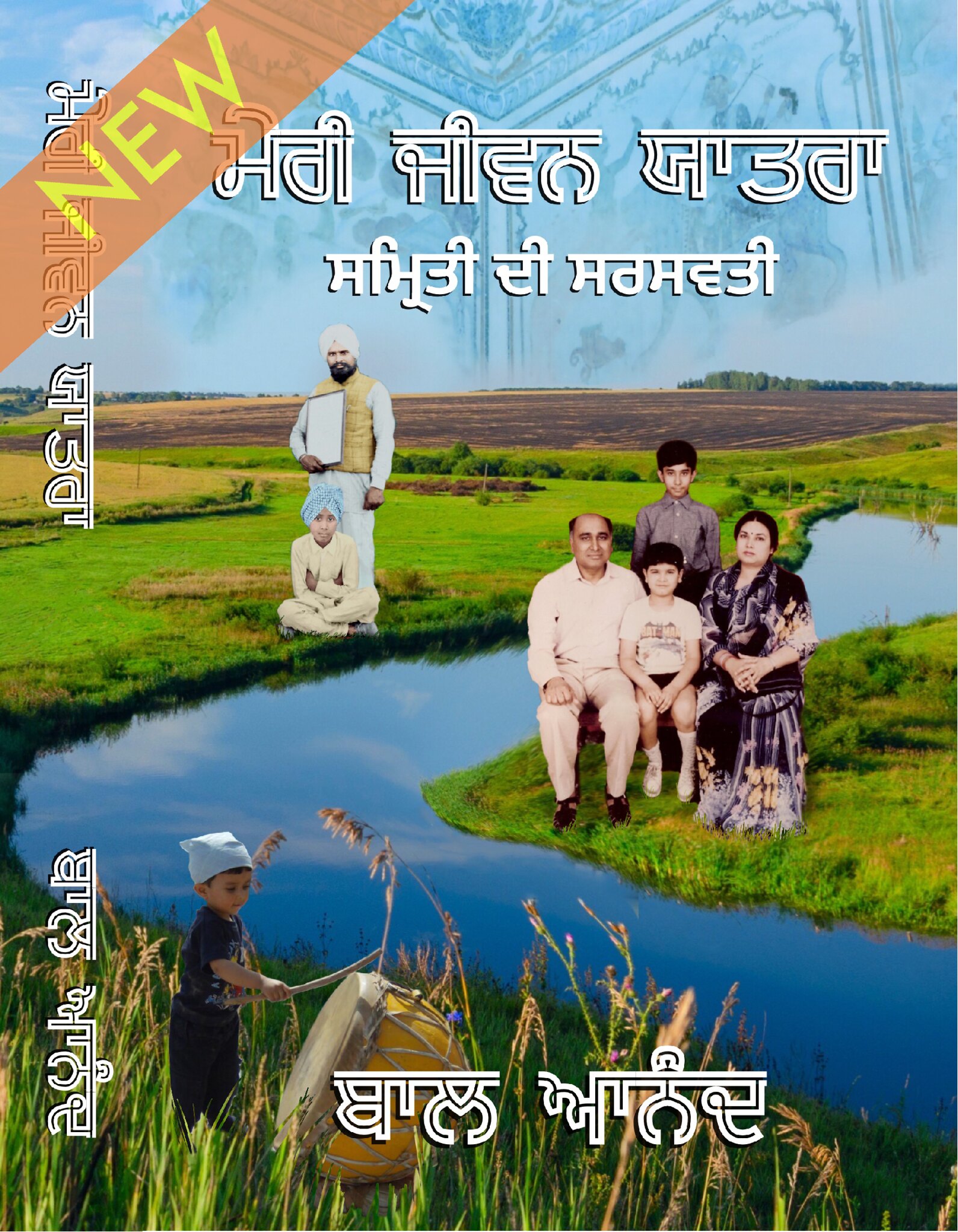
I present here my latest book, my autobiography, in Punjabi language

ਮੇਰੀ ਜੀਵਨ ਯਾਤਰਾ: ਸਮ੍ਰਿਤੀ ਦੀ ਸਰਸਵਤੀ

Meri Jivan Yatra: Smriti di Saraswati

Pilgrimage of My Life: A River of Reminiscences

Described in Amazon as

'Meri Jivan Yatra: Smriti di Sraswati - Pilgrimage of My Life: A River of Reminiscences'; 436 Pages and 24 pages of 96 rare photos.

This extraordinary narration, in Punjabi, by Ambassador Bal Anand (Born 1943) chronicles his marathon journey from a small village school to nine different capitals across the continents to represent India in 14 countries.

This amazing tale of many an unexpected twists in author's life has been told in a gently flowing poetic prose - with ripples of humor here and there. The reader is diligently taken along to travel to various interesting places and meet many talented people and also the eminent global personalities. Author also shares with the reader his trips to famous institutions, monuments and wonderful beauties of nature in the far off locations. The author has dwelt at length on the historic background of his family of saints and classical scholars and has paid rich tributes to his inspirational teachers. He has also referred to the his pleasant personal encounters with many famous personalities in politics, literature, arts, sports, etc.

This autobiography - the first ever in Punjabi by an Indian Foreign Service Ambassador - is lit up on each page with anecdotes and notes of hope and cheer. The book is indeed a must read for all the Punjabi knowing persons for an enlightened overview of the cross currents of developments in India during the 75 years of Independence and even beyond.

Video Trailer of Author's Introduction to his Book

Youtube link: https://youtu.be/z9-_DPP7sQA

Please note: The complete video is still in post-production, and will be posted here shortly.


*      *      *

Tuesday, June 23, 2020

The Great Memories of Great-Grandfather

This article was contributed to the prominent diaspora website in the USA, "India of the Past" in 2019

IT WAS October 2018. I realised - as if in a flash - on the night of 18th October that the next day was the 71st anniversary of passing away of my most beloved and esteemed great-grandfather – a unique Guru, a tactful teacher, a versatile scholar and renowned Vaidya of his time, Shri Pramatmanand ji.

L to R: Pardadee Bhua Chetan Kaur Ji, Author, Nanee Jee
Bishan Kaur & Dadee Ji Dhann Kaur. c.1956

As a child of about 4 years at that time, I have rather very vague - बहुत धुंदली सी - but distinct memories of the day. I had lost my mother about a year earlier and, therefore, used to spend more time in the loving care of my Naanee (maternal grandmother) Bishan Kaur, though my two great-grandfathers - Giatanand ji and Pramatmanand ji, not to speak of the grandparents - Dwarkanand ji & Dadee-maan Dhan Kaur, and the two paternal / grand paternal aunts simply adored me.

Father, reflecting a serious demeanour and seen mostly busy doing this or that work, seemed somewhat of a distant and forbidding figure. Perhaps, in those times, young fathers in large joint families, were also treated by the elders at home more in terms of grown up children! And they, in turn, might also have felt a bit shy or were not yet accustomed to be openly affectionate towards their own children, more particularly when there were several seniors always lurking around to do so! I was, as I have been told, a very healthy, playful and well adorned child-ever ready to ‘play’ with anyone who was imaginative enough to attract my attention and interest.


Author visiting the Baithak of his elders,
first time since childhood. 17 December 2006

Baba ji Pramatmanand ji would often like to have me by his side in his Baithak - an all-purpose larger room serving as pustkalaya (library); lekhanalya (room for writing books); aushdhalya (room with open Almirahs with lines of bottles of medicines); shishyalya (teaching room), sangityalya (with musical instruments lying around) and above all, the play-corner of his most beloved great-grandson, i.e., me – the first born of the 7th generation of the known history of the family! I was reputed to be the apple of his eyes – the fulfilment of his prayer; reputed to have been named by him even before my birth, after the name of a legendary saint scholar of a historic seminary of Amritsar! What an ironically tragic twist of destiny that it had taken me more than sixty years to cross the threshold of and enter this most pious premises, once the hallowed seat of imparting knowledge and wisdom by Vaid Bhushan Param Sant Pramatmanand Ji, my revered great grandfather !!!

Falaund Kalan
Shrine of Author's Ancestor - Baba Gajjan Shah Ji

On the fateful day of his passing away, I had been, perhaps, specially fetched – carried mostly on shoulders during the journey on foot by my maternal uncle, Jawala Singh from village Jandali, of my recently deceased mother, Malkit Kaur. It was located near the historic town of Payal, on Sirhind Canal, 7 Koh i.e., about 17 km from my parental village, Falaund Kalan. I recall that the Bawan – decorated bier for funeral procession – bedecked with flowers and buntings had in front the group of Band-baja musicians – Muslims professionals called from the nearby city of Malerkotla. The silently grieving women were moving behind the men folk. I, the Jyeshath - first born-great-grandson, was carried on his broad shoulders by my well-built maternal uncle Jawala Singh. I was waving ritually the Chaur – fly whisk – over the bier. This funeral procession, in a solemn tradition but not in overly sorrowful atmosphere, was symbolic of the expression of completion of a life of fulfilment of the most respected and distinguished elder of the family.

Baba Gajjan Shah Ji

The bier had been brought into the exclusive family cremation ground near the more than hundred-year-old Samadhi - mausoleum - of family patriarch Baba Gajjan Shah. My father was being given instructions to light the pyre. Pramatmanand Ji’s had no child and my father, Haridialnand, was his adopted grandson and the brightest shishya (pupil). He had been rigorously groomed since childhood by his Guru-grandfather to be the true inheritor of his mantle of all the multifarious scholarship and spiritual learning.

Minutes before my father was all set to light the pyre as per the ritualistic ceremonies, an army official, Ram Singh, belonging to our extended family, happened to arrive unannounced on his long awaited vacation after World War II. He was last known to have served in Italy. He had been able to bring with him a camera – something quite rare in those days in any village. He had immediately rushed to our exclusive cremation place. He politely interrupted the Agni-dah - lighting the fire - ceremony for a while, and clicked a photo of the group standing by the side of the mortal remains of the departed noble soul. I could discover the copy this small size photo in one of the family books when browsing through them after the death of my father in April 1978. Though not very clear in details, the enlarged photo has been indeed a rare monumental image capturing the moment – just before the mortal remains of the great soul were consigned to flames of fire.
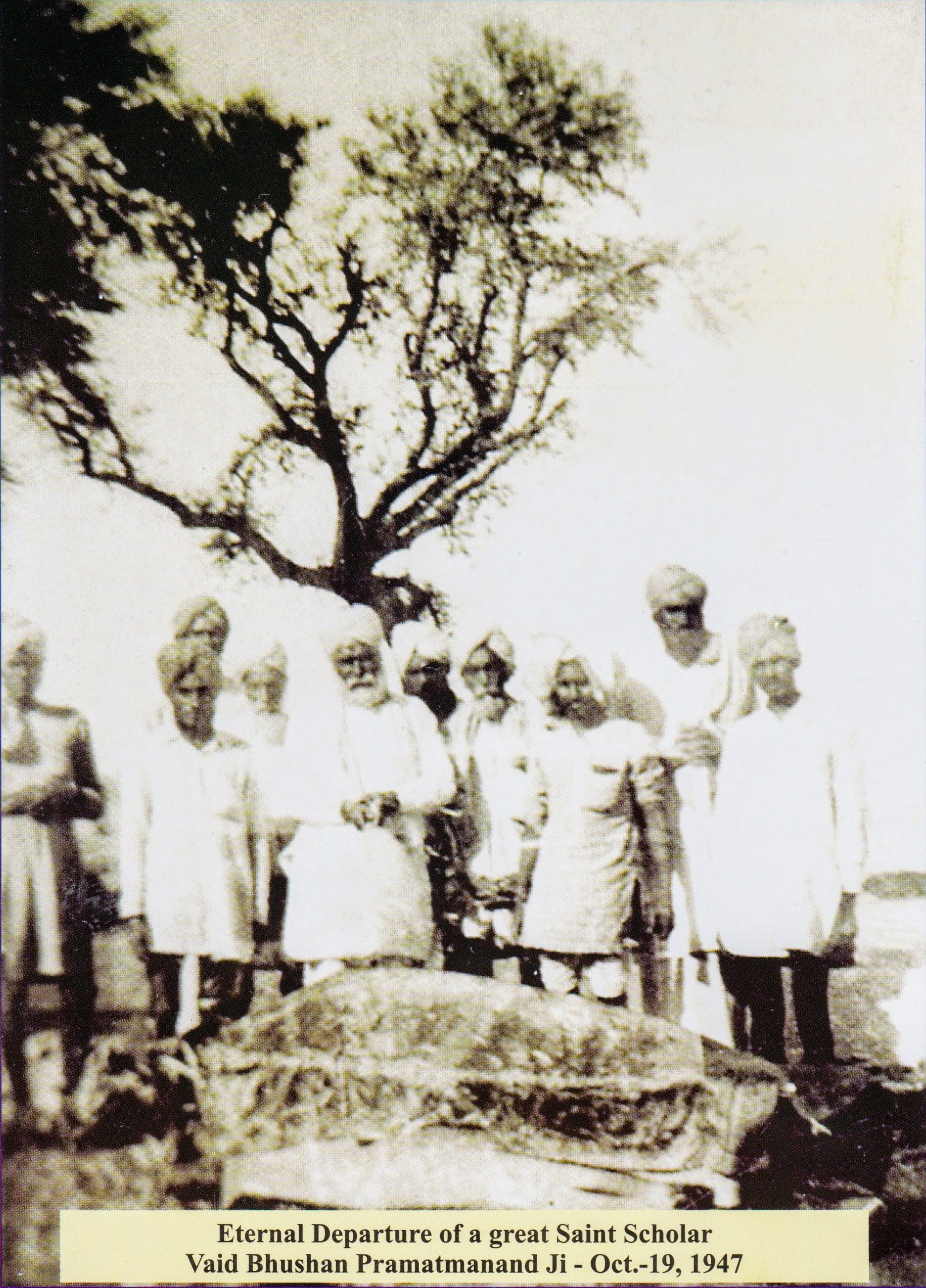
Among the ten persons in the photo, I have been able to recognise eight of them. Standing left to right- the second is Lakhmananand, a dear real nephew, then about twenty years old, who had been born posthumously; Narain Darya, another elderly distant nephew; village headman & a distant grandson, Basant Narain; Tara Singh, again a distant grandson; Shyamanand, an elderly real nephew; Haridialnand, adopted grandson and chosen heir; Mahinder Dass, a distant grandson and a learned disciple; Krishnanand, a distant grandson and a young disciple. I had known Shri Basant Narain and Krishnanand quite well and was recipient of their great affection and blessings.

I have some deeply distant recollections of the largely attended get together at the Antim Ardaas – the last Prayer function on 9th November 1947 – marking the completion of Shri Akhand Path, he uninterrupted 48 - hour recitation Shri Guru Granth Sahib. The people of the Punjab were still under spell of great gloom over the barbaric violence in the wake of Partition of India. Our village was part of the area of Muslim state of Malerkotla, and the rulers called ‘Nawabs’, had been held in high esteem by the people. The Sikhs recalled with admiration and gratitude the historic bold stand taken by Nawab Sher Mohammad Khan (1672-1712) when the two innocent young sons of Guru Gobind Singh were bricked alive by the governor of Sirhind in 1705. The territory of Malerkotla had remained comparatively quiet during the worst killings of Muslims in East Punjab. Sadly, the last Nawab Ahmed Ali Khan had passed away on 18th October 1947. I think that I had heard people talking to suggest that noble people like Nawab Sahib and Pramatmanand Ji were departing this world because such noble souls cannot withstand the barbarity, inhumanity and utter cruelty of the time!

Entry in 'Red book' of ceremonial records

In September 2019, I was able to retrieve the old family ‘red-book’ of ceremonial records and the various traditional financial dealings. My father had been tutored to cultivate a habit of recording most meticulously the minutest details of the various social and religious ceremonies. He did the same after the passing away of Pramatmanand Ji, including the mention of the exact amounts of various expenditures involved. He has, among many other details, recorded, “The Most Pious 108 Sant Baba Pramatmanand Ji breathed his last at 8p.m. on Saturday, 18th October and Biwan dwara agni sanskar was performed at 4p.m. Sunday, 19th October.” The Community Feast had been arranged on 4th November. The Function of the completion of Recitation of Granth Sahib had taken place on 9th November. The Musicians of the band for funeral part had been paid Rupees 15 - a significant sum in those days; cost of wood for the pyre was Rupees 23, and 64 coins of double Paisas - large sized copper coins - were thrown around during the journey of the funeral procession! The family Guru – a dignified Bedi Sikh, a presumed to a direct descendant of family of Guru Nanak Dev Ji - had been given a ‘Dakshina’ of Rupees 11!

Then in October 2019, I also came across revealing references in Haridwar in the records of the family Purohit - Pandits including the signatures of many elders who had gone there to immerse the ashes of the members of the family. In 2009, we had discovered a copy of a long letter, more than 2000 words, penned sometime in 1945 by Pramatmanand ji to his young nephew who had joined the Army. It was about the conflict of litigation over family lands by his maternal grandfather, and it amply revealed his anguish over the unnecessary family feud. I have been keen to highlight his legacy of multidimensional scholarship Pramatmanand Ji, particularly his original hand written works, in Gurmukhi script, of Ayurveda and commentaries on the sacred texts Hindu-Sikh spiritual tradition. One big book, called ‘Moattam Sahib’, contains thousands formulations of ingredients of very special Ayurveda medicines, considered strict secrets like - present day patents. I am glad that Gajjan Bilas, the biography the family patriarch authored by him in Brij-Bhasha, has been long last published.

I have been speaking to the elderly persons in the village - not many survive now - who had personally known Pramatmanand ji. A very senior cousin who was the first in the area to do Masters in English in 1950 - and had then joined the Indian Revenue Service - had told me several interesting anecdotes about the scholarly Baba Ji. When asked about his education, Baba Ji was fond of saying that he had studied in the University of Himalaya Parbat. Similarly, when as a high school student he had once angrily spoken to Baba ji, ‘There is no Rabb-God… all talk about Him rubbish.’ According to him, Baba Ji affectionately drew him closer to his bosom and spoke very softly and sweetly, ”Son, first of all, one should not be full of any anger when trying to understand any deeper and complicated problem!”

It was my destiny to go around the world as the representative of India and have the privilege to meet the most magnificent personalities in various fields. In an inexplicably mysterious way, I feel that my pilgrimage on the path of particular point of view of life had indeed begun very early - in the most ennobling lap of my great grandfather, an extraordinary saint scholar who had devoted every second of his earthly sojourn in the love of learning the art and science of healing- of the human mind, body and spirit!

*   *   *

Saturday, June 06, 2020

Guru Nanak's 550th Anniversary - International Conference in Chandigarh

Dear and Esteemed Colleagues,

I presume that you might be interested in the evolving contours in the recent years of Sikhism in its scholastic, spiritual, political and cross cultural dimensions. The subject has indeed assumed significant diplomatic-strategic aspects also of the 'Pilgrimacy' and role of radical elements of the Sikh Diaspora in the context of the global celebration of 550th birth anniversary of Guru Nanak (April 15, 1469 - September 22, 1539) and more particularly of Pakistan's quite unexpected coming forward for the implement - at a lightning speed indeed - of the long cherished 'Sikh psychic dream' of the 'Kartarpur Corridor'.

An institution, named interestingly, 'Centre for Research in Rural & Industrial Development (CRRID)', in Chandigarh, proclaiming its founding to Sh P.N. Haksar's inspiring motto 'ceaseless striving in search of Truth through research' hosted, co-sponsored by Govt. of Punjab and Indian Council of Social Science Research (ICSSR), an 'International Conference on Guru Nanak's Philosophy...' on 7-8 Nov 2019.

I had the pleasure to participate in this conference of eight sessions - with as many as 32 scholars / academicians making their presentations on various subjects related to the Vaani / teachings of Nanak - of the Seminar apart from the inaugural session with keynote address by Prof Murli Manohar Joshi & Presidential remarks by Sh M. Hamid Ansari. The valedictory session was addressed by Dr Manmohan Singh.

The deprivation of 'Khulle Deedaar - Unrestricted Access' to the Sikh Shrines in Pakistan has been the most agonisingly experienced psycho-spiritual wound among the faithful of the dynamic community. The matter has got incorporated in the regular Ardaas - Prayer after every formal religious function. The words are reproduced below:

ਸ੍ਰੀ ਨਨਕਾਣਾ ਸਾਹਿਬ ਤੇ ਹੋਰ ਗੁਰਦੁਆਰਿਆਂ, ਗੁਰਧਾਮਾਂ ਦੇ ਜਿਨ੍ਹਾਂ ਤੋਂ ਪੰਥ ਨੂੰ ਵਿਛੋੜਿਆ ਗਿਆ ਹੈ,
Sree Nankaanaa Sahib tae hor Gurdvaareaan’, Gur'dhaamaan’ dae jinhaan’ thon’ Panth noon’ vichhor-eaa geaa haee
ਖੁਲ੍ਹੇ ਦਰਸ਼ਨ ਦੀਦਾਰ ਤੇ ਸੇਵਾ ਸੰਭਾਲ ਦਾ ਦਾਨ, ਖ਼ਾਲਸਾ ਜੀ ਨੂੰ ਬਖ਼ਸ਼ੋ ॥
Khullhae darshan dee-daara tae sevaa san-mbhaal daa daan Khaalsa jee noon’ bakhsho.

I am taking the liberty of presenting - below - the Paper, running into about 2750 words, presented by me titled, 'Guru Nanak - Poet and prophet of Oppressed and Persecuted'. I was tempted to quote a few parts of it in this covering note - but was dissuaded by the feeling not to make it any longer - and leaving it to you to have a quick look at it - as and when you feel inclined.

Guru Nanak - Poet and Prophet of Oppressed and Persecuted

Bal Anand, Indian Foreign Service (Retired)

All those who have lived through the last five centuries in the mystically blessed and also terribly tormented ancient lands of five rivers, and areas lying beyond the adjoining north-western regions of Bharat i.e. India, have indeed been spiritually solaced and sustained by the resplendent eternal presence of Baba Guru Nanak Dev Ji (April 15, 1469 - Sept. 22, 1539 A.D.). During all these years of trials and tribulations wrought upon the people of these lands by their own innate flaws of character or inflicted upon them by the unjust rulers and rampant invaders, ‘the dhuur ki Baani-the deepest Divine discourse’ of the Guru conveyed in the soul stirring sublime poetry, in their own genuine tongue, has been burning bright for all to enlighten their lives.

2. When the toiling and harmony loving people of Guru Nanak’s beloved Punjab were brutally cut apart, amidst rivers of blood and tears - four centuries after his lifelong mission of healing the wounds of religious and social divides with Divine notes of harmony in knitting humanity together-I too had experienced shivers into morrow of my bones as an innocent child of four years, awkwardly awakening to the cruelest ways of the world, by the soul piercing song in my ‘maan-boli’, which seemed, as if, to convey it all to me, “Nanakaane vall nuun jaandia raahiaa ve, meire Pritam nuun sandesha devin jaa… O dear traveler, journeying towards Nankaana, please do convey the deepest cry of my soul to my beloved Guru…” I need not delve into details of those days of the most barbaric mass murders in history of humanity to which people of Punjab had been subjected when India was proclaimed to have awakened to the long awaited dawn of Independence.

3. While speaking to you all at this moment, ladies and gentlemen, in the city beautiful, I indeed feel acutely conscious about my own odd journey of life spanning seven decades and a half, my obvious limitations to fully fathom and understand the most pious life of the great Guru. In his relentless and epochal search until his last for the ultimate truth and an eternal moral order, more pin pointedly during the last five decades since the world had celebrated the quincentenary of the self-proclaimed ‘Saier- songster (of Supreme Creator) and ‘Neechan andar neech-the lowliest among the lowliest’, one of the most extraordinary poet-prophet of humanity has ever known..

4. Dear Friends, please permit me to start with certain basic facts to elucidate my topic of the day. Firstly, we have to begin with an honest admission that ‘no manuscript in Guru Nanak’s own hand has survived the onslaught of time’. Prof. Pritam Singh, the painstaking scholar of manuscripts, has underlined at length how the pervasive practice of writing anything in Gurmukhi or Devanagri scripts ‘without separating different syntactical units from each other’ has posed a formidable challenge and that ‘readers needed a long period of training to read such text correctly…’ Guru Nanak had, however, most thoughtfully entrusted to his toughest tested successor, Bhai Lehna elevated to be Guru Angad, the manuscripts of his own compositions and also the writings of other likeminded saint poets collated so diligently by him during his wide spread travels and intimate discussions with several of them. A total of 974 hymns - in 19 major ragas i.e. melodies of Indian classical music - attributed to Guru Nanak had been later incorporated in Sri Guru Granth Sahib (SGGS) by Guru Arjan Dev Ji, when he compiled the Granth, sixty five years later. A majority of Guru Nanak’s verse creations are in the form of quatrains and in other popular verse forms -  ‘the themes are ethical, philosophical, or devotional and in their totality make up the cosmic vision.’

5. Guru Nanak’s composition titled Japji - the Holy chant - comprising of 38 Pauris, literally 'ladders', implying poetic stanzas, has been rightly adopted as the prayer for recitation at early dawn, known in the Sikh tradition as ‘Amrit Vela-the ambrosial hour’. Japji, opening with invocation to God, has amplified the concept of Supreme Being, with a statement on the nature of God: His uniqueness, Omnipotence, Immortality, etc. and reaffirms His being both Truth and Reality. It concludes with an assertion that knowledge of God is obtained through the grace of the Guru - an enlightened individual. The prominence of this composition has been ‘recognized as such by the Fifth guru, Arjun, when he gave it the first place in the sacred anthology.’ In essence, it is a monotheistic concept of Supreme Being, known in Sikh tradition as, ‘Ek Oankar - One Sole Supreme Being’. Another composition of Guru Nanak for morning recitation is Asa Ki Var, ‘a disquisitional poem of 24 stanzas, interspersed with Slokas (groups of poetic couplets); it denounces falsehood and hypocrisy in the practice of religion in society.’ The Var Majh; in Raga Ram Kali Dakhani Onkar; Solahe (sixteen-stanza poem) in Maru Rag and Sidha-Ghoshti, again in Rag Ram Kali, Guru Nanak expresses his broader thinking over philosophical and ethical issues and points out that meditation - Naam Simran is indeed the true Yoga. The primary purpose of all these verses has been to free the minds of the ordinary people from all types of superstitions and negative social practices.

6. When we turn to the group of four poems, in Raga Asa and Telang, ‘expressing strong indignation of Guru Nanak over the barbarities perpetrated by the invading armies of Babur over the people of Punjab including large scale dishonour of the women-folk’, we come across a rare example of a man of prayer and meditation demonstrating a supreme courage of convictions in denouncing the tyrannical deeds of the ‘the Paap ki janj – marriage party - mafia of sinners coming from Kabul’. The death and destruction during the sack of Lahore for four days in the middle of January 1524 finds mention in the boastful narration in ‘Babur-nama’ by emperor Akbar’s grandfather and the forceful challenging counter narrative in the poems ’Babar-vani’ by Guru Nanak- “Bavarvani phir gayi… Babar’s sway has spread all around; even princes are roaming without food…” The painful plight of people is poignantly pictured by Nanak in another hymn: “O our Lord, our Creator, when there is such killing, such suffering, such pain, so much spilling of blood, so much shrieking, do You not feel pity for the poor!” Guru Nanak’s had felt deeply outraged with the indignities and cruelties piled upon helpless women and expressed their plight with the most graphic poetic images: “Jini siri sohani pattian, mangi paae sandhur - Women whose heads were adorned with tresses; Parting of whose hair was daubed with vermilion; Their locks are shorn with shears, their throats choked with dust… Thou art the Author of all things; Thou seest all. Strange are Thy manifestations!”

7. Guru Nanak - the indefatigable seeker of Mukti - the Salvation of the soul via the pursuit in practice of an honest living following the path of Truth and Nobility - was passionately committed to justice, equality, fraternity and fair play for all. He castigated the rich and powerful for their greed and lust and indulging in atrocities against the poor - he chose to be counted with the clans and classes of Bhai Laalo, the hardworking carpenter friend and Bhai Mardana, a soul mate lifelong musician companion, who was also dubbed to be of low caste even among followers of much acclaimed equalitarian faith of Islam. Here Guru Nanak consciously moved beyond limitations of Bhakti movement and its attendant divide of Nirgun and Sargun i.e. Formless and Formal. He equivocally challenged the hypocritical orders of the day - the caste and rituals ridden Hinduism and unjust and intolerant practices of comparatively recently arrived Islam. Guru Nanak indeed echoed Kabir, “Tu kehta kagad ki lekhi; mein kehta aakhan ki dekhi - you speak of what is written on the paper; I speak of what I have seen with my eyes,” by proclaiming, “Jiho dittha, tiho kiha - I said what I saw.” The inspiration and courage of conviction for Guru Arjan for the inclusion of the verses of the several low caste saints - Kabir, Ravidas, Nama, Sadhna, Sain, etc. - in the Granth Sahib had certainly its sacred fountain source in the integrating spiritual ground so assiduously prepared by Guru Nanak.

8. We have to understand how Guru Nanak had adopted systematic strategy to diagnose the crises of institutions of the contemporary society. He noted quite clearly how the native Hindus had become deeply demoralized and confused and were leading contradictory lives, “Antar Pooja parhi kiteba sanjum Turka Bhai… - inside home you worship (as Hindu), but outside you read other books to impress the Turks; Discard this hypocrisy! Devotion to Name will ensure liberation.” Though the ‘Nirguna’ saint poets had not hesitated to employ blatantly strong expressions to condemn caste distinctions, Nanak, in a rare poetic restraint, preferred to use touching poetic twists to ceremonial practices like the wearing of ‘janeoo - sacred thread’ saying, “Daya Kapah, santokh soot… Out of the cotton of compassion / Spin the thread of tranquility / Let continence be the knot / And virtue the twist there on. O Pandit…” Similarly, Guru Nanak sought to chastise the Muslims to follow their religion as enunciated by their saintly guides and not the sinful rulers,” Musalman kahanu muskilja hoe ta Mussalman kahave / Awwal Aaoli din kar mittha musklmana mal musaave… To be a Mussalman is not easy: only he who is one in reality, should make the claim. Follow first in the footsteps of the saintly; accept their bitter words as sweet… O Nanak, if he extends his mercy to all; treats all living beings as the same - himself a Mussalman he can proclaim.”

9. The most refreshing and relevant notes for his troubled times struck by Guru Nanak pertain to defending the dignity of the womenfolk and underlining biological and societal crucial role of women in the overall scheme of Nature. He condemned extolling of the orthodox Hindu cults of celibacy and renunciation and sought to elevate ‘Grahisatha-life of a householder’ as the noblest obligation ordained by ‘Srijanhar-Supreme Creator’ of the Universe. He was strongly critical of perverted notions among Muslims of treating women as slaves for indulging in animal lust. He emphasized that husband and wife are indeed created equal and that fidelity was enjoined on both. Guru Nanak pictured domestic bliss as a cherished ideal of life and marriage as the metaphor for consummation of love for the Divine. In the Asa ki Var, Nanak rejects the superstition of Sutak - implying that a woman giving birth to child is unclean and impure for a number of days - depending on the caste to which she belongs! In his masterly composition, Nanak says, “Impurity of the mind is greed and the impurity of the tongue is falsehood. The impurity of the eyes is to gaze upon the beauty of another man’s wife and his wealth. The impurity of the ears is to listen to the slander of others…” Nanak proclaims the eternal truth saying, “Within a woman, a man is conceived; to a woman he is engaged and married… through a woman, his future generations come… So why call her bad? From her, Kings are born.” Guru Nanak had condemned the ‘Sati-pratha - wife burning herself on pyre of dead husband’ - he says that it is nobler to live with pious memory of the departed loved one than embracing an unnatural quicker death.

10. Most esteemed friends, in the pointed context of Bharat, we must finally reckon all the reformative social and spiritual movements and their eminent apostles at the altar of the fraternity and equality of people: for their totally unalloyed belief and practice in the equality and justice for the spiritually dehumanized for ages, the so called ‘Shudras - the untouchables’: born to be treated worse than animals according to the glorified scriptures of dubious Divine Origins. Guru Nanak’s travels far and wide for interaction with the leaned scholars of various schools of spirituality including those with humbler origins but higher thinking minds indeed represented a path breaking initiative in the spiritual annals of the world. He castigated the caste distinctions as totally false and vicious man made divides, “Jaanhe jot, naa poochhe jaati - recognize the godly light in all; Braham binnd te sab utpati hoee, maati ek sagal samsaran - The Cosmic minute created it all, the entire creation has the same element.”

11. Following the path lit by Guru Nanak, the assigning of place of honor to the so called low caste Bhakats and Muslim savants in the Granth has been indeed the most admirable example in the history of the holy books of the world. The truest tribute to Baba Nanak, therefore, on the 550th anniversary of his arrival will be the sincerest pledge by all for the total rejection and purging of caste from their lives in all its ugly manifestations: the Sikhism had indeed owed its origin to equality of ‘Sangat in Pangat’ - the pious Congregation in the queue of perfect equality: enough of preaching so far, the hour of action and practical measures beacons us all from Kartarpur! The 550th anniversary of great Guru’s auspicious arrival and 70 years, 5 months and 7 days of his gracing the planet earth indeed deserve to be celebrated by everyone in the world by reflecting over all those days of his life and 974 most precious hymns composed by him to illuminate mind and soul: they are like the shining pole stars in the arduous and complex voyage by human beings in this complex world. Guru Nanak indeed exults in concluding several of his hymns, saying, “Nanak, Saier eva kahiya-thus spake, Nanak, the poet” - indeed a rare example by a spiritual master to proclaim himself a bard of Almighty! Guru Nanak was a gifted reconciler of religious and cultural differences; in a way, he foresaw the plural and multicultural destiny of India. It is no surprise why Dr BR Ambedkar had deeply admired Sikhism as a great faith practicing equality and justice and an ideal option for his people oppressed and persecuted in the name of sacred scriptures. The Nanak community has to do ‘Atam-manthan i.e. self-scrutiny to rededicate itself to eternal values of hard work, devotion, truthful living and self-sacrifice.

12. To conclude, dear friends, I may kindly be pardoned for re-striking some intimately personal notes. I recall how since my early childhood, the Gurpurab - ‘Kattak di Pooramashi, mela Nakane da’ - falling exactly a fortnight after Deepawali on Amavas, was a soul stirring festival - commemorating not any distantly mythological event but historically well documented happening of the arrival of a godly person who had no claims to any name, fame or kingdom. My pious grandmother, with always prayers on her lips, gave me ‘Gutika - a sacred booklet’ to recite, as soon as I had learnt the Gurmukhi alphabet; my initiation to Japji, Rehraas and other verses of ‘Nitnem-daily prayer’ began during years of my profound innocence. Grandfather was also not behind the scene and tried to smarter by making me soon learn ‘Hanuman Chalisa’ by heart. From a sleepy village in a small state of Muslim Nawab, the family moved to a newly emerging neighbouring town in 1951. The most impressionable first writing inscribed on a wall to be read by me was on the roadside water tank of the Gurdwara meant for animals, saying: “Sewa Kraee 500 Rupaye, His Highness Nawab Iftikhar Ali Khan Sahib of Malerkotla”. I soon understood how Guru Nanak was indeed for all faiths and all ages; children played games, shouting, “Amba Vali kothri, Anaaran Vala Vehra; Babe Nanak da Ghar Kehra?” My generation has indeed grown up shaping our sensibilities about teachings of Nanak by particularly relating them to various contours during the march of the nation since the celebration of quincentenary of his birth. Incidentally, the grand success of feature film ‘Nanak Naam Jahaj hai’ and the regular reports of excellence of the University founded in his name in Amritsar come instantaneously to my mind.

13. Esteemed Friends, exactly half a century after half the millennium of birth of Guru Nanak, our country and our world have indeed been witness to amazingly spectacular changes of the technological and socio-psychological kind. Humanity would seem to be confronted with more and more complicated challenges - including even the sheer survival of the human race on the only planet known so far to house humanity! Personally, I had never dreamt that I would be destined to trot the globe in the service of motherland, including 777 days of the ‘Tapasya-Pious Act’ of the duty in the sacred soil of the holy footprints of Nanak i.e. Nankana Sahib, Panja Sahib and 26 other ‘Guru Nanak – Dhams’ and in addition the birth place of Guru Ram Das; eight sacred spots associated with Guru Arjan and 12 with Guru Har Gobind were officially recorded by Govt. of Pakistan in 1962. I and my wife had the good fortune of roaming about in the streets of Dera Baba Nanak on March 12, 2012 - and were, by grace of Guru, luckier even in locating the long left home of birth of my wife in ‘Guru ki Nagri’. While we were having, via ‘doourbeen-telescope’, ‘Darshan-holy sight’ of Gurdwara Darbar Sahib of Kartarpur, we had not visualized that the realization of ‘historic dream’ was around the corner and that a new glorious destiny was awaiting Dera Baba Nanak and Kartarpur Sahib.

14. Guru piari Saadh sangat ji - Guru’s beloved and blessed congregation before me, lastly, let us hope and pray that in spite of various attendant odds, the Kartarpur Corridor would indeed inaugurate many new flood-lit gates for the forcibly separated people of the land of five rivers, longing for ever to live in love, peace and prosperity for all! The ‘Gurmukhs’- people of Guru’s grace - indeed look forward to the time when they would also be able to roam about as free spiritedly as their Guru had in his own epoch, singing hymns composed by him for all and for eternal Time - with ‘sarbatt ka bhala-welfare of all’ on their lips and in mind and soul!


*    *    *


Sunday, January 28, 2018

Gajnesh Sandesh - January 2018

This is Punjabi-English magazine was published on January 2018

A publication of:
Sant Pramatmanand Academy of Creative Excellence (SPACE)
Sant Pramatmanand Rachnatmic Sreshta Sansthan

Cover of magazine
Cover Page of Magazine

Download PDF copy here

Contents
ਸੰਪਾਦਕੀ ਚਿੰਤਨ : ਪ੍ਰੇਰਣਾ ਸਰੋਤ ਤੇ ਮੂਲ ਮੰਤਵ ਬਾਲ ਆਨੰਦ 2
ਇੱਕ ਇਤਿਹਾਸਕ-ਪਰਿਵਾਰਿਕ ਪੱਤਰ ਵੈਦ ਭੂਸ਼ਨ ਪ੍ਰਮਾਤਮਾਨੰਦ ਜੀ 3
ਪੜੋਤ੍ਰੇ ਵੱਲੌੰ ਉੱਤਰ-63 ਸਾਲ ਬਾਅਦ ਬਾਲ ਆਨੰਦ 5
ਮੇਰਾ ਪਿੰਡ 'ਫਲੌੰਡ' ਤੇ ਮੇਲਾ ਲੋਹੜੀ ਦਾ ਬਾਲ ਆਨੰਦ 6
ਮਾਲ 2000 ਦੀ ਹਾਰਦਿਕ ਵਧਾਇ ਸ਼ੰਕਰਾਨੰਦ 7
ਗਾਂਧੀ ਸਕੂਲ ਦੇ ਮੇਰੇ ਅਧਿਆਪਕ ਡਾ. ਹਰਨੇਕ ਸਿੰਘ ਕੈਲੇ 8
ਸ਼ੁਭ ਕਾਮਨਾ ਸੁਮਨ ਮਾਲਾ ਪ੍ਰੋ. ਕੇ. ਐਲ. ਰਤਨ 9
ਸ਼ੰਕਰਾਨੰਦ ਜੀ ਦੀ ਕਾਵਿ ਪ੍ਰਤਿਭਾ 10
ਦੋ ਗ਼ਜ਼ਲਾਂ ਅਮਰਜੀਤ ਸਿੰਘ ਸਿੱਧੂ 10
ਸੁਥ-ਸੁਨੇਹੇ - ਪੁਸਤਕ ਰੀਵਿਊ ਬਲਬੀਰ ਮਾਧੋਪੁਰੀ 11
ਬੀਤੇ ਨੂੰ ਆਵਾਸ਼ਾਂ - ਕ੍ਰਿਸ਼ਨ ਅਸ਼ਾਂਤ ਬਾਲ ਆਨੰਦ 12
ਹਨੇਰੇ ਥਿ਼ਲਾ਼ਢ ਲੜਦਾ ਸ਼ਖ਼ਸ : ਐੱਸ.ਤਰਸੇਮ ਕੇ.ਐਲ. ਗਰਗ 14
ਓਲੰਪੀਅਨ ਡਾ. ਅਜਮੇਰ ਸਿੰਘ ਜਗਮੀਤ ਸਿੰਘ ਪੰਧੇਰ 15
I Love My 'Un-Partitioned' India Rashid Latif Ansari 17
The Journey of My Life Dr. Yogendra Pal Anand 19
Independence in My School Dr. Jaswant Singh 21
Ahmedgarh - Story of a Grain Market Town A.L. Jain 22
My Career as a Doctor Dr. D.K. Batta 23
Expressions of Freedom - Introduction Bal Anand 24
Revisiting School - Five Decades Later Bal Anand 25
My Childhood in Ahmedgarh Dr. K.K. Chexal 27
A Short Profile Bal Anand 28

Download PDF copy here

* * *

Tuesday, January 09, 2018

A Tribute to a Teachers' Teacher

Prof. Pritam Singh Ji
As a life long industrious student of the various disciplines of humanities with particular focus on world literature as my post graduation; spirituality in humanity as family heritage and International Relations as my profession, I have always deemed myself as one of the most privileged disciples of Professor Pritam Singh Ji (Jan. 11, 1918 - Nov. 25, 2008), without ever attending his formal class! He had indeed become the tall human tower - a light house in Patiala - as an  eminent teacher and an extraordinary, an encyclopedic, scholar of not only Punjabi language and literature but the entire range of the composite cultural and literary heritage of humanity.

Prof. Pritam Singh had been an inspiration for generations of students of Punjabi literature till he breathed his last. He was one of the stalwarts among teachers who had been a witness, as a bright student with the most meager means, to the best of the 'un-partitioned' - of the Five Rivers - Punjab. For me, he signified an era - that is no more - of the most enlightening literary pursuits in Punjabi. He had come to personify a rare dedication to bring alive the glory of Punjabi, cutting across all the narrow divides of the dangerous mix of religion and politics with the mother tongue of the brave Punjabis. I was indeed  singularly fortunate to be in his close contact-in the ancient Guru-Shishya tradition. He remained a 'Pole Star' of guidance for me in the matters of our deeply shared mutual interests in the global contexts of languages, literature and all the myriad faiths of the people.

I vividly recall how, as a student of B.A. in the D.A.V. College Jalandhar - some time around November, 1962 - I had the first Darshan - a face to face glimps - of Professor Pritam Singh. He was presiding over an important meeting of the Kendriya Punjabi Lekhak Sabha. The meeting had soon degenerated into an uproar of noisy shouts with even the signs of clenched fists for physical fighting- between the dominant progressive writers led by the veteran Marxist S.S. Sekhon and the silver-tongued orator Comrade Jagjit Singh Anand on the one side and the promising upcoming exponents of the new-wave-experimental Poetry including Jasbir Singh Ahluwalia and Sukhpalvir Singh Hasrat. Professor Pritam Singh, impressively attired in black achkan and chooridar, reprimanded them all in chaste Punjabi, using even typically strong phrases like 'Kanwarauli, kanjarkhana, kuttekhani', etc.  The eloquence, tactfulness and firmness displayed by the Professor from Patiala had the desired effect and it turned out to be a memorable session of lively discussions interspersed with sparkling and learned interventions of wit and humour by the Chair. I, an undergraduate student, had become an anonymous life long admirer of this Professor from Patiala for his radiant charm, scholarship and unshakeable belief in order and discipline.

It was, however,  as a student of M.A. (English) in the Government College - with no needless S.C.D. prefix then - Ludhiana, perhaps, in October 1964, that I read Balwant Gargi's pen-portrait of Professor Pritam Singh in Aarsi, then a popular Punjabi monthly, alas, has ceased publication since May, 2000. Gargi, in his inimitable style laced with subtle satire and humour, had referred to the rare qualities of Professor Pritam Singh as an 'obsessed' researcher of the old manuscripts of the Punjabi language and the evolution of the Gurmukhi script. Around the same time; Professor Pritam Singh had been transferred to the College as Head of the Punjabi Department.

Prof. Pritam had been assigned by Principal K.S. Thapar, interestingly, to deliver lectures for all the students of the College, in the main lecture hall now named after old student Sahir, on the themes of National Integration, introduced under a scheme of Government of India in the wake of war with China. Again, Professor Pritam Singh was at his best both in oration and the subject matter. One day, I gathered enough courage to speak to him requesting him to visit my home to meet my father and have a look at various hand written old books in Gurmukhi in our family.  He indeed gracefully agreed and visited our home in Ahmedgarh on Jan. 24, 1964. He had an engaging exchange of views with my father, an Ayurved practitioner and a scholar of Sanskrit and classical literature. I also arranged his meeting with my school teacher Shri Ashni Kumar, a Lahore educated reputed learned man. Professor Pritam Singh wrote to me a post-card, in English, thanking me for arranging the visit and praised my teacher as a person of, 'deep scholarship and disarming courtesy' - the last phrase was indeed an ever lasting lesson for me and made me his dedicated disciple for life.

The time rolled on, I passed my M.A. in English and was delighted to achieve my dream of becoming a lecturer, first in DAV College, Jalandhar and later on Govt. College, Bathinda. It was as a lecturer in Bathinda that my contact was re-established with Professor Pritam Singh. I had to accompany another respected scholarly personality, Professor Harmandar Singh, an eminent teacher of Political Science, who had also been transferred to Bathinda, for his meeting with Professor Pritam Singh, then Principal of Government College, Faridkot. It was in November, 1968 and the time of elections to the Punjab University Senate / Syndicate. Professor Harmander Singh was upset that Principal Pritam Singh had switched to the constituency of Registered Graduates instead of the Principals, making a clash between the two great old friends inevitable. It was a mix of tension and learning for me to be a listener to the arguments between the two of my most respected Professors. After lengthy discussions, Professor Pritam Singh appeared to have convinced Professor Harmander Singh that there was sufficient space for victory for both of them in the larger constituency of the Registered Graduates. While walking with us to the Railway Station to see us off, in the 'rush of the continued arguments', he also decided to accompany us to Bathinda. We had to speak to the Guard that, in a hurry, we could not buy the tickets. Reaching Bathinda, I went to the guard to pay him the amount of tickets. Professor Pritam Singh, with a twinkle of an eye and a trade mark smile, said to the guard, "Badshaho, Eh Jhoote Tan Hoon Tohadi Bakshish 'ch hi aouon dio – let this swing-ride be under your kingly generosity!" The guard also laughed heartily and we came out thanking him. Around the time of the dinner, I requested Professor Pritam Singh that we should go to the nearby restaurant. He replied that he had his dinner in train when he was eating the 'Chholia', i.e., the green-peas of grams, taken directly from the plants!

There was again a long interruption in our correspondence after I joined the Indian Foreign Service in 1971 and moved to Delhi and many postings abroad. It was during my posting as the Deputy High Commissioner in the neighbouring Pakistan (September, 1992 - November, 1994) that we could resume our intense interaction, particularly in the context of the preparation Punjabi Lekhak Kosh – Directory of Punjabi Writers. I could contact several Punjabi writers and activists in Lahore and Islamabad to collate information for inclusion in the Directory. Prof. Pritam Singh was gracious to mention my name in the list of the persons who helped him in compiling the book which was published in 2003. Prof. Pritam Singh always replied at length to my letters regarding my observations on the shared heritage of the Punjabis and how the bond of language could be strengthened in the face of evolving complex and challenging circumstances. He had a large circle of friends and admirers in Pakistan and his deep knowledge of Persian and Urdu languages proved an immense asset as a bridge between the two Punjabs and the national and international forums..

It was after reading my long letter, in Punjabi, 'Battan Beete Vareh dian - Matters of the Year that is past', circulated in December, 1995 to my close circle of friends that he specifically directed me that I should seriously plan to write about my experiences, in Punjabi, when I am free from the burden and worries of the Service. In view of his failing eye sight, the correspondence got restricted and confined to brief and urgent e-mails. After my retirement in 2004, I availed the privilege of speaking to him more often  whenever there was some matter of mutual interest. He would again remind me of the promise I had made with him to write in Punjabi. I once said, 'Sir, there is so of much high quality writings available to read, it becomes difficult to discipline oneself and find a time to write'. He smiled and retorted, 'that is the tragedy of Punjabi, Bal Anand Ji... those who should be writing, say they have no time from reading; but those who should be reading more, go on writing more and more!'

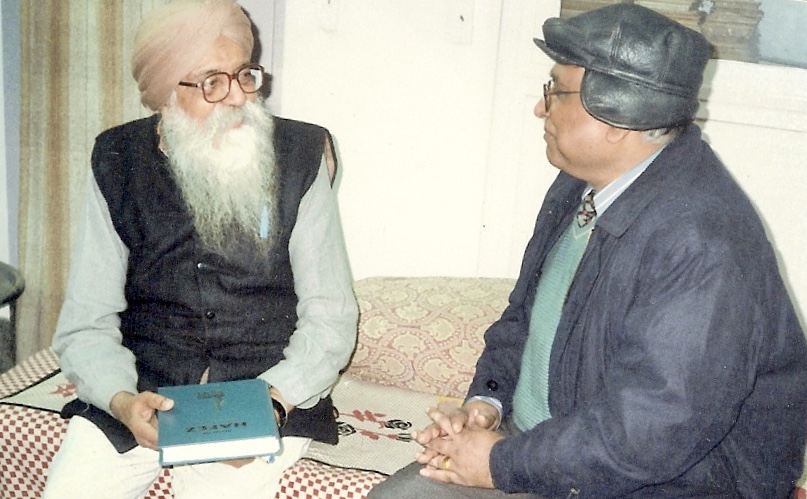
Meeting on Jan. 11, 1999 - 81st Birthday of Prof. Pritam Singh

My last meeting with Professor Pritam Singh took place in the late evening of 1st October, 2008. He appeared some what frail and time - worn but his profundity of expression, smile and laughter were indeed as intact as ever. I had presented to him 'Diwan-e-Hafiz' brought from Iran - the 'Blue book' in the picture and my write-up in Punjabi on the popular 'Chhapar Fair of Punjab' and my recent columns on Urdu poets and scholar A.J. Zaidi and Ahmad Faraz. We touched upon the current educational and cultural scene in Punjab and in the country. When I took leave of him, he persisted in walking with me the up to the main gate. I mentioned to him - at the door step - that Panth must think of establishing a museum of letters, with name, 'Zafar Namah Sahib Bhawan', inviting Punjabis all over the world to donate letters on the themes of literature and culture of Punjab - to be scientifically preserved there.

I penned my last letter to Professor Pritam Singh, on 24th of October, a day before his joining the company of the immortals, sending it care of his daughter Doctor Harshinder Kaur so that she might read it out to him. The Destiny of this letter was fated  to be different - reaching him on the address far, far beyond his earthly abode! I salute this angel of a Teacher on his birth centenary - he indeed radiated knowledge and nobility with every word spoken by him!

*     *     *


Friday, March 24, 2017

Ek Sham - Ahmedgarh ke Naam


Dear Friends,

As you know, Ahmedgarh has been my beloved place of school education - May 1951-March 1959 and my home town upto July  1971...

It was Master Ashni Kumar Ji (1916-1999) - my unique Guru-teacher - who was my anchor of life in Ahmedgarh till he breathed his last - on Saturday, Feb 16, 1999.

I had been myself so stressed and always short of time till I setlled down in retirement in 2004... after spending more than 26 years abroad - 21 of them were consecutive, from 1982-2003!

I have tried to make the best of the sun set years of life by returning - full time - to my books, rediscovering good old friends - and my love for pen and paper - rather the modern age wonder, Shriman computer-Ji!

I know how the dear friends in the tri-city beautiful have been dreaming of an evening devoted to the golden memories of childhood in our beloved Mandi... a brand new town which had sprung up from no where - in the wake Rail Revolution of India in the early twentieth century.

I am heartily grateful to the dream team of friends - Jawahar ji & Janak in particular - who conceptualized the event of the evening of Friday, 24th March to recreate the genuine spirit of love, innocence and affection dedicated to our beloved town. The inimitable Mootki - Rakesh Bhai - is indeed blessed with an abundant artistic talent and the most infectious joy in bringing to pulsating life all the beautiful memories of the sweet past...

Prof. Anu Jain was the perfect compere of the event ... the memories of his most wonderful Tayas - Amrit ji  Madan Faryadi ji - have been my most precious wealth.

I was so glad to meet many new friends and younger friends of the new generation - nasal nau - who all swear by the love of Ahmedgarh!

Brig JJ Singh Jagdev's family - we met after more than fifty years - is closely related to mine for four generations - it was his grandfather who was instrumental in persuading my family to shift to Ahmedgarh.

Sh Gobind Thukral ji has been a dear friend, philosopher and guide since we met in my retirement... 13 years ago; Dear Ashwani Gupta put in a lot of effort in managing the event in Western Court...

My sincerest thanks to all the ladies who had graced the occasion as equal & active participants... I promise to be accompanied by my 'better half' when the next such get together happens.

With my greetings & best wishes to all the dear friends,

Affectionately,
Bal Anand

PS - I am sharing three photos of the event..
Hope you would share more photos/visuals of the most joyful evening


Friday, July 01, 2016

My Lessons of History in School

I consider myself singularly lucky and blessed that the lessons in history - and poetry- started for me much earlier in life than for most people. I was myself, however, innocently unaware about all this at that time.

To begin with, take the case of the date of my birth. It was determined as 15th November, 1943 - perhaps, a year less - at the time of my admission, in October 1949, in the District Board (soon changed to be ‘Government') Primary School of the neighboring village, located in what was still called the Angrezi Ilaqa (British Territory). It was a school with one kutcha (made of mud) room; a small court yard which had low (less than three feet high) mud wall around it; two teachers and four classes. The school had about forty students from the surrounding villages.

The name of the village is Sohian, near the old town of Malaudh, about 30 Km from Ludhiana. I do recollect that the senior teacher Pandit Lachhman Dass Ji had asked my father whether he had thought for me a plan of higher education or putting me in some job soon after my matriculation. My father had replied, in a very polite but deeply determined voice, that he would like me to go for the highest possible education.

I was to come to know 55 years later - a few years after my own retirement at age of 60 - that this popular but strict disciplinarian teacher who had commanded deep respect among generations of students had served in the same school for his entire teaching career!

It was in this school, I had heard the couplets of the first folk poem by a senior student, Jagga Singh, praising Mahatma Gandhi to be clever enough to ‘outwit' the foxy white rulers!

The white Kothi (mini-palace) with high walls and surrounded by the thick lines of tall trees of a Sardar (petty chief, feudal lord) called Kaka Ji of Sohian was visible from the school. It was, however, more a like a mysterious fort for us, the young students- something like the complex buildings I was to see later in the horror films. I had, however, come to know that the Young Sardar-Kaka Ji has been recruited as a Poolas Kaptan (Police Superintendent) by the Government of Independent India. Later in life, my efforts to meet the then octogenarian, Sardar Narinder Singh Phulka, IPS (Retd.), could not bear fruit, in spite of the fact that one of his sons-in-laws, now retired in anonymity from the IAS, had been a friend from my college days.

The next historic turning point for me came in May 1951 when I was admitted in the third grade in the High School in Ahmedgarh, the nearby town. The family took some more time to shift there from the village. I felt quite at ease being exposed to a refreshing atmosphere of freedom, patriotism and nationalism surcharging this school named, soon after Independence, from Public High School to 'Mahatma Gandhi Memorial National (MGMN) High School'.

The eight years of the continuous studies in the school provided me with ample opportunities to look all around far beyond the lessons in the class rooms. I must thank Master Ashni Kumar, a senior teacher of English and Social Studies who had started mentoring me right from my sixth class.

The town of Ahmedgarh (named after Nawab Ahmed Ali of the tiny state of Malerkotla (1881-1947) had been founded in 1905 in the wake of the construction of the revolutionizing rail link connecting Ludhiana to the southern-eastern belt of Dhuri-Jakhal and beyond. The new look town regularly witnessed, as if it were a typical Greek city state, debates and dramas in the school which were often joined by the chaudhris (elders) of the town too.

The local wings of political parties - Congress, Socialists and Jan Sangh in particular - seemed to be vigorously competing to bring their national leaders to address the people in the Gandhi Chowk, in the miniature Connaught Place of the town, proclaimed to have been planned after Montgomery! The location of the town on the cross-borders of adjacent Riyasati (Princely) and Angrezi (British) pockets of territories had made it a favorite and strategic meeting place for freedom fighters playing grim games of hide and seek after daring protests and acts of defiance including an act of loot - at gun point - of the government funds in a train robbery between Ahmedgarh and Malerkotla!

In terms of history, I must refer to the tragically maddening times in the wake of Partition. My great grandfather Param Sant Vaid Bhushan Pramatma Nand Ji had passed away on October 19, 1947, a day after the death of Nawab Ahmad Ali of Malerkotla. I can vividly recall how the mourners at the Bhog ­- the last prayer - were cursing the kaliyuga (Evil Epoch) for the calamities befalling the nation and her noble people. I could later notice that many houses had been burnt down in my mother's village - apparently belonging to Muslims. The mosque had been quickly converted into a Gurdwara!

I was luckier as a child to be spared the trauma of witnessing the scenes of murders and violence. But what about the feelings of a ten-year-old boy who was witness to his father getting critically wounded when he fell down trying to board an over packed vehicle leaving Sialkot for India? He had been left behind as dead on the road. The boy turned out to be a brilliant student and rose to the highest professional position for an engineer in India. But how would the pain of losing a father in that cruelest way ever go away - even though in retirement, he became Director of Gandhi Museum, opposite the Raj Ghat!

I do remember that I was able to broadly read, when I was in the fifth class, the Golden History of India by Vishva Nath, M. A., B.T., and Jagan Nath Grover B.A., B.T., senior teachers of History, Arya High School, Ludhiana. It was a popular text book for high classes and belonged to my uncle appearing for matriculation.

I remember vividly how among brief sketches of the contemporary historical personalities: Winston Churchill was described as the plain and blunt speaker; Joseph Stalin was the son of a cobbler of Georgia; De Valera was a great revolutionary freedom fighter, and so on.

Among the teachers of history at school, Master Ram Kishore - in his typical Poadhi dialect of Punjabi - would become deeply emotional in praising Chanakaya, the great teacher and his gifted disciple Chandra Gupta Maurya. Then, he would blame all the current ills of the country on the lack of respect for the teachers! Kishori Lal Sahir would quote couplets of Persian and would turn the lesson into play - assigning the students roles of characters of history, e.g., showing Hemu getting wounded with an arrow in the eye by covering the eye of a student with the corner piece of his turban!

Giani Romesh, known for punishing students with Bhrind - painful pinches, would often use the idiom, Dushmanan de Dand Khatte kar Ditte (leave a sour taste in your enemy's mouth).  It was not by making them eat tamarind, but putting up a brave fight.

The most reputed teacher of history / Geography and English in our school was, however, Master Ashni Kumar, a skeleton-thin person known for his razor sharp intellect and sharp satirical remarks. I was destined to be his favorite student and remain so for more than four decades till he breathed his last at a ripe old age in 1999.

In the tranquility of the years of my retirement, I have endeavored to reinvigorate my interest in the history of the select historical personalities and places-particularly in the more intimate region of the Punjab. My childhood interest in Sirhind was strongly reinforced when, during my posting to Pakistan in 1993, I had to facilitate the visit for a pilgrimage to the city by Prof. S Mojaddid, a former President of the Interim Govt. of Afghanistan after the Soviet withdrawal - the family claims 14 generations to have been buried there! The city with a significant strategic location has the most fascinating and absorbing history of the rise and fall of its rulers. The Ambala-Ludhiana-Sirhind section of the Delhi-Lahore railway line was opened on Oct.1, 1869.

Sirhind has turned a new page in its history with the recent establishment of excellent institutions of higher education including the Shri Guru Granth Sahib World University. A sort of personal history was made for me when, on 8th of November, 2011, the Acting Vice Chancellor, Dr Gurnek Singh, welcomed me to the University with a very special personal warmth and affection. He surprised me by telling me that he was my student in 1968 when I was a lecturer in the Govt. Rajindra College, Bhatinda. After the privilege of crisscrossing the continents representing India in distant alien lands, it is a very special soulful delight to rediscover the deeper eternal roots of friendship and love in the soils nearer home!

The learning - and teaching - of the History of India with a balanced and dispassionate approach is a great challenge. The average individual in society rightly seems to consider the past dead and gone; and the future all day dreaming! It is, therefore, all in the present and near future which is relevant for thought and action. But our battles in the present are often fought over the different versions the past and visions of the future. When I remember the school books and the teachers, so many live images flash before my mind's eye. Alexander, the great, impressed us as students as the most mesmerizing figure of the earlier era. Ashok and Akbar seemed to define the essence of India. Whatever may his later day critics say, for most of my generation Jawaharlal Nehru certainly qualifies to be called the architect of modern India.

Epilogue

The history is continuously in the process of being re-evaluated; the state-craft is such a gigantic entity ­- the search for the total and un-alloyed truth in the affairs of the state would remain a noble pursuit. The pursuit of power and the greed for riches would seem to know no limits - the truth for the cash loads for votes in the Parliament House gets more and more mysterious! The Right to Information has been emerging as an interesting search-light to illuminate deeply hidden dark spots in the files of current history.

Let us hope for better times ahead in terms of truthful history.

References to this article


  • This article was included in the collection "India of the Past, Preserving memories of India and Indians"


Thursday, July 02, 2015

A Life Enshrined as a Pilgrimage of Love

This article was published in the July 2015 edition of Identity magazine.

Amrita Pritam
An enigmatically popular and proverbially ‘pretty-petite-poet’ of the partition-poisoned five rivers of the historic Punjab, Amrita Pritam - b. Aug. 31, 1919; d. Oct. 31, 2005 - had indeed enjoyed a larger than life image as one of the most prominent literary personalities of modern India. She was widely recognised as a pioneer, powerful and an authentic voice of feminine protest in expressing the horrors of the Partition of her beloved Punjab and the eternally atrocious gender discriminations in the globally patriarchal social orders.

She had subtly succeeded in cultivating and nourishing a significant constituency of readers and a large circle of influential individuals surpassing divides of languages and national boundaries. She had been conferred the most sought after honours including the Padma Vibhushan and the membership of Rajya Sabha, not to speak of Jnanpith Award and dozens of honorary Doctorates and other prestigious distinctions in India and abroad. She had indeed been deservedly hailed to have lived her life to the fullest as the ‘grand lady of letters’ - on her own terms - both in her literary accomplishments and the ultimate fulfilment of her socially unconventional love.

And, yet there were deeper perceptions among both her ardent admirers and determined detractors of an apparently vast void in her life. It was something of the agonisingly soulful kind - her wounded and bleeding feminine destiny and an unfathomable anguish over implied disapproval of her way of life among her dearest and nearest. Amrita’s life could certainly be categorised as the ‘mysteriously volcanic and an eerie dreamy stuff’ of which strange tales of romance, triumph and tragedy are made of. Her enormously large literary output - 21 anthologies of poetry, 10 collections of short stories and, surprisingly, 25 novels, not to speak of three titles of autobiographical writings, have all been hugely interpreted in terms of their excruciatingly experienced personal emotional overtones.

Amrita had indeed played a uniquely inspirational role for decades in spotting and grooming so many budding and promising Punjabi writers, providing them the forum of her popular monthly Nagmani - Serpent’s Jewel. The Punjabi Lekhak Kosh, 2003 - A Directory of Punjabi Writers, edited by the venerable scholar Prof Pritam Singh - has more than three pages of the entries of her writings in original Punjabi and translations in dozens of Indian and foreign languages.. Her abode for decades - K-25, Hauz Khas, New Delhi - had remained an extraordinary literary pilgrimage till her last for her dedicated readers, fraternity of writers, fellow travellers, sisters in sorrow - from India and abroad - and plain ‘Darshanarthis - the onlookers of her magnetically pretty looks!

I do vividly recall how, as an elementary school - child, I had chanced to read her poem - a pretty picture of her adorning it - in a Punjabi monthly ‘Veer Bhumi’, sometime in 1950. Then for a several years in the mid-1950s, her measured and soft voice as an anchor of the 15 minutes program in Punjabi on All India Radio, Delhi had become captivatingly familiar, as if in uniting the two sparring, grieving and singing Punjabs. It was, however, on 22nd November 1970 that there was an opportunity for me to listen to her live. It was during the Mushaira of the Golden Jubilee of my college - Govt. College, Ludhiana - Sahir’s own proud alma mater.

Sahir Ludhianvi
The Mushaira, compered by the legendary Kunwar Mohinder Singh Bedi, had started on a note of an absolute disaster of ‘Band-o-bast’. The restrictive arrangements of entry tickets had crumbled in no time in total chaos. Anyway, the huge and roaring audience, by then more in a rebellious mood to hoot than to listen, had consolation of having glimpses of shining star poets like Jan Nisar Akhtar, Mohan Singh and Amrita Pritam doing the empty ritual of recitation of their poems. Even Shiv Kumar Batalavi, the prince among new poets, had to be cajoled to recite her poem after an initial hooting. However, Sahir - the ‘old- boy-hero’ of the College in 1930s - had mesmerised all with his poem titled, ‘Ae Nai Nasl - O, New Generation’, dedicated to Principal Pritam Singh and addressed to all the past and present students. Sahir was indeed at his magical best when he poetically pierced into the hearts of the Ludhianvi audience with the lines:

Naam mera jahan jahan pahuncha / saath pahuncha hai iss dyaar ka naam.
Main yahan mezban bhi, mehman bhi / app jo chahen dijie mujhe naam.
Nazar karta hun in fizaon ko / apna dil, apni rooh, apna kalaam...
Kal jahan main tha, aaj tun hain vahan / Ai, Naee nassl! Tujh ko mera Salaam!
 
My golden College of that day, now named after ‘old-boy-scientist’ Satish Chandra Dhawan and with the main Hall named after Sahir, is struggling to breathe - and survive to celebrate its Centenary due in 2020!

My ‘real and historic’ Amrita moment was, however, destined to be on August 31, 1992, just on the eve of my departure for Pakistan, as India’s Deputy High Commissioner. Pandit Krishan Ashant, the poet-philosopher turned Jyotishcharya - astrologer - an intimate good old friend of my family had kindly taken me and my wife Aradhana to pay a respectful courtesy call on her. I had asked Amrita about some Pakistani writers whom I might meet.  She had mentioned a few names including some of women friends based in Lahore and short story writers Mansha Yaad and Mazhar Khan who was Director of the popular Pakistani Folk Art Museum, Virsa. Imroz, an incarnation of serenity and sincerity, was around and had kindly served us the famously mandatory magical tea. We had felt privileged that we had the good luck to preserve forever the precious memory of Mulaaqat with an iconic figure, a veritable literary queen of her time!

The love legend of Amrita, particularly her self-confessed decades-long passionate attraction for Sahir, has been one of the most written about and celebrated affair in the popular literary imagination in India. The year 1960, according to Amrita’s own account, was the saddest time of her life. She mentions how the report in the ‘Blitz’ about ‘a new flame of love in life of Sahir’ had totally devastated her, plunging her into dark despair. This development had, perhaps, as if in a rebound, made it possible for Amrita to attach her destiny of ‘life-lasting-soulful-love’ with the younger painter friend, Inderjit. He was soon assigned the metaphorically popular name, ‘Imroz’ - the Persian word meaning ‘today’. This unique ‘undefined’ partnership of ‘understanding’ lasting more than 45 years proved to be the most intensely enduring for the mutual esteem, affection and awesomely creative in terms of Amrita’s literary output and picture perfect of ‘made-for-each-other-soul-mates’. Such supposedly ‘idyllic’ life would only be waiting to be sung and celebrated about, not only in sweet, sentimental and eulogistic notes but also to be written about in a plaintive and poetic mix of fiction and reality.

Ek Janam Tumhare Lekhe
The lives of writers and artists have indeed been a source of immense fascination everywhere -  not only for readers and audience but also for fellow writers and critics and commentators. In the case of writers, ‘aside from their works, there are even autobiographies, letters, diaries, and memoirs of those who knew them best... others have taken  it a step further, painting a  portrait of a literary genius through those who knew him / her best’. Enters here, Gurbachan Singh Bhullar (b. 1937), an eminent short story writer, editor, and columnist, Sahit Academy Awardee in 2005, with roots in Malwa region of Punjab. He had been an alert insider in the various forums of the Punjabi writers since arrival in the capital in 1967 to work in the Soviet Information Department. He would have been privy to all the literary intrigues, factional feuds, scramble for awards and personal rivalries that always plague the atmosphere of community of writers and artists everywhere. He enjoys reputation as one of the select writers in Punjabi who are well read in literature of other languages and are painstakingly diligent in paying attention to the most appropriate vocabulary and idiom in Punjabi. It is indeed very interesting how my most favourite short storywriter and columnist decided to be a novelist. Please permit me to quote from his own 11-pages declaration, ‘How and Why I wrote the novel, Eh Janam Tumhare Lekhe - This Life I lay at thy Feet’:

“18 of March 2014 was my 77th birth day... this juncture of life can often make a person sad, even frightened... but I had felt full of enthusiasm. I had conceived the woof and warp of my maiden novel and had started designing, naturally, the flowers and petals and even the thorns... Friends had often advised, ‘A short story writer attains perfection only by writing a novel... you have plenty of stories and experiences of social life and an appropriate idiom to tell them, you must write a novel’.”

Gurbachan S Bhullar
Bhullar quotes at length many foreign writers and critics to highlight the subtle points of crafts of short story and the novel. He cites examples from the narrative traditions of epics of India and folk tales of love and how human life revolves around Arth — subsistence, Kaam - sexuality and Dharam - morality. The four word title of the novel, according to Bhullar, was decided at the very beginning. It is taken from the hymn of celebrated Dali poet Bhagat Ravidas in the Granth Sahib, “Bahut Janam bichhure the Madho, eh janam tumhare lekhe - Separated since several births, O lord, this birth is solely dedicated to thee”. How the characters of the novel would stand up to the test of this dictum of total surrender was going to be challenge for the novelist. Bhullar asserts that there are no conventional individual hero or heroine in the novel: the moral restraints prescribed by society at large and their clash with the feminine way of thinking about freedom constitute the crux of the thematic world of this novel.

The protagonist of the novel is Jagdeep - a poet, does not pose much of a difficulty to be identifiable as Amrita Pritam. It is also, interestingly, the name of a character in her novel, ‘Ek Savaal - A Question’ who has a shade of Amrita in losing her mother an early age. The names of poet Mohan Singh (1905-1978) and Sahir Ludhianvi (1921-1980) have been retained in the novel along with the use of their select poetry. To keep the fictional façade of Jagdeep intact, Bhullar has composed some poems himself and used some of the verses of Sukhvinder Amrit (B. 1963). The other characters - easily recognised among the ‘who is who’ of all the prominent friends - some turned foes - and relations of Amrita. They have been assigned meaningful names: Imroz as Inderjit-Charanjit-Navrang; her husband Pritam Singh becomes Gurmukh Singh; Bhapa Pritam Singh of Navyug Press is named Harprit Singh ‘Hiteshi’; Balwant Gargi is Kulwant Bani; Devinder (of AIR) as Harvinder, etc. The chapters about Editor of ‘Shamma’- name in novel ’Chiragh’- provide enjoyable comic and witty relief in enlarging character of Imroz’s earlier life. The cover design by artist Satwant Singh Sumail is indeed attractive in symbolising the theme of the novel - the feminine flutters for freedom of choices and the social constraints of moral behaviour.

It is after gap of many years that I have been able to read a novel in Punjabi running into exactly 400 pages. I had been presented the signed copy - ‘with intimate affection’ of the novel by Gurbachan Ji on March 16 and could finish it at my enjoyable pace on April 11, 2015. The seventeen parts of the novel, further subdivided into 3 / 4 chapters in each, make an engrossing reading with the ebb and flow events of a real life legend. Necessary liberties of the fictional kind have been taken here and there as required to enhance an atmosphere of verisimilitude. We get introduced to a gallery of unforgettable characters, majority of them ‘recreated’ after the real life dignitaries of Punjabi community of Delhi who had been closer to Jagdeep-Amrita!? - the protagonist of the novel. Since my first arrival in Delhi on June 16, 1969 and then 16 years - 11 of them consecutively now - of stay in Delhi, I have been witness to a procession of passing away of the pre-partition generation of so many distinguished Punjabis. They had been instrumental in shaping the contours of Punjabi literature and culture. The mindless violence for decades in Punjab; the 1984 anti-Sikh riots in Delhi and the consequently continuously ‘shrinking’ role of the present truncated Punjab in the national life has posed serious new challenges to the traditionally imagined values of Punjabi literature and culture. Amrita, a purely Punjabi phenomenon, had passed away proclaiming herself, perhaps, as more popular ‘original author of Hindi’!

Gurbachan Ji had brought to my attention on November 15, 2014 his masterly article on Amrita Pritam published in the September-December issue of prestigious Punjabi quarterly, ‘HUN’ (Now) dwelling on the touching theme of ‘The Triple Death Tragedy’ of the ‘Priestess of Love’ in Punjabi literature. Apart from the natural death after a protracted sickness and a long confinement to bed, her abode of ‘love-nest’ so artistically adorned by ‘love mate’ Imroz was soon got torn apart brick by brick by Amrita’s ‘emotionally-conflicted’ son - he had once questioned his mother if he was indeed the ‘biological’ son of Sahir! He was mercilessly murdered on September 20, 2012 in shady circumstances in the mean world of Bollywood. I did not know at all - nor could imagine - that this article was a subtle precursor - curtain raiser - to Bhullar’s ambitious maiden novel on the eternal theme of human conflict: the fate of femininity fluttering for freedom against the gravitational forces of patriarchal social order. She was born as the only child of a reclusive and religious couple and married at sixteen in a closely related orthodox Khatri Sikh family. Amrita, according to Khushwant Singh, “was a pretty girl with almond shaped eyes, fine features... petite... barely five feet tall... she became the toast of Punjabi literary circles (of Lahore), largely because of her stunning good looks... Ode to Warish Shah was her defining work. Much of the rest was sheer atmosphere”.

To quote from Bhullar’s elucidatory article, Amrita had once put, in her peculiarly poetic way, “In all, I have had one and a half love affairs - one with Sahir and half with Jeeti... but his half is equal to Sahir’s one full!” Amrita had written, in Punjabi, her autobiography - rather disjointed chapters - titled ‘Raseedi Ticket - Revenue Stamp’ in 1976 - which has run into a dozen editions - three after her passing away. The Hindi editions might be even more. The translation in English - apparently a hurried and poor job - by Krishna Gorowara may still be quoted, “Imroz is six years my junior... God grants too brief (a) period of youth to one and all; to me He has, in His greatness, granted two! Mine petered off; Imroz’s came on! After fourteen years... I have no regrets about the path chosen by us”. Further, Amrita says that “Imroz’s personality is like the flow of a river uncontrolled by locks and sluices... a relationship with him can last only so long as there is nothing to bind it. Unfortunately, in life there is not much natural freedom. There is society and there is the law... My suffering is the lesser truth when weighed against the greater truth of happiness of life with him...”

Bhullar has proclaimed in the blurb of his novel-in its 2nd edition within six months of the 1st - exactly a similar dilemma with the  heroine representing “feminine-way-of- thinking, the centrality of which is the longing, the desire and an attempt to live a life according to the dictates - full freedom - of her mind”. He further adds that, “the feminine thought process, in majority of the cases, gets reconciled to the 'circumscribing limits' accepting them as 'Destiny' and suppressing the urge to 'fly' - but in stray cases there are revolts too...According to science, the astronauts, who break the sphere of the gravity of the planet earth, undergo a process of powerful effects on their body and mind, Whether, according to psycho-processes, the women who dare break the circle of 'social gravity' also undergo a similar transformation of their bodies and mind, is the moot point of this novel”.

Long, long ago, while studying for my post-graduation in English literature, I had immensely enjoyed the recommended slim book, ‘Aspects of the Novel’ by EM Forster. Originally published in 1927, it has remained my favourite book till today. Discussing at length the aspects of Story, People, Plot, Fantasy/ Prophecy, Pattern / Rhythm, the Nobel novelist elaborates on the themes of birth, food, sleep /dreams, love / marriage and death as the essential elements of the structure and craft of novel. Forster points out that love and marriage - the most defining event of human destiny turns out to be the most unpredictable development. The modern science has been hugely impacting our entire approach to love and sex but the scientists are still wondering to know, ‘what fosters long-term attachment... what, really, is this thing called true Love.’ The much used – rather abused - terms like romance, attraction, bonding, passion would seem to defy all reason and logic - that is the unique beauty, as well as the inexplicable tragedy in as many cases, in every culture and civilization.

In 2019, the literary and academic institutions in India would be gearing up to celebrate the birth centenary of Amrita Pritam. Bhullar’s novel has lit up the first candle for a really enlightening revaluation of the literary output of this dear daughter of Punjab. The debates would need be as broad based as the human reason and imagination can be stretched in the multidimensional contexts of the era she had belonged.

Blessed with Punjabi as my mother tongue, I may conclude quoting the following lines of Amrita - they have been my favourite since I took the first fearful and hesitant step into the imagination of my youth:

Pher tainun yaad keeta, agg nuun chumian asan;
Ishq piala zehar da, ik ghutt phir mangia asan …

Your memory has descended on me again, and I have kissed the flame;
I have asked for a sip again, out of the goblet of poison of love!