Showing posts with label Pakistan. Show all posts

Friday, July 01, 2016

My Lessons of History in School

I consider myself singularly lucky and blessed that the lessons in history - and poetry- started for me much earlier in life than for most people. I was myself, however, innocently unaware about all this at that time.

To begin with, take the case of the date of my birth. It was determined as 15th November, 1943 - perhaps, a year less - at the time of my admission, in October 1949, in the District Board (soon changed to be ‘Government') Primary School of the neighboring village, located in what was still called the Angrezi Ilaqa (British Territory). It was a school with one kutcha (made of mud) room; a small court yard which had low (less than three feet high) mud wall around it; two teachers and four classes. The school had about forty students from the surrounding villages.

The name of the village is Sohian, near the old town of Malaudh, about 30 Km from Ludhiana. I do recollect that the senior teacher Pandit Lachhman Dass Ji had asked my father whether he had thought for me a plan of higher education or putting me in some job soon after my matriculation. My father had replied, in a very polite but deeply determined voice, that he would like me to go for the highest possible education.

I was to come to know 55 years later - a few years after my own retirement at age of 60 - that this popular but strict disciplinarian teacher who had commanded deep respect among generations of students had served in the same school for his entire teaching career!

It was in this school, I had heard the couplets of the first folk poem by a senior student, Jagga Singh, praising Mahatma Gandhi to be clever enough to ‘outwit' the foxy white rulers!

The white Kothi (mini-palace) with high walls and surrounded by the thick lines of tall trees of a Sardar (petty chief, feudal lord) called Kaka Ji of Sohian was visible from the school. It was, however, more a like a mysterious fort for us, the young students- something like the complex buildings I was to see later in the horror films. I had, however, come to know that the Young Sardar-Kaka Ji has been recruited as a Poolas Kaptan (Police Superintendent) by the Government of Independent India. Later in life, my efforts to meet the then octogenarian, Sardar Narinder Singh Phulka, IPS (Retd.), could not bear fruit, in spite of the fact that one of his sons-in-laws, now retired in anonymity from the IAS, had been a friend from my college days.

The next historic turning point for me came in May 1951 when I was admitted in the third grade in the High School in Ahmedgarh, the nearby town. The family took some more time to shift there from the village. I felt quite at ease being exposed to a refreshing atmosphere of freedom, patriotism and nationalism surcharging this school named, soon after Independence, from Public High School to 'Mahatma Gandhi Memorial National (MGMN) High School'.

The eight years of the continuous studies in the school provided me with ample opportunities to look all around far beyond the lessons in the class rooms. I must thank Master Ashni Kumar, a senior teacher of English and Social Studies who had started mentoring me right from my sixth class.

The town of Ahmedgarh (named after Nawab Ahmed Ali of the tiny state of Malerkotla (1881-1947) had been founded in 1905 in the wake of the construction of the revolutionizing rail link connecting Ludhiana to the southern-eastern belt of Dhuri-Jakhal and beyond. The new look town regularly witnessed, as if it were a typical Greek city state, debates and dramas in the school which were often joined by the chaudhris (elders) of the town too.

The local wings of political parties - Congress, Socialists and Jan Sangh in particular - seemed to be vigorously competing to bring their national leaders to address the people in the Gandhi Chowk, in the miniature Connaught Place of the town, proclaimed to have been planned after Montgomery! The location of the town on the cross-borders of adjacent Riyasati (Princely) and Angrezi (British) pockets of territories had made it a favorite and strategic meeting place for freedom fighters playing grim games of hide and seek after daring protests and acts of defiance including an act of loot - at gun point - of the government funds in a train robbery between Ahmedgarh and Malerkotla!

In terms of history, I must refer to the tragically maddening times in the wake of Partition. My great grandfather Param Sant Vaid Bhushan Pramatma Nand Ji had passed away on October 19, 1947, a day after the death of Nawab Ahmad Ali of Malerkotla. I can vividly recall how the mourners at the Bhog ­- the last prayer - were cursing the kaliyuga (Evil Epoch) for the calamities befalling the nation and her noble people. I could later notice that many houses had been burnt down in my mother's village - apparently belonging to Muslims. The mosque had been quickly converted into a Gurdwara!

I was luckier as a child to be spared the trauma of witnessing the scenes of murders and violence. But what about the feelings of a ten-year-old boy who was witness to his father getting critically wounded when he fell down trying to board an over packed vehicle leaving Sialkot for India? He had been left behind as dead on the road. The boy turned out to be a brilliant student and rose to the highest professional position for an engineer in India. But how would the pain of losing a father in that cruelest way ever go away - even though in retirement, he became Director of Gandhi Museum, opposite the Raj Ghat!

I do remember that I was able to broadly read, when I was in the fifth class, the Golden History of India by Vishva Nath, M. A., B.T., and Jagan Nath Grover B.A., B.T., senior teachers of History, Arya High School, Ludhiana. It was a popular text book for high classes and belonged to my uncle appearing for matriculation.

I remember vividly how among brief sketches of the contemporary historical personalities: Winston Churchill was described as the plain and blunt speaker; Joseph Stalin was the son of a cobbler of Georgia; De Valera was a great revolutionary freedom fighter, and so on.

Among the teachers of history at school, Master Ram Kishore - in his typical Poadhi dialect of Punjabi - would become deeply emotional in praising Chanakaya, the great teacher and his gifted disciple Chandra Gupta Maurya. Then, he would blame all the current ills of the country on the lack of respect for the teachers! Kishori Lal Sahir would quote couplets of Persian and would turn the lesson into play - assigning the students roles of characters of history, e.g., showing Hemu getting wounded with an arrow in the eye by covering the eye of a student with the corner piece of his turban!

Giani Romesh, known for punishing students with Bhrind - painful pinches, would often use the idiom, Dushmanan de Dand Khatte kar Ditte (leave a sour taste in your enemy's mouth).  It was not by making them eat tamarind, but putting up a brave fight.

The most reputed teacher of history / Geography and English in our school was, however, Master Ashni Kumar, a skeleton-thin person known for his razor sharp intellect and sharp satirical remarks. I was destined to be his favorite student and remain so for more than four decades till he breathed his last at a ripe old age in 1999.

In the tranquility of the years of my retirement, I have endeavored to reinvigorate my interest in the history of the select historical personalities and places-particularly in the more intimate region of the Punjab. My childhood interest in Sirhind was strongly reinforced when, during my posting to Pakistan in 1993, I had to facilitate the visit for a pilgrimage to the city by Prof. S Mojaddid, a former President of the Interim Govt. of Afghanistan after the Soviet withdrawal - the family claims 14 generations to have been buried there! The city with a significant strategic location has the most fascinating and absorbing history of the rise and fall of its rulers. The Ambala-Ludhiana-Sirhind section of the Delhi-Lahore railway line was opened on Oct.1, 1869.

Sirhind has turned a new page in its history with the recent establishment of excellent institutions of higher education including the Shri Guru Granth Sahib World University. A sort of personal history was made for me when, on 8th of November, 2011, the Acting Vice Chancellor, Dr Gurnek Singh, welcomed me to the University with a very special personal warmth and affection. He surprised me by telling me that he was my student in 1968 when I was a lecturer in the Govt. Rajindra College, Bhatinda. After the privilege of crisscrossing the continents representing India in distant alien lands, it is a very special soulful delight to rediscover the deeper eternal roots of friendship and love in the soils nearer home!

The learning - and teaching - of the History of India with a balanced and dispassionate approach is a great challenge. The average individual in society rightly seems to consider the past dead and gone; and the future all day dreaming! It is, therefore, all in the present and near future which is relevant for thought and action. But our battles in the present are often fought over the different versions the past and visions of the future. When I remember the school books and the teachers, so many live images flash before my mind's eye. Alexander, the great, impressed us as students as the most mesmerizing figure of the earlier era. Ashok and Akbar seemed to define the essence of India. Whatever may his later day critics say, for most of my generation Jawaharlal Nehru certainly qualifies to be called the architect of modern India.

Epilogue

The history is continuously in the process of being re-evaluated; the state-craft is such a gigantic entity ­- the search for the total and un-alloyed truth in the affairs of the state would remain a noble pursuit. The pursuit of power and the greed for riches would seem to know no limits - the truth for the cash loads for votes in the Parliament House gets more and more mysterious! The Right to Information has been emerging as an interesting search-light to illuminate deeply hidden dark spots in the files of current history.

Let us hope for better times ahead in terms of truthful history.

References to this article


  • This article was included in the collection "India of the Past, Preserving memories of India and Indians"


Sunday, October 20, 2013

Inching towards His 100th Year - ‘Whiskey-ing’, Ogling and Laughing in His Sleeves

This article appeared in the monthly magazine Identity, October 2013 issue

Sardar Khushwant Singh, once the young and struggling Sikh lawyer in the legendary Lahore – now batting at a dazzling score of 98 of an eventful life – indeed personifies an epochal transformation of himself over the many years as India’s most popular ‘money-spinner’ ‘author in English’. He has successfully worn an amazing variety of colourful turbans of being a novelist, historian, journalist, translator and, above all, ‘not a nice man to know’ who has always believed, with a childlike genius for mischief, in spreading the laughter all over the planet ‘at all costs and even high risks’. He has attained - with a devil’s diligence and an ascetic’s discipline - as an author the exalted stature of a ‘living human monument’ in the capital of Hindustan. He has been hailed as a wizardly-literary- monarch gifted with a rare impulse to feel the pulse of his vast empire of readership-cutting across all divides of age, gender, religion and international borders. The countless souls in India and abroad wonder - and pray too - whether he is destined to celebrate his so richly deserved century of life with the Nobel Prize for Literature - almost a century later than RN Tagore! 

Khushwant - even with his two sets of dates of birth of different years - happens to be several years senior to my poor but scholarly father who had passed away in 1978. I can vividly recall how I was introduced to Khushwant in the 1st year of my college in 1959 by Shri A B (Arun Barun) Shome, a young and bachelor (soon to fall in love with a well-endowed Punjabi lady) teacher with an MA degree who had joined the High School in our small town, 20 KM from Ludhiana. He, a studious Bengali and I, a fresh collegiate, became quite friendly. Shri Shome had kindly suggested to me a reading list of books - novels and short stories - in English authored by the Indians. I recall that the names of Bhabani Bhattacharya, Mulk Raj Anand, Kamla Markandaya, RK Narayan and Khushwant Singh. I was soon able to obtain Train to Pakistan (1956) issued from the College Library and read it with a deep sense of awe, wonder and intimacy. I was then a daily commuting student from Ahmedgarh to Malerkotla and impressions of anecdotes of blood shed of innocent passengers in trains - to and from Pakistan - seemed still smelling in the air of Punjab. I had read some stories of the saddest and shameful spectacle of partition by Krishan Chander (Ham Vahshi Hai - We are Barbarians) and several other writers of Punjabi and Hindi. The Train to Pakistan, however, had left a uniquely lasting impression on my teen age mind. Being a student of the non-English medium school, the book made me familiar with a vastly new range of vocabulary and tons of tragi-funny usages! I had particularly shared with friends the translation of a popular film song - “In the breeze is flying, my veil of red muslin, o sir, o Sir…” and many typically naughty-including four-letter Punjabi expressions rendered into English. I have ever since been a dedicated - though at times a grudging and a protesting one too - reader of the inimitably thought provocative writings of Khushwant Singh. Another book in English by an Indian author which I had immensely enjoyed reading soon after - in the summer of 1960 - was Khawaja Ahmed Abbas’s semi fictional autobiography titled, ‘Inquilab’.

The Sikhs Today (1959) by Khushwant Singh, an attractively produced slim book with photographs of eminent Sikhs, was a very interesting and informative reading for me - particularly for the explosive foreboding that the symbols of Sikh identity might not last more than a few decades. During the next several years of my higher studies and till my entry into the Indian Foreign Service in 1971, I was more intensely occupied with the subjects of the curriculum but always enjoyed Khushwant Singh’s journalistic writings /columns particularly in The Illustrated Weekly and later the two national dailies, The National Herald and Hindustan Times. Khushwant Singh’s proximity with Indira Gandhi’s government and particularly his support of Sanjay Gandhi and the infamous Emergency earned him the title of ‘Khushamad’ - flatterer/sycophant - Singh. He had been awarded Padma Bhushan in 1974 and was also made a member of the Rajya Sabha for the term of 1980-86. The decade’s long extremist violence in Punjab witnessed Khushwant Singh taking a bold stand against perpetrators of communal violence. He wielded his powerful pen to voice reason and secular values and had to be provided security by the government against the hot headed of his own beloved community! 

The worst turmoil of eighties involving ‘Operation Blue Star’ and the assassination of PM Indira Gandhi by her Sikh body guards followed by the barbaric killings of the Sikhs must have left Khushwant totally shattered and perplexed. The publication of Delhi: A Novel in 1990 was marketed as a major event of literary career of the author – Khushwant claimed that it took him almost twenty five years to complete this work. He dedicated it to his son, Rahul - a confirmed bachelor - and his ‘long-time girlfriend’, Niloufer Billimoria. Khushwant further stated, in his trade mark style, that, ‘History provided me a skeleton, I covered it with flesh and injected blood and a lot of seminal fluid into it.’ I was destined to read this ‘seminal’ Khushwant work while posted in the distant canal country of Panama, sometime in 1995. I indeed pondered over each word and page of it. The history, society and culture of the legendary capital of Bharatvarsha-Hindustan-India is ruthlessly dissected and laid on the table as if for a class of interns for lessons not only in human anatomy and physiology but the entire gamut of life, particularly the perversities and depravities of the flesh juxtaposed against the sublimity and serenity of the human spirit. The narrator’s - suggestively Khushwant himself, disguising as an aging and foreign returned journalist’s - relationship with a hijra-eunuch, hermaphrodite whore, who is neither male nor female but possessed a ‘uniquely exotic sex appeal’ provides him the role of a classic Sutradhar to explain all the travails of the ‘damned-damsel - Delhi’ through Time, right up to the Sikh holocaust of1984. Some serious minded readers felt angry and disgusted over the overflow of ‘extensive erotica’ in the book and dubbed the 300+ pages as ‘nothing but sleaze.’ However to quote a learned critic, “The text seems to be liberating itself from the high seriousness of history… history is parodied, transvestited and travestied. The novel could be hailed as Singh’s significant contribution to English fiction for its erudite content and insightful recreation.”

Khushwant’s long-awaited autobiography titled Truth, Love and a Little Malice (2002) had remained mired for years in legal injunction obtained by the once protégé and friend Maneka Gandhi against its publication ‘for invasion on her privacy.’ “No autobiography”, according to erudite author-columnist Dilip Bobb, “has been awaited with as much tongue-hanging anticipation.” I rushed to obtain a copy of it while posted in New Zealand, and most interestingly, had read some of its chapters in the same room of the enchantingly located elegant home of Barrister Santokh Singh Bhullar in Tamaranui where Khushwant Singh had also stayed a few years earlier! The book was indeed a deep delight, great instruction and a sort of emotionally cathartic experience for me. After finishing the book, I tried to ponder over the years of my own life. I felt that every one’s life has its own riddles of plus-minus; multiplication-division and various kind of brackets - and one has to struggle to solve one’s own particular problems of the ever evolving body and calls of the mysteriously invisible soul too. I am inclined to agree with Dilip that the best parts of the book are the accounts of his early life, ‘as a pampered son of a prominent, affluent father…’ Interestingly, German Ambassador Riedler in New Zealand, my friend since our postings together in Pakistan and Panama, was a voracious reader of Khushwant and was immensely delighted to receive the gift of ‘Delhi’ from me!  

Khushwant Singh - In the Name of the Father
by Rahul Singh
In my years of retirement since 2004, I have been meticulously looking for reading Khushwant’s articles. I have enjoyed reading Rahul Singh’s, ‘Khushwant Singh - In the Name of the Father’ (2004) containing rare old family photos, published by Roli Books, in the Family Pride Series. Rahul details many intimately touching aspects of the personality of his father. He describes how Khushwant had tried to keep in touch with his Muslim friends in Pakistan and that brilliant Barrister Manzur Qadir and Mrs Asghari Qadir were his parents’ dearest friends. It is mentioned that Khushwant had ‘managed’ to pass BA from the Government College, Lahore in the third division and, therefore, did not qualify for admission in Oxford or Cambridge - “So, the choice fell on the King’s College, London University, where he enrolled for an L.L.B. while applying for admission to the Inner Temple to qualify as a barrister.” Rahul, like his father, has no hesitation in writing,  “Mangat Rai (E.N., ICS) was enamoured of my mother even after he married Champa… There was a time when my mother seriously considered leaving my father and marrying Mangat Rai. But, perhaps, because of the trauma it would cause my sister and me, they held back.” Rahul confesses that, “Delhi and The Company of Women got such scathing reviews that I decided not to read them… though both became best-sellers.” Rahul opines that Train to Pakistan remains to date his father’s finest work of fiction while in the two-volume A History of the Sikhs, Khushwant is at his scholarly best. 

My life-time ‘Khushwant - moment’ was destined to come, expectedly - where else, but in Pakistan in November 1993. Manzur Qadir’s son, Basharat and his wife Bambi had become our kind friends during posting to Islamabad. They had hosted an intimate dinner in honour of Khushwant Singh at their home - No.14, Street 37, F-7 / 1. I was seated with Khushwant and Begum Asghari Qadir and enjoyed intently listening to their conversation replete with references to their shared great pre-partition times in bubbling Lahore. Khushwant had to repeat himself and speak louder because Begum Ashgari had become audio-challenged. I could obtain Khushwant Singh’s autograph on the invitation card - it has been carefully preserved as a rare memento. 

I may raise a toast to ‘Mr Khushwant-Global Singh’, wishing him a reasonably O.K. health for his age and power to his pen! I am tempted to quote from his book, Absolute Khushwant (2010), “I would like to be remembered as someone who made people smile.” Musing over death, he had stated, “All my contemporaries - whether here or in England or in Pakistan - they are all gone… All that I hope for is that when death comes to me, it comes swiftly, without much pain, like fading away in sound slumber. Till then I’ll keep working and living each day as it comes. There is so much left to do. I content myself by saying these lines of Iqbal:

Bagh-e-bahisht se mujhe hukm-e-safar diya the kyon?
Kaar-e-jahaan daraaz hai, ab mera intezar kar.
Why did you order me out of the garden of paradise?
I have a lot left to do; now you wait for me. 

Khushwant had written his own epitaph many years ago:

Here lies one who spared neither man nor god
Waste not your tears on him, he was a sod
Writing nasty things he regarded as great fun
Thank the Lord he is dead, this son of a gun.

Zindabaad, Sardar Sahib - Long live, Sir!

__________________________________________

Links:


Tuesday, June 25, 2013

Pakistan‘s latest Tryst with Democracy - Promises and Pitfalls

This article appeared in the monthly magazine Identity, June 2013

The community of the democratic states of the world - including India, in the forefront - had already announced the award of the gold medal to Pakistan for establishing its maiden national record: an elected civilian government had been enabled to complete its mandatory term of five years! The traditional three A’s - Allah, America and Army had opted not to play the role of a ‘spoiler’; and it was the meek and humble, often forgotten, the fourth A - the Awaam - the People of Pakistan who gave their verdict in a loud and clear voice, braving all the odds to cast their votes. The ‘Lion’ of Punjab who had been in political wilderness for fourteen long years was installed as the King again: almost, every Pakistani has been proclaiming that the Lion has indeed been ‘tamed’ or transformed during the years of adversity; and that he was the best bet for his beleaguered country. Mian Nawaz Sharif, born on December 25, 1949, has been lucky for the unprecedented third time to lead his nation of 200 million people who are all desperately yearning for peace, progress and harmony.

The seasoned Pakistan observers - in London, Washington and, of course, Delhi - have struck cautiously optimistic notes on the emphatic electoral victory of Nawaz Sharif. “Right now people think he is the best hope the country has,” a media doyenne was quoted saying. Sharif has been given credit for refusing to conspire to bring down the last government and was even accused of running a ‘friendly opposition’. The Sharif family had cast their lot with Zia-ul-Haq in the late 1970’s in the wake of the nationalization of their metal factories by the ZA Bhutto led PPP. There was never a looking back for the Sharifs and Nawaz rose to be the Finance Minister / Chief Minister of Punjab under the Zia regime. He became Prime Minister during 1990-93 and again in 1997-99 when he was ousted in a ‘popular’ coup by Gen. Pervez Musharraf. The friends quote him saying that ‘his entire outlook was changed by the misery of arrest and exile in Saudi Arabia and the UK... to his immense anguish, he was banned from returning to Pakistan to bury his beloved father.’ Sharif had finally returned in 2007 a ‘transformed man’, with even his enemies pointing to ‘his bald plate gaining hair transplants’. Dr AQ Khan, the (in)famous father of Pakistan’s Nuclear Bomb, wrote in his column on 20th May, “As far as the position of PM is concerned, Mian Sahib’s long cherished dream has been fulfilled. The signing of the Charter of Democracy, the alliance with the PPP, the ‘friendly opposition’ and the 18th Amendment all have contributed to achieving this goal...”

Firstly, we must understand the complex dynamics of the forces attendant upon General election 2013 to 14th Parliament of Pakistan which have resulted in an emphatic win for Nawaz’s Pakistan Muslim League (N). The ‘Sharif’ Party scooped 124-116 out of the 148 from the province of Punjab - of the 272 seats of the National Assembly (NA), some 20 above the most optimistic forecast. It is further pointed out that PML-N has managed in Punjab to win higher number of seats out of a comparatively lower percentage of vote - 78% seats with 49% votes compared with 5% seats against 18% votes for Imran’s Pakistan Tehreek-e-Insaaf (PTI) and 1.4 seats against 10% share of the votes polled. The proportion of votes and seats share becomes slightly better at the national level. The PTI success - 17% votes and 9.6 percent seats - has been the biggest story of Election 2013. The PML-Q, the second largest in terms of votes and 42 directly elected seats has been almost obliterated. The commentators have drawn attention to the threats by extremist groups to the liberal / secular parties mainly the PPP and Awami National Party (ANP).The success of the role of media in inspiring people to come out to vote has been positive factor - the 60% turn out, against 44% in 2008, has been the highest and equaled the record of fateful elections in 1970. The backdrop of elections in terms of ‘failing economy, cruel power cuts, all pervasive corruption, militancy within and the unpopular alliance with America over terrorism’ made the people walk to vote.

The analysts in India have not sufficiently commented on the results of the elections to the Provincial Assemblies. The PML-N has secured 211 out of 297 seats decimating all opposition - full credit to Nawaz’s brother Shahbaz for managing the volatile province for five years with a degree of efficiency and reasonable trust among the people - ‘the younger Sharif, with a reputation for of getting things done, delivered several projects in time and faces no corruption charges.’ The province of Sindh has solidly voted back the PPP/MQM combine with more than 100 seats in the house of 130. The PTI led by Imran has won 34 seats out of 99 in the troubled Khyber Pakhtun Khwa province and the PML-N with 13 seats has decided to give him a chance to cobble up the coalition with the help of 14 independents. As regards the resources rich and violence rocked Balochistan, the local nationalist Pakhtunkhwa Milli Awami Party has emerged the largest group in an Assembly of 51 and is expected to lead the coalition with PML-N. To quote a Pakistani student in the Tuft University, “Sharif’s Party has won without a national mandate, causing many in the smaller provinces to call his victory the tyranny of the majority.” The independent observers emphasise that despite disarray at homeland obstacles to regional integration, Nawaz Sharif has the opportunity to make Pakistan, “a safe, pluralistic and prosperous trading hub and shun the path of becoming Asia’s second North Korea.”

Nawaz Sharif, a billionaire steel magnate who has been hailed as ‘comeback king’, has certainly raised a sense of confidence among the business community of Pakistan. The Karachi Stock Exchange saluted him with the 100 index crossing 20,000 points for the first time in history within the first session of trading the day markets opened after his victory. Nawaz was quoted saying that privatization, free market economy and deregulation have been hall marks of his party in government. While he expressed confidence that he could work with the IMF to put economy back on track, Sharif’s two time Finance Minister and enduring adviser, Sartaj Aziz said, “We need stabilization with growth... all we need from the IMF is a little more time to pay back $5 billion.” The usual IMF recipe of cutting subsidies would also not be an easy task. The habit of tax evading among the rich Pakistanis has been historically proverbial. The budget making process must already be under way and would send strong signals across the financial markets of the intentions of the third Sharif regime.

In foreign policy Sharif faces formidable challenges. To quote a former Pakistani diplomat, 

“Finding a balance in relations with India is an urgent task ... setting the tone during the ‘long chat’ with PM Manmohan Singh, both invited the other to visit their respective countries. There is, perhaps, no better time for the two countries to move forward.” - Nawaz

*    *    *

The Old Ties Must Endure

Miangul Aurangzeb, former ruler of Swat and  prominent politician with Begum Nasim Miangul (daughter of Field Marshall Ayub Khan). He sent this New Year Card to Ambassador Bal Anand in 1994.


*    *    *

Up turns and down turns of diplomacy


*    *    *


Tuesday, March 20, 2012

My Ocean of Memories


This article was published in monthly magazine Identity, March 2012

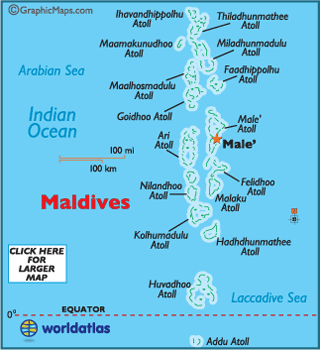
Maldives, India's oceanic neighbor in the south, surfaces in the media but once in a blue moon - often for the attempted coup plots, with a tailor made role for India to thwart them. The nature and consequences of what happened on 7th of February this year forcing President Mohamed Nasheed, the first to be democratically elected in the history of the nascent republic, to resign his post, is still being debated in the concerned diplomatic and political quarters. India has, in the meanwhile, rushed its two top diplomats to help restore calm in troubled political waters. These entire goings on made me look back and reflect with the mellowed wisdom of decades of hindsight on my own 555 consecutive days of duty as an envoy of India to this country of a garland of islands of the Indian Ocean.

I may start with a bit of a startling confession. My worst fears about joining the Indian Foreign Service with duties of 'lying abroad' had indeed stared squarely in my face during the first posting abroad to Tehran where I had joined on September 29, 1975, the day of the anniversary of the martyrdom of the 1st Shia Imam, Ali. My wife and I had lost, suddenly and quite prematurely, our fathers at ages 56 and 58, in December 1977 and April 1978 respectively. We, the eldest in the families, were feeling an overwhelming burden of emotional responsibilities. I was advised by sympathetic colleagues to make a representation to the 'dear Ministry' requesting for the next posting in one the 'neighboring countries' on 'compassionate grounds'.

The invisible and inscrutable hand of 'Mighty Ministry' struck like a proverbial 'bolt from the blue'. I was posted to, what appeared to me, the most mysterious piece of planet Earth, which could technically or more appropriately 'geographically', be termed to be situated in the neighborhood of Bharat! In the afternoon of the 'Bag Day' on 7th Sept'78, the friendly but often stressed Private Secretary to Ambassador V K Ahuja breezed into my room and intriguingly scribbled 'MALE' in my table diary. I reflexively quipped, "Bhadgal Sahib, who has been blessed with a son?" Her returned to my room after the 'bag fever' had subsided and explained to me that I have been posted to Maldives and that 'Male - pronounced Maa-Le' was the name of its capital! I continued to be in a state of shocking disbelief about the decision of the Ministry over my petition for a posting to a place in the periphery of the country. Before leaving office for the day, Ambassador Ahuja called for me and told me, holding the letter of the Ministry in his hands, that I have been posted as Charge D'Affaires in the recently established Embassy in the Republic of Maldives and added, "You will be the monarch of all you survey."

I was literally and metaphorically 'at sea' about my posting to Maldives and even considered making another representation to 'Dear Ministry', a recourse Ambassador Ahuja firmly rejected. Meanwhile Iran had started witnessing street processions with the students in the forefront. The protests gathered strength and had culminated into crippling strikes by end of November. I was able to sell my car but had to leave my TV and refrigerator with Shri Bhadgal to salvage some reasonable amount. The professional packers had become unavailable in view of the disturbed conditions. We packed our wares in the Indian style to catch the last civilian flight departing in the late evening of 11th December from Mehrabad Airport just before the revolutionary guards took it over. The Ministry had turned down my request for a brief leave in India, even a week's consultation duty in the Ministry during the transit in Delhi. Leaving my wife and four year old son behind, I reported in Male on 12th December 1978, flying Indian Airlines up to Trivandrum and further by a small Avro plane.

Like most of the Punjabis and a majority of the north Indians, I had the least opportunities to see the sea in its magnificent moods. Many in Punjab wondered what the hell promising singer Ishmeet who had crowned Voice of India had gone to do in Maldives in July 2008, but driven by the destiny of a watery grave! I remember how my well read school teacher Giani Sucha Singh Ji was singing songs of the sea after having actually seen the ocean in Bombay for the first time - he was at great pain for more than a month to explain how what we read in books could not exactly convey the vast expanse and massive might of the real oceans which cover the four-fifths of the surface of the planet. I myself had 'Sagar darshan' as late as in Feb 1973 during the offical Bharat Darshan tour and later around Nourouz in March 1977 in Iran during travels with Dr SS Johl who was then serving in Iran as ans adviser with UNDP.

When I reached Maldives, President Maumoon Abdul Gayoom had just taken over as President. India was the first country to open diplomatic mission in Male, to be followed by who else, but Pakistan!

My predecessor in Maldives, a well meaning Tamilian who had risen from the ranks (he was reputed to be an expert in 'decoding' the handwriting of Shri TN Kaul, I.C.S., had been at logger heads with the India experts on deputations particularly the school teachers. The State Bank of India and the Indian Airlines wielded a larger presence, and an obvious clout, than the embassy, a Padmini Fiat, imported from India came with some manufacturing defect and could never function properly and the local driver, in disgust, had once pushed it in the sea! The International Airports Authority of India (IAAI) was executing the project of Hulule Airport. It was indeed a challenging task with even the soil and sand imported from India and the German Consultants engaged by the donors, the Kuwait Fund pressing hard on the quality of the work. The project proved to be a long drawn affair with series of controversies it was being said that everyone had made a good profit out of it except the contractors, i.e. the IAAI.

Let us know more about our lesser known neighbor. Maldives, also earlier called Maldive islands now, formally Republic of Maldives, Divehi Jumhurriyyah consist of a chain of about 1,300 small coral islands and sand banks. They extend in Indian Ocean for more than 820 Km from North to South and 130 Km from East to West. The Maldive Islands with a total land area of about 298 sq Km is built of coral on the crowns of an ancient submerged volcanic mountain range. All the islands are incredibly low lying, none rising more than 6 feet above sea level. The clusters of islands or atolls have sandy beaches, lagoons and luxuriant growth of coconut palms, breadfruit trees and tropical bushes. The tourism potential of the country was envisioned in seventies by the western tour operators and several islands around capital Male were developed with necessary facilities. The chartered flights from European countries to this 'Paradise of Sun, Sand and Surf' have indeed transformed the entire life pattern of the people of Maldives. Fishing and shipping are the other pillars of the economy of the country. The smallest in term of land surface and the ocean arrested Maldives scores over other members of the South Asian community in several vital indicators of socio-economic development including education and health with only 16 percent of its total population of about 400,000 counted below poverty line.

I had tried to cope with the most trying conditions of living in terms of the hot and humid climate (no air conditioning) and non availability of the provisions of daily food, particularly the vegetables. The medium of cooking was kerosene stove. The rain water was collected in a well and boiled for drinking. The messenger cum-driver Mohamad Naeem who had served in a ship and had also lived in Mumbai, was very efficient and dedicated young man. The other house help Ismail would ask us when we would go to our island! A snake was found near the refrigerator and there were too many large sized lizards and chameleons roaming about the house making my wife run in panic.

Male, and island of one and a half sq Km, wore a neat and clean look. But during the rains the streets became pools of water for days. I had not imagined all this to be a part of the Indian Foreign Service. The only advantage of this experience was, perhaps, that we became toughened to face any odds in future.

The 16 mm projector in the embassy proved to be a real blessing. We could screen several popular feature films received from the Ministry; I do recall that we had repeatedly screened Kora Kagaz, Garam Hawa, Shatranj Ke Khilari and Satyajit Ray's Gopi Gayan Bagha Payan. We could also arrange the facilities for Table Tennis and Badminton which became quite popular involving Maldivian officials also. I started building up a small library. I particularly remember having read there Balwant Gargi's Naked Triangle among many other books. The Radio Maldives played popular film songs and the only so called cinema showed pirated copies of Indian films using several TV screens. The audio cassettes were becoming popular and the two in on sets were indeed considered a prize item.

The interaction with a few Pakistanis in Maldives proved quite interesting. The Pak CDA Amir Mohammad Khan, an elderly gentleman with four pretty young daughters had been transferred from Kenya. I remember that he gifted me a cassette of songs by Didar Singh Pardesi. My staff member Gurchetan Singh told me one day that Hanif of Pakistan embassy had greeted with Sat Sri Akal saying that he was a Punjabi with ancestral link with Hoshiarpur and had further added that it was nice that the CDA of India was also a Punjabi. Gurchetan said that when he asked bout the Pakistani CDA, Hanif had replied that 'he was from UP/CP'. It was my early lesson in the ethnic divides and the Mohajir issue. The manager of Habib Bank, Baz Mohamad Khan and his charming family had been very friendly towards us. He surprised me by telling, on the eve of my departure, that Parvez Hasan Cheema (he too professed great friendship with me), the Maulvi, religious instructor, deputed by the government of Pakistan in Maldives, had complained to the Pak authorities against him for being friendly with me. Baz Mohamad added that such so called religious but foolish people as Cheema posed a serious threat to not only the good relations between Indian and Pakistan but peace all over the world. How prophetic from someone belonging to the tribe of Badshah Khan!


Saturday, August 27, 2011

Sufism - An Integrating Path to Peace

The following article was published in the bi-annual journal 'Studies in Sikhism & Comparative Religion', Vol.XXIX, No.1, January-June 2010, Guru Nanak Foundation, New Delhi


Music - the Soul of Sufism,
Golkonda, circa A.D. 1660-1670
How, why and when the concept of creation and preservation of all the animate and inanimate beings on planet earth and the entire gamut of universe around it got attributed to an Invisible yet All Pervasive Power - call it God or by one of other countless names in myriad of languages - originated has remained as mysterious a secret as ever for all the most diligent, dedicated and the cleverest inquisitive seekers. The 'Godhood' has been the most ennobling uniting as well as single deadliest divisive force in the history of humanity. It could be concluded with all the evidence available in the most authentic chronological details that all the big battles fought by the mightiest and - even those considered wisest and noblest - of various rulers were, after all, for meager earthly gains and soundly selfish reasons, though often invoking unearthly and 'higher heavenly' considerations in the names of new and ancient faiths. It is, therefore, with a much greater degree of solace that one can turn to the mystical Islam, popularly known as Sufism, for its emphatically stated principles of promoting a deeper sense of fellow feeling among practitioners of the different faiths envisioned in different segments of the only a planet proven inhabited by the species that has dared to conjure up the most fascinating 'dream-like-reality' of Godhood .

Interestingly, it was not till as late as early nineteenth century that the Western scholars of Islam popularised the term 'Sufism' for Islamic mysticism - then called Tasawwuf, literally to dress in wool, in Arabic, and Sufi being itself an abstract word from Suf - wool - obviously a reference to the coarse woolen garments worn by early Islamic ascetics. The words fuqura, plural of Arabic Faqir and Persian darvish - both meaning the 'poor' also used for the Sufis soon got elevated to be words of English. Though the sources Islamic mysticism have been variously traced to non-Islamic traditions - the Prophet is quoted, "There is no monkery in Islam", it is now widely accepted that the elements of the ideology emerged as a reaction and counter measure to 'increasing worldliness' and luxurious living of the fast expanding Muslim community of Arabs as rulers in the near and far flung new territories with many of them of them having highly developed religion-cultural traditions. The Sufis sought to solace and calm down the people by exhorting them to deepen their spiritual well being - and they were viewed better than the stern sharia enforcers. The Sufis were soon in the forefront of the missionary activity in the rapidly growing Islamic world. It goes to the credit of Sufis that they imparted a wider and more acceptable imagery to the Prophet and enlarged the scope of Muslim Piety. The creative Sufis gifted with literary accomplishments skillfully employed the local languages, often bursting out in sublime poetry, in the service of spreading Islam in Iran, Turkey, India and lands far, far beyond.


Heavenly Attraction (detail)
Mahmoud Farshchian, 1990
The evolution of Islamic mysticism included the stages of early asceticism and constant meditation in the pious circles as reaction against materialism that had set in during Umayad period (661-749). This was followed by increase in the fraternal groups of Sufis. It was Rabiah al-Adawiyah, a young lady of Basra, who is credited with developing the Sufi ideal of a love of God - seeking no reward of Paradise, having no fear of hell. The Iraqi school of mysticism founded by al-Muhasibi (d-857), further advanced by Junayad of Baghdad (d-910), laid emphasis on strict self control and 'purging of the soul' and tawakkul - absolute trust in God. The Egyptian Sufi Dhu an-Nun (d-859) introduce ma rifah - interior knowledge - in contrast to 'learnedness', while Iranian Abu Yazid al-Bistami (d-874) contributed the significant concept about annihilation of self, Fana - the sparkling symbolism that ignited the imagination of generations of later day brilliant mystical poets. The theosophical theorists of mystical dimensions of man's sojourn in this world and the Immensity of the personality of Prophet could not be far behind. This trail blazed by Sahl at-Tustari (d-c.896) was diverted to dazzling heights by his disciple al-Husayn ibn Mansur al-Hallaj whose proclamation, Ana al-Haqq "I am the (creative) Truth" - derived from the thesis that God created Adam, "in His own image" - so infuriated the theologians of Shariat that they got him executed in 922 in Baghdad. Mansur, in his death, was soon to be consecrated as the, 'martyr of love' and his poems and other writings are considered the most exquisite examples of mysticism around the personality of the Prophet. Adopting an attitude of not needlessly provoking the orthodox theologists, the Sufis operated in smaller circles during the earlier centuries of Islam. They preferred to underline their adherence to established theological traditions. Abu Hamid al-Ghazali (d-1111), in his numerous writings including Ihya Ulum ad-din - the Revival of Religious Sciences - advocated moderation in the tendency in mysticism of equating God and the world.

The 13th century witnessed a further crystallization of the Sufi thoughts. The Spanish born Ibn al Arabi, elaborating on the relation of God and world and the underlying divine reality, put forward the theory of, "Unity of Being". The Egyptian Ibn al-Farid, the Persian Farid od-Din Attar (d-c.1220) wrote the finest mystical poetry while Central Asian Najmuddin Kubra discussed at length the psychological experiences of the mystics. It was, however, the poetic-philosophical genius of Jalal ad-Din Rumi (1207-'73) whose Masnavi in about 26000 couplets, dedicated to his mystical-master-beloved Shams ad-Din of Tabriz, is a rare compendium of broader religious ideas. Rumi became inspiration for whirling dervishes who promoted elaborate dance rituals and music for 'purificatory ecstasy' of the soul. Rumi's mystical poetic strains found resounding echoes in works of his younger contemporary Turkish Yunus Emre and Egyptian ash-Shadhili (d-1258). This was the period when Sufis became torch bearers of message Islam across the continents. The encounters with the Hindu traditions of mysticism encompassing the idea of divine unity and the Buddhist practices in Central Asia of life in Viharas in closer proximity to people for their service and welfare not to speak of the adversarial proximity with some grudging admiration for activities of social service by the Christian and even Jewish seminaries. The Sufis were inclined to pick up relevant elements from here and there in the cultures of alien lands as long they could serve the purpose of spreading the message of Prophet in conformity with the evolving Islamic Sunna. They were guided by the divine wisdom contained in the Quran, 'to be interpreted with increasing insight'. The doctrine of the Last Judgement; the assertion that, 'God loves them (mankind) and they love Him'; the strictly regulated life of Prophet - all provide the strong spiritual anchor of Sufism. Another fundamental concern in Islam has been Tawhid, "There is no deity but God" which thinker Junayd Baghdadi (d-910) had tried to explain, "Recognising God as He was before creation". The two aspects - God and creation - as one Immanent reality, Wahdat al-Wujud, were further reinforced in terms of Tawhid to mean that there is nothing existent but God.

Though Sufism had certainly been developing a distinct character by the twelfth century, great Sufi saints in the length and breadth of the vast Islamic empire were not rigidly disposed to fine tuning the nuances of the faith when under compulsions of commandments of the kings and what would work with the people. The Sufi influence in India came from north west when Shaikh Ali Hujwairi (d-c1079), widely known for his work Kashf al-Mahjub, settled in Lahore - his Shrine has been attracting a constant stream of devotees professing all faiths. Shaikh Muinuddin Chishti (1142-1236) estabilished himself in Ajmer after Shihabuddin Ghori defeated Prithvi Raj. Shaikh Bahauddin Zakaria(1176-1271), after blessing by Shihab al-Din Suhravardi of Baghdad, came down to Multan. The Sufi orders, silsilas, mentioned to be 14 in the Ain-e-Akbari had a vast expansion with the consolidation of Muslim rule in India - the most important being the Chishtia, Suhrawardia, Naqashbandia, Qadria, Firdausia, Shattria among the 'orthodox' and the Qalandars and Madars among the 'unorthodox'. With passage of time, many Sufi saints like Shaikh Muinuddin Chishti, Hazrat Ali bin Uthman - popular as Data Ganj Baksh - Shaikh Bahaauddin Zkaria, Shaikh Fariduddin Ganj-e-Shakar (1175-1265), Hazrat Nizamuddin Auliya, Hazrat Mian Muhammad Mir (1585-1655) have become the most adored ones with their tombs becoming places of pilgrimage and huge popular fairs. While most of the Sufi saints shunned the seats of power and kept a safe distance from the rulers even when sought after, some others were known to play politics and influence peddling. There were trying situations during struggles of royal successions which got murkier and bloodier in history and Sufi leaders had to pay for their proximity to the losers. Dara Shakoh, the crown Prince designate by Shahjahan was not destined to be 'the Sufi King of Hindustan': and his spiritual guide and friend Sarmad, the naked Sufi poet, became Mansur of India and Prince among martyrs of faith.


Celebration of Learning (detail)
Mahmoud Farshchian, 1993
The Sufism has indeed left a strong imprint not only on the socio-religious history of India but has also made lasting contribution in the realms of literature, arts, philosophy, music, crafts and other dimensions of national life. The Sufis were, in their own way, the harbingers of 'soft power' of globalisation and even the dialogue of civilizations in their times. The concept of composite culture of the sub-continent can be traced to doors of the khanqahs of the Sufis. The Sufi centres encouraged and provided for education and learning among the masses.The message of social equality, particularly against the curse of the Caste system in Hinduism was never conveyed so loud and clear in theory and practice as by the Sufi derveshes. They were often advocating the causes of the poor and the deprived sections of society. Being tireless travellers, the Sufis propagated bridging of narrow cultural divides. The twin towers of strength of Sufis were their aquida ie faith and ishq that is love - both for Allah and his makhluq - creation. To quote Hazrat Bayazid Bistami:

If you aspire communion with God / Be kind, generous and just to your fellow beings.
If you desire effulgence like the dawn / Be magnanimous to all, like the sun.


As for India, the partition of the country on the basis of an untenable communal ideology has involved the challenging task of renewal of values of communal harmony not only in in India but tellingly in predominantly Muslim Pakistan too - what the Sufis had tenaciously worked to accomplish. No wonder that the studies in Sufism have been increasingly encouraged in higher academic institutions and there is tremendous interest in the movement epitomising Majma-al Bahrain - Mingling of Two Oceans - Hindu and Muslim mystical ideas. The most palpable and profound impression of Sufism has been in literature of various Indian languages. The Sufi impulses have inspired the sublimest poetry with the celebrated saints preferring the local regional tongues for the most intimate communion about the universal divinity for all. The poetry of Ameer Khusrow, Baba Farid, Kabir and many more in Bhakti-Sufi tradition, not to speak of later Urdu, Hindi, Sindhi and Panjabi poets but also the idiom of progressives, indeed draw upon the core of the span and spectrum of the rainbow of India's Bhakti-Sufistic heritage.

According to eminent Urdu writer - thinker Ali Jawad Zaidi, the Sufis were indeed the pioneers in promoting Urdu using sayings - malfuzad - and Dohas to serve their missionary purposes. Sheikh Gangoi was a great poet of Braj Bhasha and also wrote in Hindi under the pen-name of Alakhdas. The echo of Sufi sayings and ideas is apparently distinct in hymns of Namdeva (1270-1350) of Marathwada. Kabir (c1399-1515), the weaver, has been rightly hailed as one of the most popular saint poets of India who wove magic in a simpler language to convey his forthright views on the prevailing socio-religious hypocrisy. The celebrated Hindi critic Acharya Hazari Prasad Diwedi has commented that, "Kabir had a rare and powerful grip on language...he had no peer in the use of to satire and irony...he hit (hypocrites) so hard in simple and chaste words that the target had no choice but flee in surprise...he indeed holds a unique position in the millennium of Hindi literature". Kabir says it all in his inimitable way:

Main kahta hun ankhi dekhi / tu kehta hai kaagaz ki lekhi
I speak of what I observe; you are quoting the writing on a piece of paper.


Among other saint poets in the fraternity of sufis, mention must be made
of Sant Dadu Dayal, Mallookdas, Dharam Das and the Prem Marg - love path - saints like Kutuban of Jaunpur, Mamjhan who wrote Madhumalati, Malik Mohammad Jaysi of Padmavat fame, Usman of Ghazipur etc. The land of Sindh, the seat of the earliest civilization on the banks of the legendary river which has imparted its name to the country, had its own intimate interaction with Sufism with the mystical domain of Sindhi poetry led by Qazi Qadan (1463-1551) followed by Shah Abdul Karim (1536-1623) known for his beautiful Baits, Shah Inat (c1623-1712), Shah Latif (1689-1752) famous for long wail of firaq - separation - in Risalo and Sachal Sarmast (1739-1812) who composed beautiful kaafis and Ghazals. Sindhi sufi poets were also great integrators and remained above any narrow sectarian and religious divisions - Shah Abdul Latif says: Bestowal is regardless of caste and creed, all who seek may obtain Him!

It was however,among people of the land of five rivers, always fertile for fresh and healthier all embracing ideas since ages, that Sufism was received with enthusiasm and deeper commitment. Shaikh Baba Farid should be considered among the major figures of renaissance in India whose spiritual insights remain valid even after eight centuries. The inclusion of Farid's evocative hymns and shlokas in the Granth Sahib compiled by Guru Arjan Dev has been a subtle point of reference in the realm of theology in India apart from their literary merit. In the words of Prof Attar Singh, "By admitting these verses into the Guru Granth Sahib, Guru Arjan Dev no doubt added a new dimension and lent them universality by juxtaposing them with religious writing drawn from other traditions." It is interesting to study the medieval Bhakti, Sufi and Sikh poetry to discover that they were all 'struggling against the deadening enslavement to orthodoxies of religions'. Prominent Punjabi Sufi poets including Sultan Bahu (1629-1691), Bulle Shah (1681-1757) and Ali Haidar (1690-1785), following the path shown by Farid, had reacted sharply against indignities based on religion at the behest apparently of Naqashbandis. Even though the process dialogue initiated by the Sufis had a set back in the background of historical circumstances of bloody wars of succession between the Mughal Princes, the frame work of reference for reconciliation had got registered for ever in the minds of a vast majority of people.

What is the contemporary relevance of ideas propounded by the Sufis of sub-continent? Annie Zaidi, a young journalist, has narrated in a charming essay titled, A Little Bit Wild in the Faith Department in her recently released book how generation of young people like her in India - in South Asia as a whole - are irresistibly drawn towards Sufistic ideas and symbols, particularly the music and poetry popularised by Nusrat Fateh Ali Khan's clan and Rabbi Shergill's evocative, Bulla Ki jaana main kaun? not to mention legions of popular singers of of folk tradition and Bhajan circuit led by Hans Raj Hans. The films have also immortalised gems of Sufi poetry. The Deras of different persuasions are comfortable accommodating the Sufi values and some of them like the Radha Soami Satsang Beas have published scholarly commentaries and translations on the works of Sufis like Sarmad, Shaikh Farid, Bulleh Shah etc. The famous Sufi shrines are receiving devotees - expectant visitors - in hundreds of thousands. The state machinery would also appear to be well disposed towards the Sufi heritage in the region. The historians in India have no credible theory to explain mass conversion of people to Islam in India. Harbans Mukhia refers to an essay of 1952 by Prof Muhammad Habib stating that caste oppression might have been a crucial factor among the lower strata of the society. Interestingly, the largest conversions have taken place between mid 19th century and 1941 when Sufism had been in decline due to internal weaknesses. Some Islamists of the Fundamental kind, particularly the Deobandis, likened to Saudi Wahhabis, have been critical of several Sufi practices including the adoration of tombs. It is sadly true that all the faiths proclaim to unite people but every faith has its share of sharply divisive - many times violent - controversies.

In Sufi poetry, the sojourn of a person in the world has been symbolised as musafir - a wayfarer - and a saudagar - a trader - while the world itself is called a Sarai - inn - in the way where traveller / trader has a short stay. Bulleh Shah wishes to travel far, too far to find the Invisible Beloved:

Bindraban me gaooa charae / Lanka charh ke naad vajae
Makke da Haji ban aae / vahva rang vatai da
Hun kisto aap chhapai da!
You graze cows in Brindaban / You sound victory horn in Lanka
You change colors so wonderfully / From whom are you hiding now!


The 21st century had promised to be different for humanity but a decade later the world finds itsef deeply enmeshed in the ancient conflicts of the religious kind - fancifully termed 'clash of civilizations' - with weapons of total annihilation still proliferating while the life sustaining precious natural resources and ecology are fastly dwindling threatening life again in toto! One intuitively turns to pray with words of the Sikh scripture Guru Granth Sahib,

Jagat jalanda raakh le, apni kirpa dhar
Save this scorched earth, O Lord, with your bountiful mercy


____________________________

Author's father striking notes of Sufi-istic harmony and innocence
Circa, 1952

____________________________


Sunday, February 20, 2011

Faiz A. Faiz - Romancing the Revolution

Since my return to Delhi in retirement in 2004 after crisscrossing the continents for consecutive 21 years-including 777 days in Pakistan during 1992-94 - my 1st day of the new year has been invariably celebrated attending the day-night cultural function dedicated to the memory of Safdar Hashmi. Safdar was a political street-theatre activist in mid–thirties of his life when he was martyred on this day in 1989 by goons of a Party never tired of invoking the name of Mahatma Gandhi. This multidimensional event showcasing music, drama, poetry, painting, book-sale/souvenirs, etc - all embracing revolutionary, secular, progressive causes - has come to personify the touching simplicity and dignity of nostalgic grandeur of all that the Marxist and progressive ideology has stood for. The themes of 150 years of 1857 / Birth Centenary of martyr Bhagat Singh; threats to freedom of expression of artists and tribute to Chhatisgarh - theatre fame Habib Tanvir have been the focus of special celebration in the recent years. I have been expectantly looking forward to what signature tune - and tone - of the national cultural consciousness would be ushered in for the new year in the lawns of Vithal Bhai Patel House, boasting an all-weather-withered grass!

It was indeed immensely impressive and appropriate to find that it was ‘Faiz Hi Faiz’ as the theme of the year 2011 to herald the year long activities in India, Pakistan and all over the world - where ever a few ‘Deewanas - aficionados’ of Ghalib and Gorakhpuri’s medium of poetic expression happen to lie! As on 13th February, the 100th birth day of Faiz (1911 - Nov.20, 1984), more than 60 countries have already announced various kinds of functions dedicated to the memory of the poet with a global vision of the relentless struggle for the freedom, justice and dignity for the oppressed and exploited humanity. The internet has surely become the most potent instrument of revolutionary upsurges in ‘globally-wired-connected community’ - including the celebration of centenary of Faiz. The poet of people would have certainly penned his most lyrically eloquent poem in praise of ‘internet’ which has united the largest ever number of people in history!

The Safdar Hashmi Memorial Trust (Sahmat) function was indeed a very generous (the word, ‘Faiz’, interestingly means generosity, bounty, beneficence) and imaginative treat for the indulgent and ‘well-versed’ audience which included Minister Jai Ram Ramesh (not the slightest protocol fuss) and controversially dazzling Arundhati Roy not to speak of so many stalwarts of the progressive platforms led by historian Prof Bipin Chandra and jeans-shawls adorned youthful Tulba-university students. The Shamiana venue was tastefully decorated with the calligraphic posters of proverbially quoted shae’rs - poetic couplets - of Faiz. The popular lyrics - Ghazals - of Faiz were soulfully sung by Rekha Raaz while recitation of select Nazms - longer compositions - by film-maker activist Sohail Hashmi and scholarly Syeda Saiyidana Hameed were a rare delight to listen - in their impeccable Tallafuz-accent of Urdu which Faiz himself might have envied!

The solid and the most significant content of Sahmat function was, of course, the release of the ‘Faiz Centenary Special’ commemorative issue of quarterly in Hindi, ‘Naya Path - New Path’, Vol. 24, Issue 4, Oct.-Dec. 2010, Price Rs 100. The journal is an organ of Janvadi Lekhak Sangh - Peoples’ Writers Union. The impressive publication of 432 pages, with four portraits of the poet by eminent artists is indeed a collectors’ item for Faiz aficionados. The editorial under title, 'Yun hi uljhati rahi hai zulum se khalaq - the people have, for ever, risen against tyranny’ underlines that celebration of Faiz’s birth centenary is becoming a part of the incessant struggle of the oppressed against the oppressors. Faiz was a firm supporter of friendship between India and Pakistan and considered it to be vitally important for peace and prosperity in the region and beyond. He remained in the forefront in the movement for restoration of liberal democracy in Pakistan and his ideas expressed in exquisite poetry were indeed a source of strength, inspiration and solace for the terrorized masses. It is particularly pointed out that the publication has brought forth for the first time the views of younger poets of Hindi explaining how they are indebted to Faiz for their creative energy and inspiration. The special number has four parts - titled respectively, the Mirrors of Memories; Conversations via Letters; Faiz’s Select Poetry/ Essays and In the Eyes Literary Critics. The publication has even endeavored to bridge the Urdu-Hindi divide by explaining meanings of less familiar words in the select poetry in it.

The Faiz Centenary Calendar, 2011 released by SAHMAT has 6 evocative paintings by M F Hussain - 'Faiz - A Portrait'; 5 paintings with quotations of Faiz poetry - Aaj ke naam aur aaj ke gham ke naam… to the present and sorrows of present…; Zuban pe mohar lagi hai to kya… It matters not that the lips are sealed …; Mere Qatil, mere dildaar mere paas raho… my tormentor, my love, be near me…; Nisar mein teri galion pe ae vatan… I abandon myself defenseless to your streets ,my country…; hamne jo tarz e fughan ki thi qafas mein iizaad… lamentations which we had created in cage…. Mazrooh Sultanpuri is quoted proclaiming Faiz as the Meer Taqi 'Meer' of progressive poetry while Raghupati Sahai 'Firaq' Gorakhpuri observes that, "enlightened wisdom, sensitivity and artistic finess with which Faiz combined affairs of the heart with other social concerns was something novel and unique in Urdu poetry."

For me at a deeper person level, introduction to the poetic magic of Faiz was made some time in May 1956 during a local conference of the Communist Party affiliated Primary School Teachers Federation in my small town, near Ludhiana. I, freshly promoted to Sixth class, was hanging around the venue of the conference because my uncle, a teacher, was closely involved in organizing it. I can distinctly recall how the lines of Faiz’s celebrated 10 line poem titled, 'Tarana - Chorus Song’ recited by teacher Bahadur Singh had, as if, pierced into my soul. Later, I was to know more about this poem of Faiz but must quote first the memorable lines:


Ai Khaqnashinon, utth baitho,veh vaqat qarib aa pahuncha hai
Jab takhat giraye jayenge, jab taaj uchhale jayene….
Katate bhi chalo,barhte bhi chalo,bajoo bhi bahut hain,sar bhi bahut
Chalte bhi chalo ke: ab dere Manzil pe hi dale jayenge….

O, the oppressed, Rise up: Time has indeed arrived
When thrones will be pulled out, crowns will be tossed around
March ahead, even with limbs severed: arms are many, heads many more,
Press on, move forward; we would stop only at point of destination

The free translation by me cannot do justice to the ringing rhythm of the original. How fascinatingly strange that these very lines were echoing in my ears thirty two years later in the winter of 1978 in Tehran when I was a witness to surging street protests against the Shah of Iran!

I was further privileged in Tehran to enjoy the most instructive company of great poet and critic Ali Jawad Zaidi (1916-2005) who had himself been a leading light of progressive movement. Zaidi observes in his celebrated classic, 'History of Urdu Literature', "Faiz raised his voice in support of freedom of expression… He has created new symbols or imbued old ones with new meaning and has a knack for conveying … the most fiery sentiments in a misty tone which cast a spell on the reader … His real greatness lies in utilizing the traditional erotic imagery to express the patently social aspirations and conflicts without being obviously didactic about a theme which invites a semi-philosophical approach. He absorbs the agony of the wounds time has inflicted on his poetic being to recreate his experiences into a moving symphony of words."

When I landed in Lahore in the evening of 6th of September 1992, it was the lines of Faiz haunting my thoughts - "Ae roshnion ke shahar - O, city of Lights…" So many kind friends in Pakistan including Faiz’s poetic inheritor Ahmed Faraz narrated to me tons of anecdotes to bring out how Faiz was a (Sufi) saintly soul, a rare gentleman and a friend-philosopher to a generation of struggling creative individuals in Pakistan and India. The current state of affairs in Pakistan, particularly the atmosphere bloodily surcharged by the religious extremism in the wake of broad day killing on 4th Jan. of Faiz’s nephew, Governor of Punjab, Salman Taseer made Faiz’s daughter Salima to recall her father’s verse:

Jis dhaj se koi maktal mein gaya, baat yehi rah jaani hai.
Yeh jaan tou aani jaani hai, iss jaan ka rona kya kije.

The tale how proudly he walked to slaughter house, will endure forever
This life comes and goes anyway, what use is there to mourn its loss!

A statement made by Progressive Writers Association ( PWA) of Pakistan on Faiz centenary has emphasized, "…when identity of Pakistani people has been severely tarnished by self - appointed protagonists of Islam who are engaged in heinous crimes against humanity, there is no one better than Faiz to project the real self of the nation…". The PWA, Pakistan has invited all to protect and project all the ideals and central concerns of Faiz’s poetic vision. In Pakistan, the Association has called upon to promote peace and harmony amongst people of all races and nationalities, transcending religious, ethnic and linguistic differences and, globally, to represent Faiz as the ambassador of the soul and feelings of people of Pakistan, with the theme of Faiz centenary:

Aaiye hath uththaein ham bhi
Baraey aman-e alam aur insaani khushahali

Come, let us all raise our hands in prayer
For peace in world, and prosperity of all people

The two most esteemed souls I had the unique privilege to know and who knew Faiz so well - AJ Zaidi and Ahmed Faraz - would have surely more to add to the statement by PWA, Pakistan.


Wednesday, March 31, 2010

In time of terrorism, Pakistan seeks peace in Sufism

The following article appeared in the online publication South Asia Post, Issue 108 Vol IV, March 31, 2010

AT the first sight, it indeed appeared a bit intriguing to me to receive an e-mail invitation on 6th February for, 'International Conference of Writers & Intellectuals on "Sufism and Peace" to be held in Islamabad from March 14-16, 2010. That it was being organised by Pakistan Academy of Letters (PAL)/Government of Pakistan seemed OK but it was the name of Mr Fakhar Zaman, Chairman of PAL which was reassuring and made me inclined to think positively about my participation in it. Fakhar Zaman has been, like an inspired and dedicated Sufi, steadfastly pursuing the ideas of nourishing Indo-Pak forums for friendship and creative interaction.

The tougher question, of course, seemed to be the timing of the conference - the Sufi Discourse under the alarming shadow of terror looming large on all horizons in Pakistan!

While keeping fingers crossed till the last about availing this tempting opportunity of revisiting Islamabad after more than fifteen years, I soon started pondering over all the aspects of the topic of the Conference. I could recall how as a school child of seven, I was taken by my father to the dim lit Dharamshala for an evening of Sufi music by eminent Qawwals of Malerkotla who had come to perform during the Lohri festival (1952) in our village; all that I still remember is that they were singing one of the 'Qaafis' of Bulleh Shah with its refrain, 'Aap Yaar binan nee Rabb Rehnda...God cannot live without a devoted lover!' After a few years, I chanced to find a book at home, with its sides eaten by the white ants: it turned out to be, 'Rubbayiyat of Omar Khayyam' with a remarkable poetic translation in Panjabi with full rhyme by S. Gehal Singh, a Retired judge. I could soon learn several of them by heart - and can recite even today !

Later while doing my Intermediate in the Govt College Malerkotla during 1959-61, we had a textbook of Panjabi poetry titled, 'Purana Makhio', ie 'Old Honey'. Prof Iqbal Singh, a short and rotund Sardar migrant from District Jhang with his typically pronounced accent of Panjabi, particularly vowel 'o'-a tingling for us Malwais of South of Sutluj - taught us poetry of Baba Farid, Bulleh Shah, Shah Hussain, Sultan Bahu, Baba Vajid, etc, explaining at length the meanings and contexts. All that has endured with me and how ecstatic to listen that poetry sung by talented singers like Jagjit Singh (class fellow in 1961-63), Hans Raj Hans, Jasbir Jassi etc. While doing my MA in English in Goverment College Ludhiana, we knew from friends doing MA in Panjabi how Prof Gulwant Singh was an authority on Sufism and Prof Pritam Singh has done a scholarly research on Baba Farid. After joining Indian Foreign Service, my first posting was to Iran and a rare satisfaction for me was the opportunity on 22nd March, 1977 to have made pilgrimage to Omar Khayyam's mausoleum in Nishapore. I could visit monuments of Hafiz & Sheikh Saadi much later in 2000. In Spain, I could visit the monastery of Saint Teresa of Avila (1515-1582 AD), the Christian soul - sister of celebrated Sufi saint Rabiah of Basrah(717-801 AD)

The terrorist’s attacks in Lahore on 12th March and anxiety expressed by family and friends in this context notwithstanding, I was able to take them into confidence and boarded evening flight to Lahore on 13th March, overruling fears by my wife, reminding me of lines in Julius Caesar. I was immensely relieved to meet at Indira Gandhi International Airport other friends including author Pran Neville (famous Lahori); former VC Jamia Millia Shahid Mahdi;the veteran of AIR and eminent Urdu poet Zubair Rizvi; Satish Jacob of BBC fame who were also braving to travel to Islamabad. We were soon in legendary Lahore and were able to reach Islamabad before the change of date. The made to order beautiful capital of Pakistan is often described in words of poetic wit including its splendid isolation from the mainstream hustle bustle of life in Pakistan. The security 'Bandobast' was writ large all around - the 'masti and Josh-o- khrosh' was clearly missing, strikingly reminding me of period of long night of terror in our own Panjab. How long would the shelf life of terror be for our neighbour? I deeply felt like offering prayers to all the Sufi saints of the subcontinent for peace within and progress around for all the people of this ancient civilization!

Coming to the Conference, Mr Fakhar Zaman and his dedicated team of PAL colleagues presented a picture perfect in terms of courtesy, hospitality and facilities for delegates of more than thirty countries. The Pakistani writers and academicians were well represented. About 40 papers were presented on different dimensions of Sufism and Peace. Fakhar Zaman had himself set the parameters in his inaugural address dwelling on the role players by writers in the revolutionary progressive movements in the of world, including Pablo Neruda, Andre Malraux, Camus and Faiz in Pakistan. The strong delegation of Sweden led by eminent poet and peace activist, Peter Curman, mooted the idea of, 'Peace Cruise in the Indian Ocean' of writers and intellectuals on the similar cruises earlier in the Baltic, Black and Aegean. In a departure from scheduled programme and amid tight security, the delegates were hosted and addressed by President Asif Ali Zardari at the President's House. Sardar Asif Ali, the influential Minister of Education, also participated in this function.

Mr Zubair Rizvi of India who was not listed to present any paper but was specially asked to speak gave an eloquently detailed account of of the strong manifestations in India of the Sufi inspirations in various realms of arts like dance, theatre, painting, music, etc. and mesmerised the audience by concluding with his popular poem, 'Aman ka Geet' Mr Tulsi Diwasa Joshi of Nepal was also listened with deep interest for poetic presentation profused with his poetry in English. Mr Salman Taseer, Governor of Panjab made an impressive address, qouting Allama Iqbal and other Sufi saints in the morning of of 16th March. Mr Mahmud Erol Kilik, a prominent Turkish scholar on Tasawwuf, presented a competent paper highlighting contribution of Ibne Arabi as a Sufi philosopher. I was suddenly asked to be in the presidium in pre-lunch session. I shared my intellectual and personal encounters of the Sufi kind, particularly highlighting the unique contribution of Sufi saints in the the spiritual and literary heritage of Panjab and that Baba Farid's poetry has been given the singular honour of inclusion in the Sikh scripture Guru Granth Sahib. There were several lady scholars who read interesting papers referring to message of love of humanity by Sufis irrespective of all divides. The cultural show with by students of University of city Gujrat on 14th March was impressive with background Panjabi Sufi poetry and, most surprisingly, Amrita Pritam's celebrated poem on Partition, 'Ajj Aakhan Waris Sha nun...I appeal to Waris Shah.’

The media attention to the Conference on a daily basis, perhaps as some calculated measure, seemed moderate though several younger TV reporters were at the venue and recorded interviews, particularly with the Indian participants to be telecast later. The TV channels seemed quite flourishing in terms of live discussions on current national issues. Mr Fakhar Zaman, in a briefing on 18th February, had said that Mohtrama Benazir Bhutto Shaheed had desired in her address to the International Conference on 'Literature, Culture and Democracy', held in Nov 1995 that such a Conference should be held, 'to highlight Pakistan's soft image in the world'.

The observers have pointed out that the rising tide of extremism and terrorism in Pakistan since 2007 had led even the Musharraf regime to turn to Sufism to counter 'Talibanized Islam' particularly after army action on the Red Mosque in Islamabad in July 2007. The PPP led Govt since February 2008 has two prominent Feudal Pirs in PM Youssaf Reza Gilani and the Foreign Minister Shah Mahmud Qureshi. The PPP Govt has revived the National Sufi Council and has been seen inching closer to Barelvi movement and sectarian groups opposed to Deobandis and the Taliban. It is pointed out that the number of Pakistani madarasas had grown from 250 in in 1947 to around 10,000 in 2002 with over 1,50,000 students attending them; currently their number is 13,000 to 15,000 with highest growth in southern Panjab. The cumulative Saudi support to these madarassa has been estimated in the range of U$ 70 billion. It has been observed by the knowledgeable sources that while the Wahhabis make up only 2% of world's Muslims, they have been using their huge oil revenues to marginalise moderate and tolerant Sufi philosophy. It is also noted that while some 60% of Pakistanis are 'Barelvis' with moderate interpretation of Islam have only 13% of madrasas, 19% 'Deobandi-Salafi-JI' conrol over 70% of the madrasas in Pakistan. According to Y. Sikand, an eminent scholar of Islamic affairs, in some Sunni-Deobandi madrasas, Jihad (Holy War) against Shias is as much a religious duty as jihad against non-Muslims: any space for culture of dialogue simply does not exist.

While in modern epoch, the US/West has to share some historical blame for supporting autocrats/tyrants in the Islamic world as well for having 'mid-wifed' the one dimensional Islamic radical sect to spite the former adversary, the Soviet Union, time has indeed come calling the Islamic political & spiritual leadership around the world to rise to the occasion to face the new millennium with the pristine truth and a fresh outlook. Islam, as the largest Faith of Humanity with the most magnificent civilizational contribution in the history of mankind, has to play a vital role in furthering the cause of peace and prosperity for race of Adam inhabiting this planet. To quote one of the verses of Maulana Jalal al-Din Rumi (1207-1273 AD) in which God tells Moses:

Thou had been sent by God, O Moses Not to divide but to unite His creatures.