Showing posts with label iran. Show all posts

Tuesday, March 20, 2012

My Ocean of Memories


This article was published in monthly magazine Identity, March 2012

Maldives, India's oceanic neighbor in the south, surfaces in the media but once in a blue moon - often for the attempted coup plots, with a tailor made role for India to thwart them. The nature and consequences of what happened on 7th of February this year forcing President Mohamed Nasheed, the first to be democratically elected in the history of the nascent republic, to resign his post, is still being debated in the concerned diplomatic and political quarters. India has, in the meanwhile, rushed its two top diplomats to help restore calm in troubled political waters. These entire goings on made me look back and reflect with the mellowed wisdom of decades of hindsight on my own 555 consecutive days of duty as an envoy of India to this country of a garland of islands of the Indian Ocean.

I may start with a bit of a startling confession. My worst fears about joining the Indian Foreign Service with duties of 'lying abroad' had indeed stared squarely in my face during the first posting abroad to Tehran where I had joined on September 29, 1975, the day of the anniversary of the martyrdom of the 1st Shia Imam, Ali. My wife and I had lost, suddenly and quite prematurely, our fathers at ages 56 and 58, in December 1977 and April 1978 respectively. We, the eldest in the families, were feeling an overwhelming burden of emotional responsibilities. I was advised by sympathetic colleagues to make a representation to the 'dear Ministry' requesting for the next posting in one the 'neighboring countries' on 'compassionate grounds'.

The invisible and inscrutable hand of 'Mighty Ministry' struck like a proverbial 'bolt from the blue'. I was posted to, what appeared to me, the most mysterious piece of planet Earth, which could technically or more appropriately 'geographically', be termed to be situated in the neighborhood of Bharat! In the afternoon of the 'Bag Day' on 7th Sept'78, the friendly but often stressed Private Secretary to Ambassador V K Ahuja breezed into my room and intriguingly scribbled 'MALE' in my table diary. I reflexively quipped, "Bhadgal Sahib, who has been blessed with a son?" Her returned to my room after the 'bag fever' had subsided and explained to me that I have been posted to Maldives and that 'Male - pronounced Maa-Le' was the name of its capital! I continued to be in a state of shocking disbelief about the decision of the Ministry over my petition for a posting to a place in the periphery of the country. Before leaving office for the day, Ambassador Ahuja called for me and told me, holding the letter of the Ministry in his hands, that I have been posted as Charge D'Affaires in the recently established Embassy in the Republic of Maldives and added, "You will be the monarch of all you survey."

I was literally and metaphorically 'at sea' about my posting to Maldives and even considered making another representation to 'Dear Ministry', a recourse Ambassador Ahuja firmly rejected. Meanwhile Iran had started witnessing street processions with the students in the forefront. The protests gathered strength and had culminated into crippling strikes by end of November. I was able to sell my car but had to leave my TV and refrigerator with Shri Bhadgal to salvage some reasonable amount. The professional packers had become unavailable in view of the disturbed conditions. We packed our wares in the Indian style to catch the last civilian flight departing in the late evening of 11th December from Mehrabad Airport just before the revolutionary guards took it over. The Ministry had turned down my request for a brief leave in India, even a week's consultation duty in the Ministry during the transit in Delhi. Leaving my wife and four year old son behind, I reported in Male on 12th December 1978, flying Indian Airlines up to Trivandrum and further by a small Avro plane.

Like most of the Punjabis and a majority of the north Indians, I had the least opportunities to see the sea in its magnificent moods. Many in Punjab wondered what the hell promising singer Ishmeet who had crowned Voice of India had gone to do in Maldives in July 2008, but driven by the destiny of a watery grave! I remember how my well read school teacher Giani Sucha Singh Ji was singing songs of the sea after having actually seen the ocean in Bombay for the first time - he was at great pain for more than a month to explain how what we read in books could not exactly convey the vast expanse and massive might of the real oceans which cover the four-fifths of the surface of the planet. I myself had 'Sagar darshan' as late as in Feb 1973 during the offical Bharat Darshan tour and later around Nourouz in March 1977 in Iran during travels with Dr SS Johl who was then serving in Iran as ans adviser with UNDP.

When I reached Maldives, President Maumoon Abdul Gayoom had just taken over as President. India was the first country to open diplomatic mission in Male, to be followed by who else, but Pakistan!

My predecessor in Maldives, a well meaning Tamilian who had risen from the ranks (he was reputed to be an expert in 'decoding' the handwriting of Shri TN Kaul, I.C.S., had been at logger heads with the India experts on deputations particularly the school teachers. The State Bank of India and the Indian Airlines wielded a larger presence, and an obvious clout, than the embassy, a Padmini Fiat, imported from India came with some manufacturing defect and could never function properly and the local driver, in disgust, had once pushed it in the sea! The International Airports Authority of India (IAAI) was executing the project of Hulule Airport. It was indeed a challenging task with even the soil and sand imported from India and the German Consultants engaged by the donors, the Kuwait Fund pressing hard on the quality of the work. The project proved to be a long drawn affair with series of controversies it was being said that everyone had made a good profit out of it except the contractors, i.e. the IAAI.

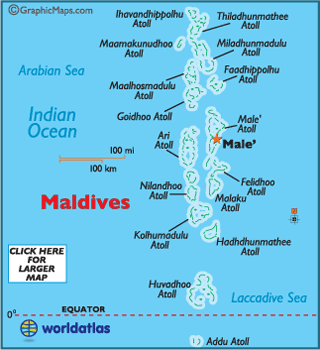
Let us know more about our lesser known neighbor. Maldives, also earlier called Maldive islands now, formally Republic of Maldives, Divehi Jumhurriyyah consist of a chain of about 1,300 small coral islands and sand banks. They extend in Indian Ocean for more than 820 Km from North to South and 130 Km from East to West. The Maldive Islands with a total land area of about 298 sq Km is built of coral on the crowns of an ancient submerged volcanic mountain range. All the islands are incredibly low lying, none rising more than 6 feet above sea level. The clusters of islands or atolls have sandy beaches, lagoons and luxuriant growth of coconut palms, breadfruit trees and tropical bushes. The tourism potential of the country was envisioned in seventies by the western tour operators and several islands around capital Male were developed with necessary facilities. The chartered flights from European countries to this 'Paradise of Sun, Sand and Surf' have indeed transformed the entire life pattern of the people of Maldives. Fishing and shipping are the other pillars of the economy of the country. The smallest in term of land surface and the ocean arrested Maldives scores over other members of the South Asian community in several vital indicators of socio-economic development including education and health with only 16 percent of its total population of about 400,000 counted below poverty line.

I had tried to cope with the most trying conditions of living in terms of the hot and humid climate (no air conditioning) and non availability of the provisions of daily food, particularly the vegetables. The medium of cooking was kerosene stove. The rain water was collected in a well and boiled for drinking. The messenger cum-driver Mohamad Naeem who had served in a ship and had also lived in Mumbai, was very efficient and dedicated young man. The other house help Ismail would ask us when we would go to our island! A snake was found near the refrigerator and there were too many large sized lizards and chameleons roaming about the house making my wife run in panic.

Male, and island of one and a half sq Km, wore a neat and clean look. But during the rains the streets became pools of water for days. I had not imagined all this to be a part of the Indian Foreign Service. The only advantage of this experience was, perhaps, that we became toughened to face any odds in future.

The 16 mm projector in the embassy proved to be a real blessing. We could screen several popular feature films received from the Ministry; I do recall that we had repeatedly screened Kora Kagaz, Garam Hawa, Shatranj Ke Khilari and Satyajit Ray's Gopi Gayan Bagha Payan. We could also arrange the facilities for Table Tennis and Badminton which became quite popular involving Maldivian officials also. I started building up a small library. I particularly remember having read there Balwant Gargi's Naked Triangle among many other books. The Radio Maldives played popular film songs and the only so called cinema showed pirated copies of Indian films using several TV screens. The audio cassettes were becoming popular and the two in on sets were indeed considered a prize item.

The interaction with a few Pakistanis in Maldives proved quite interesting. The Pak CDA Amir Mohammad Khan, an elderly gentleman with four pretty young daughters had been transferred from Kenya. I remember that he gifted me a cassette of songs by Didar Singh Pardesi. My staff member Gurchetan Singh told me one day that Hanif of Pakistan embassy had greeted with Sat Sri Akal saying that he was a Punjabi with ancestral link with Hoshiarpur and had further added that it was nice that the CDA of India was also a Punjabi. Gurchetan said that when he asked bout the Pakistani CDA, Hanif had replied that 'he was from UP/CP'. It was my early lesson in the ethnic divides and the Mohajir issue. The manager of Habib Bank, Baz Mohamad Khan and his charming family had been very friendly towards us. He surprised me by telling, on the eve of my departure, that Parvez Hasan Cheema (he too professed great friendship with me), the Maulvi, religious instructor, deputed by the government of Pakistan in Maldives, had complained to the Pak authorities against him for being friendly with me. Baz Mohamad added that such so called religious but foolish people as Cheema posed a serious threat to not only the good relations between Indian and Pakistan but peace all over the world. How prophetic from someone belonging to the tribe of Badshah Khan!


Sunday, February 20, 2011

Faiz A. Faiz - Romancing the Revolution

Since my return to Delhi in retirement in 2004 after crisscrossing the continents for consecutive 21 years-including 777 days in Pakistan during 1992-94 - my 1st day of the new year has been invariably celebrated attending the day-night cultural function dedicated to the memory of Safdar Hashmi. Safdar was a political street-theatre activist in mid–thirties of his life when he was martyred on this day in 1989 by goons of a Party never tired of invoking the name of Mahatma Gandhi. This multidimensional event showcasing music, drama, poetry, painting, book-sale/souvenirs, etc - all embracing revolutionary, secular, progressive causes - has come to personify the touching simplicity and dignity of nostalgic grandeur of all that the Marxist and progressive ideology has stood for. The themes of 150 years of 1857 / Birth Centenary of martyr Bhagat Singh; threats to freedom of expression of artists and tribute to Chhatisgarh - theatre fame Habib Tanvir have been the focus of special celebration in the recent years. I have been expectantly looking forward to what signature tune - and tone - of the national cultural consciousness would be ushered in for the new year in the lawns of Vithal Bhai Patel House, boasting an all-weather-withered grass!

It was indeed immensely impressive and appropriate to find that it was ‘Faiz Hi Faiz’ as the theme of the year 2011 to herald the year long activities in India, Pakistan and all over the world - where ever a few ‘Deewanas - aficionados’ of Ghalib and Gorakhpuri’s medium of poetic expression happen to lie! As on 13th February, the 100th birth day of Faiz (1911 - Nov.20, 1984), more than 60 countries have already announced various kinds of functions dedicated to the memory of the poet with a global vision of the relentless struggle for the freedom, justice and dignity for the oppressed and exploited humanity. The internet has surely become the most potent instrument of revolutionary upsurges in ‘globally-wired-connected community’ - including the celebration of centenary of Faiz. The poet of people would have certainly penned his most lyrically eloquent poem in praise of ‘internet’ which has united the largest ever number of people in history!

The Safdar Hashmi Memorial Trust (Sahmat) function was indeed a very generous (the word, ‘Faiz’, interestingly means generosity, bounty, beneficence) and imaginative treat for the indulgent and ‘well-versed’ audience which included Minister Jai Ram Ramesh (not the slightest protocol fuss) and controversially dazzling Arundhati Roy not to speak of so many stalwarts of the progressive platforms led by historian Prof Bipin Chandra and jeans-shawls adorned youthful Tulba-university students. The Shamiana venue was tastefully decorated with the calligraphic posters of proverbially quoted shae’rs - poetic couplets - of Faiz. The popular lyrics - Ghazals - of Faiz were soulfully sung by Rekha Raaz while recitation of select Nazms - longer compositions - by film-maker activist Sohail Hashmi and scholarly Syeda Saiyidana Hameed were a rare delight to listen - in their impeccable Tallafuz-accent of Urdu which Faiz himself might have envied!

The solid and the most significant content of Sahmat function was, of course, the release of the ‘Faiz Centenary Special’ commemorative issue of quarterly in Hindi, ‘Naya Path - New Path’, Vol. 24, Issue 4, Oct.-Dec. 2010, Price Rs 100. The journal is an organ of Janvadi Lekhak Sangh - Peoples’ Writers Union. The impressive publication of 432 pages, with four portraits of the poet by eminent artists is indeed a collectors’ item for Faiz aficionados. The editorial under title, 'Yun hi uljhati rahi hai zulum se khalaq - the people have, for ever, risen against tyranny’ underlines that celebration of Faiz’s birth centenary is becoming a part of the incessant struggle of the oppressed against the oppressors. Faiz was a firm supporter of friendship between India and Pakistan and considered it to be vitally important for peace and prosperity in the region and beyond. He remained in the forefront in the movement for restoration of liberal democracy in Pakistan and his ideas expressed in exquisite poetry were indeed a source of strength, inspiration and solace for the terrorized masses. It is particularly pointed out that the publication has brought forth for the first time the views of younger poets of Hindi explaining how they are indebted to Faiz for their creative energy and inspiration. The special number has four parts - titled respectively, the Mirrors of Memories; Conversations via Letters; Faiz’s Select Poetry/ Essays and In the Eyes Literary Critics. The publication has even endeavored to bridge the Urdu-Hindi divide by explaining meanings of less familiar words in the select poetry in it.

The Faiz Centenary Calendar, 2011 released by SAHMAT has 6 evocative paintings by M F Hussain - 'Faiz - A Portrait'; 5 paintings with quotations of Faiz poetry - Aaj ke naam aur aaj ke gham ke naam… to the present and sorrows of present…; Zuban pe mohar lagi hai to kya… It matters not that the lips are sealed …; Mere Qatil, mere dildaar mere paas raho… my tormentor, my love, be near me…; Nisar mein teri galion pe ae vatan… I abandon myself defenseless to your streets ,my country…; hamne jo tarz e fughan ki thi qafas mein iizaad… lamentations which we had created in cage…. Mazrooh Sultanpuri is quoted proclaiming Faiz as the Meer Taqi 'Meer' of progressive poetry while Raghupati Sahai 'Firaq' Gorakhpuri observes that, "enlightened wisdom, sensitivity and artistic finess with which Faiz combined affairs of the heart with other social concerns was something novel and unique in Urdu poetry."

For me at a deeper person level, introduction to the poetic magic of Faiz was made some time in May 1956 during a local conference of the Communist Party affiliated Primary School Teachers Federation in my small town, near Ludhiana. I, freshly promoted to Sixth class, was hanging around the venue of the conference because my uncle, a teacher, was closely involved in organizing it. I can distinctly recall how the lines of Faiz’s celebrated 10 line poem titled, 'Tarana - Chorus Song’ recited by teacher Bahadur Singh had, as if, pierced into my soul. Later, I was to know more about this poem of Faiz but must quote first the memorable lines:


Ai Khaqnashinon, utth baitho,veh vaqat qarib aa pahuncha hai
Jab takhat giraye jayenge, jab taaj uchhale jayene….
Katate bhi chalo,barhte bhi chalo,bajoo bhi bahut hain,sar bhi bahut
Chalte bhi chalo ke: ab dere Manzil pe hi dale jayenge….

O, the oppressed, Rise up: Time has indeed arrived
When thrones will be pulled out, crowns will be tossed around
March ahead, even with limbs severed: arms are many, heads many more,
Press on, move forward; we would stop only at point of destination

The free translation by me cannot do justice to the ringing rhythm of the original. How fascinatingly strange that these very lines were echoing in my ears thirty two years later in the winter of 1978 in Tehran when I was a witness to surging street protests against the Shah of Iran!

I was further privileged in Tehran to enjoy the most instructive company of great poet and critic Ali Jawad Zaidi (1916-2005) who had himself been a leading light of progressive movement. Zaidi observes in his celebrated classic, 'History of Urdu Literature', "Faiz raised his voice in support of freedom of expression… He has created new symbols or imbued old ones with new meaning and has a knack for conveying … the most fiery sentiments in a misty tone which cast a spell on the reader … His real greatness lies in utilizing the traditional erotic imagery to express the patently social aspirations and conflicts without being obviously didactic about a theme which invites a semi-philosophical approach. He absorbs the agony of the wounds time has inflicted on his poetic being to recreate his experiences into a moving symphony of words."

When I landed in Lahore in the evening of 6th of September 1992, it was the lines of Faiz haunting my thoughts - "Ae roshnion ke shahar - O, city of Lights…" So many kind friends in Pakistan including Faiz’s poetic inheritor Ahmed Faraz narrated to me tons of anecdotes to bring out how Faiz was a (Sufi) saintly soul, a rare gentleman and a friend-philosopher to a generation of struggling creative individuals in Pakistan and India. The current state of affairs in Pakistan, particularly the atmosphere bloodily surcharged by the religious extremism in the wake of broad day killing on 4th Jan. of Faiz’s nephew, Governor of Punjab, Salman Taseer made Faiz’s daughter Salima to recall her father’s verse:

Jis dhaj se koi maktal mein gaya, baat yehi rah jaani hai.
Yeh jaan tou aani jaani hai, iss jaan ka rona kya kije.

The tale how proudly he walked to slaughter house, will endure forever
This life comes and goes anyway, what use is there to mourn its loss!

A statement made by Progressive Writers Association ( PWA) of Pakistan on Faiz centenary has emphasized, "…when identity of Pakistani people has been severely tarnished by self - appointed protagonists of Islam who are engaged in heinous crimes against humanity, there is no one better than Faiz to project the real self of the nation…". The PWA, Pakistan has invited all to protect and project all the ideals and central concerns of Faiz’s poetic vision. In Pakistan, the Association has called upon to promote peace and harmony amongst people of all races and nationalities, transcending religious, ethnic and linguistic differences and, globally, to represent Faiz as the ambassador of the soul and feelings of people of Pakistan, with the theme of Faiz centenary:

Aaiye hath uththaein ham bhi
Baraey aman-e alam aur insaani khushahali

Come, let us all raise our hands in prayer
For peace in world, and prosperity of all people

The two most esteemed souls I had the unique privilege to know and who knew Faiz so well - AJ Zaidi and Ahmed Faraz - would have surely more to add to the statement by PWA, Pakistan.


Thursday, July 31, 2008

Humanistic roots of Islam

A Tribute to Shri A.J. Zaidi


  At the function with the Vice President of India, Shri M. Hamid Ansari
HAVING spent my childhood years in the village and later growing up in a town, both located in the closer vicinity of Malerkotla, the only princely state in the East Punjab ruled for centuries by the Muslim Nawabs, I had started wondering and pondering since long over the harmonies and divides between the Hindus and Muslims. The small state of Malerkotla had remained comparatively immune from the mindless violence during the Partition of the country. I have a vivid memory of an inscription, intact in 1951 but decimated soon after, of the name of Nawab Iftikhar Ali Khan on the front wall of the Gurdwara in Ahmedgarh for his donation of Rs. 500.00 – it must have been a princely sum in those days ! I had instinctively developed a faith in the mutual accommodation among faiths long before I was destined to be an Indian diplomat in Iran, Saudi Arabia, Pakistan and Maldives!!

This is a prologue to my tribute to late Ali Jawad Zaidi (1916-2004) who embodied for me the highest virtues of all the faiths of mankind. It was during the period of my posting to Iran in 1975-78 that I had opportunities of extended interaction with Shri S.A.J. Zaidi who had been posted as a Special Correspondent of All India Radio based in Tehran, covering other countries of the Gulf also. It was my first diplomatic posting, while it was the swan song assignment for Shri Zaidi.

I discovered in Shri Zaidi a thorough gentleman steeped in the composite culture of Awadhi Lucknow. He was soon able to gather around him many talented persons among the recently arrived doctors, engineers and other professionals interested in literature. A regular routine of literary meetings emerged attended by Indians and Pakistanis. Shri Zaidi made extra efforts to engage the Punjabi Sahitya Mandal also. It was his magnetic personality which brought people together for livelier literary sessions, particularly of Urdu, Hindi and Punjabi poetry. All this indeed provided me a rare learning opportunity to witness in action the strength of the composite culture of the sub-continent, notwithstanding the under currents of suspicions and rivalries of the Indo-Pak kind.

Never a person to talk about himself, I could some time engage Shri Zaidi to share some of his first hand experiences during the freedom struggle as a student leader and a poet. He had worked along with other youthful activists for the election in 1939 of Netaji Subhas Chandra Bose as President of the Congress against Pattabhi Sitaramayya, the candidate proposed by Mahatma Gandhi. He told me about the touching experience when Subhas Babu, as the President of the Congress, had himself come to meet the group of students putting up in an ordinary dharamshala in Calcutta for a mid-night session of discussions!

On being pressed to tell if he had ever met Mahatma Gandhi, Zaidi narrated how he and his two other student friends had got late for an appointment with the Mahatma - and received a severe reprimand from Sarojini Naidu. He, nevertheless, could meet the Mahatma during the same week, but did not touch Mahatma's feet like his the two friends accompanying him. After the brief meeting, however, according to Zaidi, his hands unconsciously were at the feet of the Mahatma!

Ali Jawad Zaidi had started with the themes of patriotism and national unity in his early poetry. He had the distinct advantage of knowing Hindi and Sanskrit. He was soon to excel as a scholar and critic also. It was in the fitness of the things that after Independence, he was inducted into the Indian Information Service. He was deputed as Adviser to Bakshi Ghulam Mohammad, the "Prime Minister" of Jammu & Kashmir - he distinguished himself in this position beyond the call of duty by producing admirable works on the literature and culture of Kashmir. He served as the Secretary of the High Powered Committee on Urdu headed by Shri I.K. Gujral. He was also the convenor of the Golden Jubilee Celebrations of the All India Students' Conference held in Lucknow in August 1986.

Shri Zaidi did not rest on his laurels after retirement. Apart from his multifarious responsibilities as Chairperson of the UP Urdu Academy and later as Advisor to the State Govt on National Integration, he wrote, in English, the monumental History of Urdu Literature, published by the Sahitya Academy in 1993. During the sunset years with failing eyesight, he was intensely occupied with the editing of the various versions of Ramayana written in Urdu. It is indeed noteworthy that four scholars have already obtained their PhD degrees for research on the literary works of Shri A. J. Zaidi. It is only appropriate that the Zaidi Foundation has been recently established to propagate literary and philosophical legacy of Zaidi Sahib. A large quantity of manuscripts left behind by him awaits scholarly scrutiny and publishing.

  Shri Ansari releases 'Islami Taraqqui Pasandi'

It was a solemn Function on 15th July, 2008 at his residence when 'Islami Taraqqui Pasandi' i.e., 'Progressivism in Islam' by late Shri A.J. Zaidi was released by the Vice President of India, Shri M. Hamid Ansari. Professor Ilyas Shauqui, the book's editor, highlighted the features of this highly researched and timely book. The former Vice-Chancellor of the Jamia Milia, Shri Shahid Mahadi, recalled his long personal association with Shri Zaidi. He quoted Shri Zaidi's lines:

Yeh To Sach Hai Kar Guzarta Hai, Jo Dil Mein Than Le
Kya Ghalat Hai, Log 'Gar Zaidi Ko Diwana Kahein.
It is indeed true that he does accomplish, whatever he determines to
The people are not wrong if they call Zaidi a crazy fellow!

Shri M. Hamid Ansari, in his thoughtful remarks, observed that the book was a commendable effort in putting the tenets of Islam in proper perspectives. He said that Shri Zaidi has demonstrated a rare capability to explain complex issues. He welcomed the publication of this book of great contemporary relevance.

Dr. A.S. Brar, the Vice-Chancellor of Lucknow University, proposing Vote of Thanks, dwelt on the role of Lucknow University in institutionalizing the memory of its great alumni. He said that there are opportunities in terms of an annual memorial lecture; a chair of national integration in his name; seminars on his seminal literary output etc. He remarked that a healthy competition with other relevant institutions to propagate the invaluable literary legacy of Zaidi Sahib would indeed be welcome.

While enjoying the wonderful company of many friends and admirers of late Zaidi Sahib during the tea following the Function, I was lost in the myriad memories of Shri Zaidi who became a kind of Murshid or a Guru as well as the most admired elderly friend for me. I quote the lines from his poem, 'Ajeeb Tanhaee', penned during his Sojourn in Iran:
Raasta Naapne Wale To Bahut Hain, Lakin
Inmein, Dekhein To Zara, Aabla Paa Kitnein Hain!

The surveyors of path are many
Look, how many of them have blisters under their feet!