Showing posts with label book. Show all posts

Friday, January 07, 2022

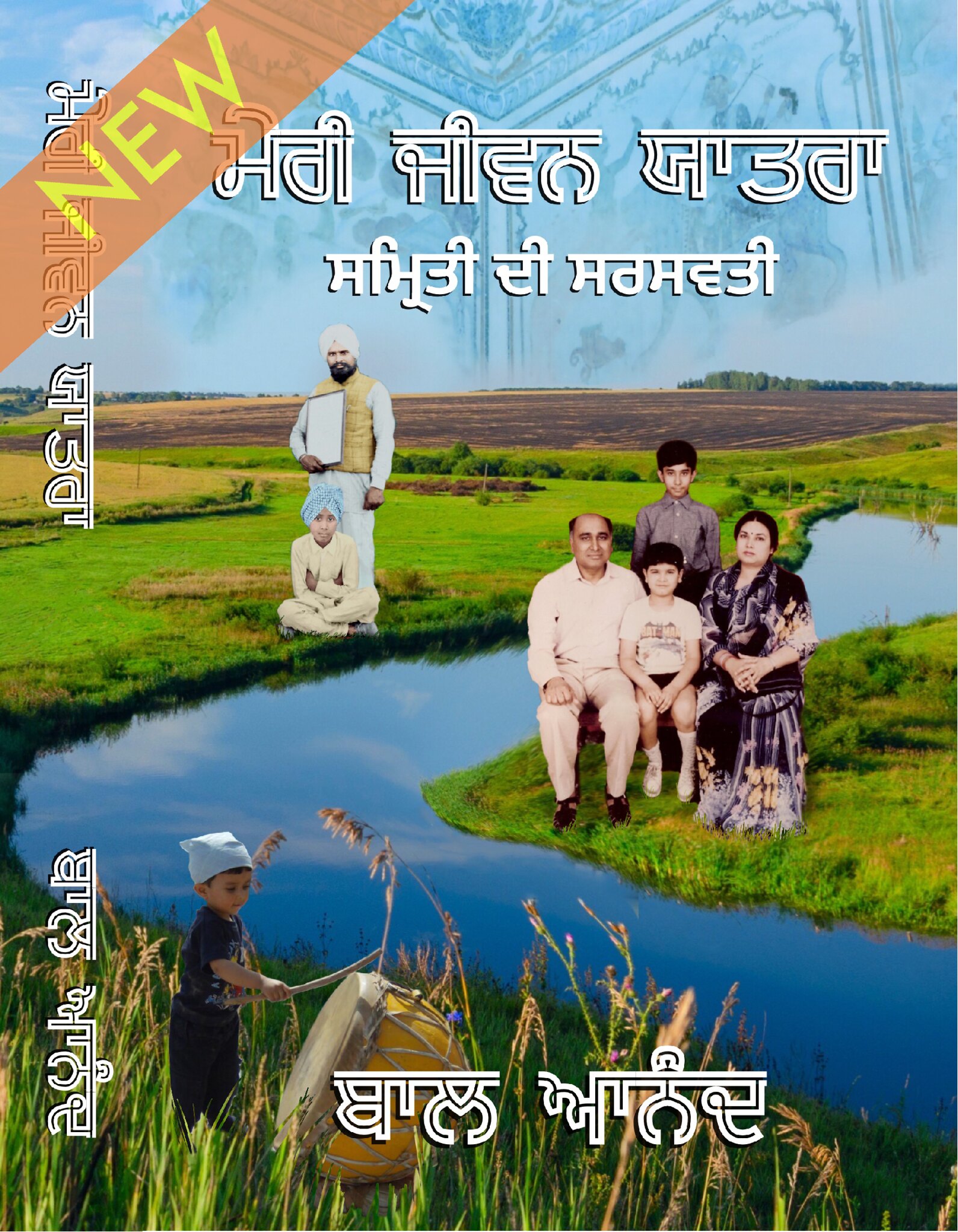
Meri Jivan Yatra, Smriti di Saraswati

Available in Amazon at 
https://tinyurl.com/4brn44rd

I present here my latest book, my autobiography, in Punjabi language

ਮੇਰੀ ਜੀਵਨ ਯਾਤਰਾ: ਸਮ੍ਰਿਤੀ ਦੀ ਸਰਸਵਤੀ

Meri Jivan Yatra: Smriti di Saraswati

Pilgrimage of My Life: A River of Reminiscences

Described in Amazon as

'Meri Jivan Yatra: Smriti di Sraswati - Pilgrimage of My Life: A River of Reminiscences'; 436 Pages and 24 pages of 96 rare photos.

This extraordinary narration, in Punjabi, by Ambassador Bal Anand (Born 1943) chronicles his marathon journey from a small village school to nine different capitals across the continents to represent India in 14 countries.

This amazing tale of many an unexpected twists in author's life has been told in a gently flowing poetic prose - with ripples of humor here and there. The reader is diligently taken along to travel to various interesting places and meet many talented people and also the eminent global personalities. Author also shares with the reader his trips to famous institutions, monuments and wonderful beauties of nature in the far off locations. The author has dwelt at length on the historic background of his family of saints and classical scholars and has paid rich tributes to his inspirational teachers. He has also referred to the his pleasant personal encounters with many famous personalities in politics, literature, arts, sports, etc.

This autobiography - the first ever in Punjabi by an Indian Foreign Service Ambassador - is lit up on each page with anecdotes and notes of hope and cheer. The book is indeed a must read for all the Punjabi knowing persons for an enlightened overview of the cross currents of developments in India during the 75 years of Independence and even beyond.

Video Trailer of Author's Introduction to his Book

Youtube link: https://youtu.be/z9-_DPP7sQA

Please note: The complete video is still in post-production, and will be posted here shortly.


*      *      *

Saturday, June 20, 2020

Mahabharat in Armenian

Cover of Mahabharat in Armenian
Մահաբհարատա. Հնդկական էպոս
Mahabharat in Armenian Language (2001)
ISBN:99930-64-59-9

This edition of Mahabharat, translated into Armenian was published in 2001, by NOR-DAR publishing house sponsored by the Embassy of India in Armenia. 

Title Մահաբհարատա. Հնդկական էպոս
Mahabharat. An Indian Epic
Code 00-00005416
Barcode 2000000192017
Publisher Нор-Дар
Nor-Dar
ISBN 99930-64-59-9
Language հայերեն
Армянский
Armenian
Publication date 2001

Download PDF Extract

Ambassador's Foreward:

An Epic of Wisdom, Beauty and Joy for Ever

The Mahabharat has been hailed as a unique phenomenon in the history of human civilisation. The epic, consisting of about 220,000 illness of sublime poetry, is the longest literary work of encyclopaedic proportions which touches upon the entire range of knowledge about the heritage of the Indian people: their religion, mythology, ethics, philosophy, cosmology, law, state-craft, art of war, history, ethnology, etc. It as been said that, whatever is embodied in Mahabharat may be found elsewhere; but what is not found in this epic, it would be impossible to find anywhere else. In the context of the ancient tradition of intense cultural interaction between India and Armenia, it is indeed an occasion of fulfilment for the Embassy of India in Armenia that the celebrated annotated edition of the epic, original written in Russian for young readers by eminent Indologist Ms. Natalia Guseva is made available in Armenian language to the impressionable and discerning readers.

The Armenian people are well-aware fo the tradition of epic through David of Sasun, a superb work of this literary genre. The essence of the heroic epic of Mahabharat deals with the story of the descendants of Bharata, son on King Dushyant and Shakuntala, namely the Pandavas and their cousins, the Kauravas. The greed, jealousy, anger and vanity of the Kauravas in depriving the noble Pandavas of their rights leads ultimately to a bitter and bloody war. The Kauravas are killed one by one. The Pandavas establish a rule based on Dharma, i.e. the Righteousness and Truth. The dead heroes, by the grace of Holy Vyasa, al emerge from the sacred Ganges and purged of their sins, meet in Heaven where there is no rancour or malice. The theme of ultimate peace and reconciliation represents the essence of Indian ethos.

The main story of Mahabharat accounts for hardly one fifth of the epic poem. It is the skilful narration and juxtaposition of the ultimate themes of Right and Wrong; Action and Contemplation; Life and Death; Friendship and Enmity; Love and Hatred, etc., which make Mahabharat the most comprehensive treatise of the eternal dilemmas of man. The metaphysical poetry of the epic takes on into the realm of soul-searching and soul-vision, expounding universal precepts and principles. Mahabharat could be called an epic of becoming, and the reader vividly witnesses the titanic heroes bringing ruin on themselves through flaws in their characters. The universal lesson is spelt by righteous Yudhishthir: “in all cases, war is evil… he who gains victory, also suffers losses”. This remains valid for all times and for all nations and individuals. The recent TV serial on the epic in India captured the imagination fo the people as an amazingly relevant interpretation and telling commentary on the contemporary themes of crucial significance.

For this edition of Mahabharat in Armenian language, the Embassy of India first and foremost, would like to express deep and gratefulness to Ms. Natalia Guseva for her spontaneous concurrence to the proposal for the translation in Armenian of her admirable work and also for her gracious gesture to contribute a forward to this edition. Ms. Guseva’s work has been ranked as a classic in its own right in telling the tale of the great epic in words of rare beauty, sublimity and simplicity.

The Embassy of India in Armenia expresses profuse thanks to Mr. Abgar Apnian, the First Secretary of the Writer’s Union of Armenia for conceptualising and implementing the project of the Armenian edition. The Embassy places on record deep appreciation of the dedicated and competent work of the translators, Mr. Nico Manukian, for his superb illustrations fo the book: his brush has surely succeeded in delineating the heroic characters of the epic in all their glory and downfall; compassion and vengeance; agony and ecstasy, etc. The Embassy is confident that the Armenian edition of Mahabharat would go a long way in further deepening and strengthening the historical and cultural bonds between India and Armenia.

Bal Anand
Ambassador of India to Armenia
(2001)


illustrations from the book - Mahabharat in Armenian illustrations from the book - Mahabharat in Armenian
illustrations from the book - Mahabharat in Armenian Back cover from the book - Mahabharat in Armenian

Back Cover


*    *    *


Sunday, July 22, 2018

An Autobiography of Global-Warrior-Poet

Professor Doctor Ved Prakash ‘Vatuk’ (वेदप्रकाश 'वटुक'), an amazingly gifted poet and a multi-disciplinary scholar, has presented-on his 87th birth day, on April 13, 2018 - the fullest autobiographical account of his life and time to his global circle of readers and comrades. He has solemnly stated, "Dedicated with reverence to the pious memory of my ancestors and love to my descendants."  He quotes lines from Atharava Veda to emphasize and eulogize the dire necessity - like Oxygen - of ‘Freedom from Fear’ for all living species - humans above all - during their limited sojourn on this planet. A meticulously disciplined and deeply devoted artist of ‘penning words of beauty and wisdom’, he had started this magnum opus on 11th October, 2016 - the birth day of his late scholarly brother Ramniwas Vidyarthi - and completed it on 21st November, 2017 - the date of the anniversary of death of both Ram and a sister, Shanti. The reader will have to be a brave hearted and a determined seeker to complete the ‘Paath - study with reverence’ of this epochal saga of Ved’s multi-challenged early life and a continuously active participation in the struggles for justice and human dignity waged by the marginalized and discriminated people in all the countries of the world. This unique literary creation requires to be studied and meditated upon as an epic of poet’s marathon run of life in his soulful lifelong search and ceaseless struggle in quest of Freedom, Equality and Justice for the human race.  

We have to embark upon poet Vatuk’s ‘Meri Saar Gujashat-Aap-‘hadd’ (bones) Beeti i.e. An Account of my Life’ accepting an ugly and harsh truth that the entire history of humanity can be studied, analyzed and understood as an endless chronology of personal and collective travails of bloody conflicts and violence premised and disguised in the utterly false pretexts like race and religion but plainly paraphrased as crude and naked barbarity, loot and plunder. The wise philosophers of earlier civilizations; learned political thinkers of later centuries;  the modern socio-biologists and the latest breed of behavior scientists have all made ceaseless and sincere endeavors to decode deeper underlying impulses behind the mass elimination of one group of ‘naked apes’ by another of the same species - audaciously still calling itself 'homo sapiens'! The colonial imperialism created and practiced by the various European countries during the last five centuries of the world history - in the wake of the era of discoveries of the new oceanic routes - characteristically differed from the earlier versions of the empires patched up via the tough terrains of the land routes. The subjugated countries were, in the new deal of dehumanizing discrimination amounting to enslavement, to be systematically exploited for enriching the distantly lying conquering countries. The tiny tribe from the British Isles was, perhaps, to turn out to be the cleverest of all to put together the most splendid example of this model by adopting ‘nashtam-pushtam i.e. destroy and nourish’ policy in the ‘legendary ancient land of glory that was India’. 

The historic background of the emergence of the brand new nation named the United States of America was, however, peculiarly unprecedented: the consequence of the sectarian persecution in Europe - majority of them  being Anglo Saxons - creating a vast new state. The process had been preceded by a brutal decimation of the local people and their cultures. The newly contrived state then proclaimed itself to be the first in the world to craft a Constitution adopting the high and lofty ideals of governance which were, however, adroitly confined to the few people of the Caucasian race. The inspiration for the participatory democracy had surely come from the intoxicating slogans of the French Revolution of July 1789 - Liberty, Equality and Fraternity. The Iberian colonial powers - Spain and Portugal - outsmarted others in resorting to ruthless genocidal oppression in eliminating the local populace - but having no compunctions in ‘cultivating’ their women and ‘pro-creating’ a new racial dimension; and then resorting to oppression against their own blood-product!

The dawn of the twentieth century witnessed the beginning of the determined efforts by the natives in many countries to regain their freedom from the colonial powers. The long drawn - faithfully claimed to be based on 'Ahimsa - Nonviolence' - struggle in India waged by the Indian National Congress under the leadership of MK Gandhi - indeed set unimagined high moral standards for its followers to attain their political goals. It is in this overarched frame of reference that we have to study and examine the epochal autobiography of Ved Prakash ‘Vatuk’, a many splendored man - a versatile scholar-academic; a lifelong activist for equality and justice and above all a Mahankavi - a gifted prolific poet. 

This essay is an attempt at a difficult literary task - a reader friendly lucid review of the mighty work of a poet-thinker, published in Four Parts of Paper Back - running into a total 1231 pages - written in masterly Hindi of the soil of Tulsi and Rahim, aptly hailed as a ‘Historic Document disguised as an Autobiography’. The life of Ved Prakash, born on April 13, 1932 in a Gaud Brahmin family, living in a small village called Fazal Pur - meaning, ‘Full of Blessing’, located 32 km from historic city of Meerut, in its North West, indeed embraces the heart and soul of the pulsating and evolving India as well as the tumultuous and technology driven new world of the Europe, UK and the USA. How simple boy from a small place belonging to a ‘Swatantarata Senani - Soldiers of Freedom’ family of very modest means managed to beg and borrow money here and there from friends and relations for the sea fare and mustered enough courage to take the plunge - at the age of 23 - into the vast unknown to cross oceans and face all the unimagined challenges of living, learning and protesting - all indeed constitute the spinal-cord of the story of our unusual hero. He had sought to brave it all with just the inherited integrity and nobility of his personal character - and the only craft he had known: to compose poetry! 

Book 1 - भटकाव ही पथ बन गए
To get an introduction and broader understanding of this most truthful literary testament chronicling ‘toil, tears and triumph’ of our self-effacing hero, let us begin with a summarized over view of the Aatam Katha - literally, Story of the soul - I am even tempted call it ‘Vatukayan’, after the immortal Indian epic! The First Part - 67 chapters, without any headings and list of contents in the beginning, spanning 384 pages - is interestingly titled, ‘Getting Stranded: It also paved Path Ways’ describes, in the minutest details, the early life of Ved, son of Krishan Lal (b. 1886) and Kripi Devi who had been married, as per tradition, in their early teens. Ved - their 13th and the last issue, born on April 13, 1931 - had been preceded by the 1st born eldest brother, Sundar Lal (b. in 1906) and then the three sisters; the next seven male issues had not survived more than a couple of years. Most memorably, the saintly son, Sunder, is quoted consoling his mother, “Don’t worry, my dear Mom; like my three sisters, we will be three brothers too!” - P. 22. And Ved, most  memorably, records, "As if to prove this pious prediction by the noble - in the scriptural echo - son to be correct, younger brother Ram Niwas was born, 21 years later after  Sunder’s own birth and I followed four years later!" - P. 23. So deeply sadly, writes Ved with a courage of his conviction, “mother became blind after the birth of Ram - may be - because of lack of proper nursing care and had to live with the disability from age 41 till her death at 85 in 1971” - P. 30. He, however, states that lack of sight did not inhibit her life style of active routine and a fuller participation in all the affairs of the family. Ved, the Shravan son, proudly refers to her phenomenal memory - which the youngest son would seem to have inherited in equally ample measure! Vatuk’s love and devotion towards the two elder brothers - father had died in 1941, at the age of 55 - and the three sisters might seem to have been, as if, inspired straight from pages of Hindu scriptures. 

The dedicated patriot and social servant of the strictly Gandhian creed, Sunder Lal, was arrested and imprisoned six times between 1921-42, for a longer spell during the ‘Quit India Movement’ in 1942. A son, named Onkar Dutt, was born to his wife Balwanti Devi in Oct. 1942. Ved was deeply inculcating the values of self-denial, patriotism and sacrifice for the society in the rapidly expanding joint family and in the company of many elders around who were all self-sacrificing freedom fighters. He braved with the crowd - as a child of eight - to walk a distance of 10 km on a cold day of January in 1940 to have glimpse of Neta Ji Subhas Chandra Bose. The 54th Session of the Congress in Meerut on November 23-26, 1946 was indeed the most memorable - a dream come true - a life time opportunity for ‘boy-Ved’ to have,’paavan Darshan - holy sight’ of the top leaders of the freedom struggle. The witty Acharya JB Kriplani impressed him. Jawaharlal was the perfect picture of grace and people simply adored him. Ved passed his Matriculation Examination in 1948 obtaining the first position in his school. He went on to complete M.A. in Sanskrit in 1954; he had obtained special distinctions in the earlier Intermediate and B.A. Examinations, displaying a distinct aptitude and high proficiency for languages. A few sadder experiences in seeking some suitable employment and increasing disappointment with the steep decline in the Gandhian-values based politics and creeping ‘hera-pheris - unfair practices’ in the government of the Congress Party confused him-more of it is authentically detailed in later Parts. It was, however, the sudden strong urge to go abroad and the attraction ‘to see the wide world’ overpowered his mind with the idea to go abroad. An old friend Narayan’s example of doing well in London was an added inspiration. Managing to obtain the passport after several hiccups - a tough task in those days if you could not pull some high official string - and borrowing small sums from several friends and relations to purchase the ticket for journey by sea to London, Ved has given hilarious accounts of situations because of his not having lack of basic necessities like proper clothing for such a travel and ignorance about food and other amenities in the ship - he was even uncomfortable using the flush system! Anyway, braving all the odds of all kinds, he reached London (P. 296) in the morning of November 4, 1954 - a brighter day of soft sun shine; he had in his pocket 10 shillings-equivalent to Rupees Six and a half! 

Ved was guided by his friend Narayan to find his feet in the quite different life of London. He could manage to get various type of manual jobs including a stint in the mortuary to ‘care and carry’ dead bodies. He was able to find company of Indian students and enrolled himself in School of Oriental and African Studies. Soon the doors of many other eminent institutions and organizations opened for him. A chance meeting with Sylvia, an American student of Hindi, in December 1956 developed into intimacy and culminated in marriage in July 1957. They were blessed with a son, who was named Sanjay, on January 23, 1958 (To the immense delight of Ved, it was Neta Ji Subhas’s birth Day). The couple then decided to move to the USA in December 1958.  The reader will be amply rewarded to study the First Part as an authentic socio-cultural documentation of the life of that period in the region of Western Uttar Pradesh. Ved’s descriptions of the various friends in London - some of them, including Romila Thapar, Irfan Habib, RS Sharma and SC Dubey, later became iconic academicians in India - and the prestigious British institutions during his four years of stay in London are indeed deeply instructive and most enjoyable.

Book 2 - पंचवटी के खोज में
The Second Part of the Autobiography titled, 'In Search Of Panchvati' (The mythological Woodland in Ramayana) comprises of 40 Chapters covering 319 pages. The mingling with Silvia’s larger family - including her three married sisters, parents and grandparents - was full of interesting experiences for Ved in understanding the life styles and cultural contours in the USA. He could initially get job in a mental hospital as a nursing assistant. He also joined Boston University to learn Russian language where he also met Amiya Chakravarty - one time secretary to RN Tagore. A daughter Aruna, named after the Indian revolutionary in the Quit India Movement, was born in March, 1959. During this period, the American political scene was witnessing new developments surcharged with a different atmosphere in the wake of the Presidential election. Ved had felt drawn towards the comparatively liberal Democratic Party and the emergence of the candidature of youthful John F. Kennedy and his victory surely gladdened him. The movement for the Civil Rights of the Black people in the USA certainly attracted the Gandhian Ved. He was delighted on receiving the offer, in January 1962, to join University of Colorado as an Assistant Professor to train the Peace Corps Volunteers to be sent to India and Pakistan. He had an enjoyable and purposeful time in the job. The year 1963 brought many happy tidings for him - including birth of the fourth and the last child - named Jaidev; Sanjay’s finishing nursery class - and purchase of the First car! (P. 99). Then in September 1963, Ved was offered the position of Professor of Hindi by the University of California, Berkley. He accepted the appointment with a great enthusiasm. He was impressed by the cosmopolitan character of the larger place though he also missed the intimate intensity of life in smaller Colorado. The most shocking assassination of President John Kennedy and several policies of President Johnson - particularly the escalation of war in Vietnam - deeply disappointed Ved. He was inspired to join the various protest movements in the USA for Civil Right and world Peace. He had felt impressed by the struggle waged by Caesar Chavez for the rights of the farm laborers (Chapter 29). He had also to undertake intense personal struggle against the authorities of the University for their biased and racially discriminatory decisions. Meanwhile, Ved’s two major proposals for funding - to the Department of Education for - Text to Learn Hindi and to the American Institute for Indian Studies for a research Project in India - were approved. He resigned his position in the University of California. The stay in Berkeley had made him deeply involved as a lifelong crusader to highlight the sacrifices of the patriots of the Ghadar Movement - with the 19 year martyr Kartar Singh Sarabha in the forefront - operating from there in the Second decade of the Twentieth century. 

Book 3 - देश-परदेश सब बिराना है  
The Third Part of the Autobiography, evocatively titled, 'Home-land or Distant-land: All are Desert-Waste-Lands', is slightly shorter than the other three - it comprises of 24 chapters covering 272 pages. It opens with an interesting observation by Ved: "I had thought that my time in India would be spent in peace and comfort but it appears that I have not been born to lead such a life. My circumstances and ‘sanskaar - inherited instincts’, as if, would never permit that such a situation should ever occur." He narrates the course of events triggered by the movement started by Jai Prakash Narayan which culminated into the imposition of Emergency by PM Indira Gandhi on June 25, 1975. Ved‘s dearest brother ‘Poojya Agrej - His Worship, the eldest’ Master Sunder Lal Ji, a pious Gandhian and a dedicated social reforms activist had also to suffer imprisonment for 19 months under inhuman conditions. Ved felt disgusted and disappointed with many of his eminent friends and he has not felt shy to name - and shame - those who had felt too timid to stand up against the suppression of fundamental rights of the people in India. The 19 month old Emergency was over and-to the utter disbelief of the world - the Congress led by Mrs. Gandhi was routed. The JP blessed newly formed Janata Party Government, however, failed miserably to come up to the expectations of the people. It collapsed under its own dead weight of quarrels, false egos and mutual back-stabbings among its degenerated old leadership - paving the path for a roaring return to power by Mrs. Indira Gandhi in 1980. Ved had, however, been shaken completely, on the eve of the 19th anniversary of his wedding on 20th July, 1976 - by a totally unexpected ‘seismic’ personal shock.  Sylvia had written to him, “You will be as grievously sad to read this letter as I have been in writing it... we have reached a stage when we cannot live together...”, adding that he should  speak to her lawyer on the given telephone number. Ved felt shattered; children were dazed and confused; but he did not want to fight an ugly legal case. He did not make any counter legal claims in the case and divorce was legalized on December 15, 1976. 

Ved had come to India for a few months in 1977 to ‘recover’ from the shattering shock of his life. He utilized various opportunities for an extensive interaction with many top politicians in the government of the Janata Party and had deeper discussions with several eminent literary figures. He was a prominent participant in early 1980 in a Conference in Mysore on ‘Indo-American Folk Lore’. This occasion provided him a very useful opportunity to explain how the western methodologies and frame work of reference unduly dominated the approaches in India to the studies of all the social sciences. He also undertook extensive study tours of the various other southern states. Meanwhile, most mysteriously, many of Ved’s friends and relations became hyper active to propose a second marriage to him with some suitable Indian lady - ‘an American Daamad - son-in-law’ was indeed considered a prize catch; the harbinger of an, ‘American - synonymous with Heaven - Dream come true!’ How a close old friend proposed an ‘ideal match for our broken-hearted poet’ - with an amazingly appropriate name, Kalpana! She was a very pretty woman, in her 31st year; it was mentioned that she had recently become a widow, and had two daughters. Ved’s quicker paced narration details how he was tricked to marry in an indecent haste. She turned out to a personification of all the oddities and so many intrigues and dark secrets - he mentions even her ‘big appetite for sex’!

Their roller-coast time together for eighteen month could be termed an inflammable stuff with so many deceptions on the part of the lady and even her two smaller children. The short part of Ved’s life can certainly be described as the stuff fit for producing ‘heroine-vamp-double-role’ box office hit Bollywood masala film, with location shootings in the USA! This most mysterious chapter in the life of our poet-hero still awaits the formal-final-closure - she was known to have even given birth to Ved’s son!!  The third Part further extensively deals with several events in India - like the World Hindi Conference in 1983; strange twists in the lives of so many talented friends; activities of the Khalistanis and major developments in the USA including the War with Iraq over Kuwait in January 1990. He was deeply disturbed with the demolition of Babri Masjid in December 1992 and organized protests against growing communalism in India. The graduation of younger daughter Sunita with Physics and Math was a great comfort and pride for Ved, who celebrated his 60th birth day in April, 1991. Meanwhile Ved had got deeply immersed in high lighting the heritage of the Ghadar Movement by organizing regular activities not only in America and Canada but also promoting the memories of the Ghadarites in India. Incidentally, I had also got the pleasant opportunity to know him during the Ghadr Centenary Seminar organized by Guru Nanak Dev University, Amritsar in November, 2013.  

Book 4 - घर ही कारागार बन गया 
Coming to the Fourth - not yet formally called the Final - part of Autobiography, titled 'Home itself Turned into a Prison', deals with Ved’s thoughtful account of various personal, national and world events during 1995-2015. The project of bringing a group of students from the USA for a study tour in India proved a successful experience. The birth centenary of Kartar Sarabha was celebrated in 1996 with several functions in the USA. The participants included Prof. Harish Puri of the GND University Amritsar and Prof. Jagmohan Singh (son of Shahid Bhagat Singh’s sister) of the PAU, Ludhiana - Sarabha village is situated in the neighborhood of this beloved city of Sahir. Jagmohan is a prominent human rights activist (P. 18). Ved organizes a forceful front against efforts by the Khalistanis to distort its ideals and history. He had felt outraged over the increasing divisions among Indian community into the narrow sectarian and caste based groups. He was conferred, in August 1996, the award by the Hindi Institute of the Govt. of Uttar Pradesh, for his contribution to Hindi Literature as a ‘Pravasi - Non-Resident-Indian author’-his friends celebrated this recognition, more than him! Ved does not mince words to express his views against the policies of the AB Vajpayee led government. He was particularly upset and dismayed over the conduct of the Nuclear Tests by the nation calling Gandhi Ji its Father. Ved has been, personally, no admirer of Atal Bihari’s oratory and considers him a hypocrite and communalist - not a statesman but a salesman. He even campaigned against him in Lucknow in the general election in 2004. He was, however, utterly disappointed by the poor organization, political strategy and the total lack of will among the opposition parties to win the confidence of the voters. 

Meanwhile, the ‘terrorist’ attack - on September 11, 2001 - on the World Trade Centre, the iconic symbols of ‘America-God’s own country’ had changed overnight the entire global political atmosphere. Ved’s indignation over the series of bloodiest wars waged by the USA against innocent citizens in so many countries, Afghanistan and Iraq in particular - has found thoughtful expression in several of his poems - P.85-91. On the level of his personal life, the circumstances enabled Ved to spend more time with his younger children Jaidev and Sunita. Meanwhile, his larger and extended family in India with the grown up new generation was developing strains with signs of inevitable disintegration. His large circle of friends in the USA were keen to offer him any assistance in the eighth decade of his life. He shares many touching tales of friends and his sense of deep loss with passing away of several of them, "the vacuum in my heart had been growing bigger since the dawn of 21st century (P. 128)... sometimes I felt as if my heart was a huge graveyard and I have been cremating the memories of the soulmates in it since the age of nine years...” - P.163. Ved quotes a memorable shae’r, "Meri Qismat mein gham ‘gar itne thhe / dil bhi ya Rabb kaee diye hote!" He, however, also records that 20th of May, 2009 was one of the happiest days of his life - P.181. I was the day when the Centre for South Asian Studies, in the University of California, organized a function, 'Celebration of Life and Work of a Poet' to honor and felicitate him. Ved recalls with pride how, he had started a grim struggle against the policies of racial discriminatory and intellectual imperialism in the University, ‘The white supremacy of the intellectual empire lasting half a century had been decimated. I was proud that I had a hand in this transformation and that the first crucial move in that direction was mine.’ The year 2010 had brought various tensions for Ved emanating from the evolving relations among the grown up children of his clan in Meerut. He had, however, decided to return permanently to India, much against the advice of well-meaning friends both in Meerut and in the USA, 'you will get devalued the moment you return.' They pointed out that ‘not to be an American citizen’ was also a folly. But he expressed confidence that he would be able establish himself as an independent author and academician. After making suitable arrangements for his papers and books, he undertook the long travels by rail for ‘Farewell Round of the USA.’ Ved describes in memorable words how he returned for good into the lap of ‘Bharat Mata’ on March 29, 2011 - having departed from Meerut on October 13, 1954 (P. 211). The last Five chapters in this fourth part make an uncomfortable and painful reading with Ved getting deeply disgusted and disillusioned over the soul scorching quarrels in his clan - a la descendants of Lord Krishna - and atmosphere of increasing intolerance in the country! The Epilogue - two poems of exquisite beauty about the tragic juxtaposition of character and destiny - provide us ‘virat roopa - multiversal form’ of the tormented soul of our Maha Kavi.

Ved Ji - the name itself indeed invokes the mythological master creator of Mahabharata - has honestly - often deeply painfully and quite bluntly chronicled the vicissitudes in the lives of several generation of his clan - and would seem consequently suffering the fate of Bhishama in Mahabharata. The reader of today might judge him harshly for his scriptural emotional attachments and failures in striking a harmony in competing relationships. He has been very fair in assessing and accepting the changing sexual and family mores in the post-2nd World War USA. The long running commentaries on the post-Independence politics in India could be adjudged more ‘poetical’ than perceptive analysis of the complex socio-economic forces. It is to his great credit that he has not been timid to spare likes of Chaudhary Charan Singh with their ‘feudal, murderous and caste prejudiced’ mind sets. He has been careful in pointing out fault lines of electoral politics since the First General elections in 1952. He has courageously underlined the all-pervasive oppression of Dalits / Adivasis by the unscrupulous upper castes. A reader more seriously interested in this uniquely Indian societal disease to go to Vatuk’s epic poetry in ‘Uttar Ram-katha’ and ‘Abhishapat Dwapar’  for profound references to the cancerous civilizational wounds inflicted by the caste divides on the destiny of India. The solitary reference to Dr B.R. Ambedkar in the Autobiography - Part1, P. 252 - might, however, appear more to be based on some hearsay - and, factually, Dr Ambedkar had resigned as Law Minister before the 1952 General Elections and he had been himself defeated, according to some accounts, by adopting unfair practices. It would seem rather paradoxical that that the authorship of both the Mahabharata and Ramayana is attributed to so called ‘Shudras’ - Ved Vyas and Valmik! One might imagine that Ved’s next poetic epic would celebrate the titanic struggle of an ‘Untouchable icon’ relevant to Today’s India. Ved has been a shrewd and intimate witness to all the amazing - alarming too - changes in human life during his own life: it has been pointed out that that the speed of changes, with the information technology in the forefront, during the last five decades has been, perhaps, more than the last five centuries, or even more! We await and pray for more sublime poetry during the days ahead from Dr. Ved Prakash Vatuk’s mighty, beautiful and justice-loving mind!           

To sum up, I may earnestly state that it has been a deep delight and great instruction for me - and my wife, Aradhana - to study this land mark Autobiography of a heroic-poet - with his character reminding us of the many of Shakespeare’s heroes - suffering with their subtle tragic flaws - hamartia - but emanating that rare ennobling fragrance of the soul. The Four Part ‘precious life blood’ of Dr Ved Prakash ‘Vatuk’ would seem to be calling for equally heroic readers to read this major work of Indian Literature to be published in 2018.        

More about Prof. Ved Prakash 'Vatuk':
  • Kira Hall's Preface to Dr VP Vatuk writings (PDF file)
  • Book Review: Studies in Indian Folk Tradition by Dr VP Vatuk (PDF file)
  • Videos: Poet's Justice... Vatuk reciting poetry!


*   *   *


Friday, March 24, 2017

Ek Sham - Ahmedgarh ke Naam


Dear Friends,

As you know, Ahmedgarh has been my beloved place of school education - May 1951-March 1959 and my home town upto July  1971...

It was Master Ashni Kumar Ji (1916-1999) - my unique Guru-teacher - who was my anchor of life in Ahmedgarh till he breathed his last - on Saturday, Feb 16, 1999.

I had been myself so stressed and always short of time till I setlled down in retirement in 2004... after spending more than 26 years abroad - 21 of them were consecutive, from 1982-2003!

I have tried to make the best of the sun set years of life by returning - full time - to my books, rediscovering good old friends - and my love for pen and paper - rather the modern age wonder, Shriman computer-Ji!

I know how the dear friends in the tri-city beautiful have been dreaming of an evening devoted to the golden memories of childhood in our beloved Mandi... a brand new town which had sprung up from no where - in the wake Rail Revolution of India in the early twentieth century.

I am heartily grateful to the dream team of friends - Jawahar ji & Janak in particular - who conceptualized the event of the evening of Friday, 24th March to recreate the genuine spirit of love, innocence and affection dedicated to our beloved town. The inimitable Mootki - Rakesh Bhai - is indeed blessed with an abundant artistic talent and the most infectious joy in bringing to pulsating life all the beautiful memories of the sweet past...

Prof. Anu Jain was the perfect compere of the event ... the memories of his most wonderful Tayas - Amrit ji  Madan Faryadi ji - have been my most precious wealth.

I was so glad to meet many new friends and younger friends of the new generation - nasal nau - who all swear by the love of Ahmedgarh!

Brig JJ Singh Jagdev's family - we met after more than fifty years - is closely related to mine for four generations - it was his grandfather who was instrumental in persuading my family to shift to Ahmedgarh.

Sh Gobind Thukral ji has been a dear friend, philosopher and guide since we met in my retirement... 13 years ago; Dear Ashwani Gupta put in a lot of effort in managing the event in Western Court...

My sincerest thanks to all the ladies who had graced the occasion as equal & active participants... I promise to be accompanied by my 'better half' when the next such get together happens.

With my greetings & best wishes to all the dear friends,

Affectionately,
Bal Anand

PS - I am sharing three photos of the event..
Hope you would share more photos/visuals of the most joyful evening


Thursday, July 02, 2015

A Life Enshrined as a Pilgrimage of Love

This article was published in the July 2015 edition of Identity magazine.

Amrita Pritam
An enigmatically popular and proverbially ‘pretty-petite-poet’ of the partition-poisoned five rivers of the historic Punjab, Amrita Pritam - b. Aug. 31, 1919; d. Oct. 31, 2005 - had indeed enjoyed a larger than life image as one of the most prominent literary personalities of modern India. She was widely recognised as a pioneer, powerful and an authentic voice of feminine protest in expressing the horrors of the Partition of her beloved Punjab and the eternally atrocious gender discriminations in the globally patriarchal social orders.

She had subtly succeeded in cultivating and nourishing a significant constituency of readers and a large circle of influential individuals surpassing divides of languages and national boundaries. She had been conferred the most sought after honours including the Padma Vibhushan and the membership of Rajya Sabha, not to speak of Jnanpith Award and dozens of honorary Doctorates and other prestigious distinctions in India and abroad. She had indeed been deservedly hailed to have lived her life to the fullest as the ‘grand lady of letters’ - on her own terms - both in her literary accomplishments and the ultimate fulfilment of her socially unconventional love.

And, yet there were deeper perceptions among both her ardent admirers and determined detractors of an apparently vast void in her life. It was something of the agonisingly soulful kind - her wounded and bleeding feminine destiny and an unfathomable anguish over implied disapproval of her way of life among her dearest and nearest. Amrita’s life could certainly be categorised as the ‘mysteriously volcanic and an eerie dreamy stuff’ of which strange tales of romance, triumph and tragedy are made of. Her enormously large literary output - 21 anthologies of poetry, 10 collections of short stories and, surprisingly, 25 novels, not to speak of three titles of autobiographical writings, have all been hugely interpreted in terms of their excruciatingly experienced personal emotional overtones.

Amrita had indeed played a uniquely inspirational role for decades in spotting and grooming so many budding and promising Punjabi writers, providing them the forum of her popular monthly Nagmani - Serpent’s Jewel. The Punjabi Lekhak Kosh, 2003 - A Directory of Punjabi Writers, edited by the venerable scholar Prof Pritam Singh - has more than three pages of the entries of her writings in original Punjabi and translations in dozens of Indian and foreign languages.. Her abode for decades - K-25, Hauz Khas, New Delhi - had remained an extraordinary literary pilgrimage till her last for her dedicated readers, fraternity of writers, fellow travellers, sisters in sorrow - from India and abroad - and plain ‘Darshanarthis - the onlookers of her magnetically pretty looks!

I do vividly recall how, as an elementary school - child, I had chanced to read her poem - a pretty picture of her adorning it - in a Punjabi monthly ‘Veer Bhumi’, sometime in 1950. Then for a several years in the mid-1950s, her measured and soft voice as an anchor of the 15 minutes program in Punjabi on All India Radio, Delhi had become captivatingly familiar, as if in uniting the two sparring, grieving and singing Punjabs. It was, however, on 22nd November 1970 that there was an opportunity for me to listen to her live. It was during the Mushaira of the Golden Jubilee of my college - Govt. College, Ludhiana - Sahir’s own proud alma mater.

Sahir Ludhianvi
The Mushaira, compered by the legendary Kunwar Mohinder Singh Bedi, had started on a note of an absolute disaster of ‘Band-o-bast’. The restrictive arrangements of entry tickets had crumbled in no time in total chaos. Anyway, the huge and roaring audience, by then more in a rebellious mood to hoot than to listen, had consolation of having glimpses of shining star poets like Jan Nisar Akhtar, Mohan Singh and Amrita Pritam doing the empty ritual of recitation of their poems. Even Shiv Kumar Batalavi, the prince among new poets, had to be cajoled to recite her poem after an initial hooting. However, Sahir - the ‘old- boy-hero’ of the College in 1930s - had mesmerised all with his poem titled, ‘Ae Nai Nasl - O, New Generation’, dedicated to Principal Pritam Singh and addressed to all the past and present students. Sahir was indeed at his magical best when he poetically pierced into the hearts of the Ludhianvi audience with the lines:

Naam mera jahan jahan pahuncha / saath pahuncha hai iss dyaar ka naam.
Main yahan mezban bhi, mehman bhi / app jo chahen dijie mujhe naam.
Nazar karta hun in fizaon ko / apna dil, apni rooh, apna kalaam...
Kal jahan main tha, aaj tun hain vahan / Ai, Naee nassl! Tujh ko mera Salaam!
 
My golden College of that day, now named after ‘old-boy-scientist’ Satish Chandra Dhawan and with the main Hall named after Sahir, is struggling to breathe - and survive to celebrate its Centenary due in 2020!

My ‘real and historic’ Amrita moment was, however, destined to be on August 31, 1992, just on the eve of my departure for Pakistan, as India’s Deputy High Commissioner. Pandit Krishan Ashant, the poet-philosopher turned Jyotishcharya - astrologer - an intimate good old friend of my family had kindly taken me and my wife Aradhana to pay a respectful courtesy call on her. I had asked Amrita about some Pakistani writers whom I might meet.  She had mentioned a few names including some of women friends based in Lahore and short story writers Mansha Yaad and Mazhar Khan who was Director of the popular Pakistani Folk Art Museum, Virsa. Imroz, an incarnation of serenity and sincerity, was around and had kindly served us the famously mandatory magical tea. We had felt privileged that we had the good luck to preserve forever the precious memory of Mulaaqat with an iconic figure, a veritable literary queen of her time!

The love legend of Amrita, particularly her self-confessed decades-long passionate attraction for Sahir, has been one of the most written about and celebrated affair in the popular literary imagination in India. The year 1960, according to Amrita’s own account, was the saddest time of her life. She mentions how the report in the ‘Blitz’ about ‘a new flame of love in life of Sahir’ had totally devastated her, plunging her into dark despair. This development had, perhaps, as if in a rebound, made it possible for Amrita to attach her destiny of ‘life-lasting-soulful-love’ with the younger painter friend, Inderjit. He was soon assigned the metaphorically popular name, ‘Imroz’ - the Persian word meaning ‘today’. This unique ‘undefined’ partnership of ‘understanding’ lasting more than 45 years proved to be the most intensely enduring for the mutual esteem, affection and awesomely creative in terms of Amrita’s literary output and picture perfect of ‘made-for-each-other-soul-mates’. Such supposedly ‘idyllic’ life would only be waiting to be sung and celebrated about, not only in sweet, sentimental and eulogistic notes but also to be written about in a plaintive and poetic mix of fiction and reality.

Ek Janam Tumhare Lekhe
The lives of writers and artists have indeed been a source of immense fascination everywhere -  not only for readers and audience but also for fellow writers and critics and commentators. In the case of writers, ‘aside from their works, there are even autobiographies, letters, diaries, and memoirs of those who knew them best... others have taken  it a step further, painting a  portrait of a literary genius through those who knew him / her best’. Enters here, Gurbachan Singh Bhullar (b. 1937), an eminent short story writer, editor, and columnist, Sahit Academy Awardee in 2005, with roots in Malwa region of Punjab. He had been an alert insider in the various forums of the Punjabi writers since arrival in the capital in 1967 to work in the Soviet Information Department. He would have been privy to all the literary intrigues, factional feuds, scramble for awards and personal rivalries that always plague the atmosphere of community of writers and artists everywhere. He enjoys reputation as one of the select writers in Punjabi who are well read in literature of other languages and are painstakingly diligent in paying attention to the most appropriate vocabulary and idiom in Punjabi. It is indeed very interesting how my most favourite short storywriter and columnist decided to be a novelist. Please permit me to quote from his own 11-pages declaration, ‘How and Why I wrote the novel, Eh Janam Tumhare Lekhe - This Life I lay at thy Feet’:

“18 of March 2014 was my 77th birth day... this juncture of life can often make a person sad, even frightened... but I had felt full of enthusiasm. I had conceived the woof and warp of my maiden novel and had started designing, naturally, the flowers and petals and even the thorns... Friends had often advised, ‘A short story writer attains perfection only by writing a novel... you have plenty of stories and experiences of social life and an appropriate idiom to tell them, you must write a novel’.”

Gurbachan S Bhullar
Bhullar quotes at length many foreign writers and critics to highlight the subtle points of crafts of short story and the novel. He cites examples from the narrative traditions of epics of India and folk tales of love and how human life revolves around Arth — subsistence, Kaam - sexuality and Dharam - morality. The four word title of the novel, according to Bhullar, was decided at the very beginning. It is taken from the hymn of celebrated Dali poet Bhagat Ravidas in the Granth Sahib, “Bahut Janam bichhure the Madho, eh janam tumhare lekhe - Separated since several births, O lord, this birth is solely dedicated to thee”. How the characters of the novel would stand up to the test of this dictum of total surrender was going to be challenge for the novelist. Bhullar asserts that there are no conventional individual hero or heroine in the novel: the moral restraints prescribed by society at large and their clash with the feminine way of thinking about freedom constitute the crux of the thematic world of this novel.

The protagonist of the novel is Jagdeep - a poet, does not pose much of a difficulty to be identifiable as Amrita Pritam. It is also, interestingly, the name of a character in her novel, ‘Ek Savaal - A Question’ who has a shade of Amrita in losing her mother an early age. The names of poet Mohan Singh (1905-1978) and Sahir Ludhianvi (1921-1980) have been retained in the novel along with the use of their select poetry. To keep the fictional façade of Jagdeep intact, Bhullar has composed some poems himself and used some of the verses of Sukhvinder Amrit (B. 1963). The other characters - easily recognised among the ‘who is who’ of all the prominent friends - some turned foes - and relations of Amrita. They have been assigned meaningful names: Imroz as Inderjit-Charanjit-Navrang; her husband Pritam Singh becomes Gurmukh Singh; Bhapa Pritam Singh of Navyug Press is named Harprit Singh ‘Hiteshi’; Balwant Gargi is Kulwant Bani; Devinder (of AIR) as Harvinder, etc. The chapters about Editor of ‘Shamma’- name in novel ’Chiragh’- provide enjoyable comic and witty relief in enlarging character of Imroz’s earlier life. The cover design by artist Satwant Singh Sumail is indeed attractive in symbolising the theme of the novel - the feminine flutters for freedom of choices and the social constraints of moral behaviour.

It is after gap of many years that I have been able to read a novel in Punjabi running into exactly 400 pages. I had been presented the signed copy - ‘with intimate affection’ of the novel by Gurbachan Ji on March 16 and could finish it at my enjoyable pace on April 11, 2015. The seventeen parts of the novel, further subdivided into 3 / 4 chapters in each, make an engrossing reading with the ebb and flow events of a real life legend. Necessary liberties of the fictional kind have been taken here and there as required to enhance an atmosphere of verisimilitude. We get introduced to a gallery of unforgettable characters, majority of them ‘recreated’ after the real life dignitaries of Punjabi community of Delhi who had been closer to Jagdeep-Amrita!? - the protagonist of the novel. Since my first arrival in Delhi on June 16, 1969 and then 16 years - 11 of them consecutively now - of stay in Delhi, I have been witness to a procession of passing away of the pre-partition generation of so many distinguished Punjabis. They had been instrumental in shaping the contours of Punjabi literature and culture. The mindless violence for decades in Punjab; the 1984 anti-Sikh riots in Delhi and the consequently continuously ‘shrinking’ role of the present truncated Punjab in the national life has posed serious new challenges to the traditionally imagined values of Punjabi literature and culture. Amrita, a purely Punjabi phenomenon, had passed away proclaiming herself, perhaps, as more popular ‘original author of Hindi’!

Gurbachan Ji had brought to my attention on November 15, 2014 his masterly article on Amrita Pritam published in the September-December issue of prestigious Punjabi quarterly, ‘HUN’ (Now) dwelling on the touching theme of ‘The Triple Death Tragedy’ of the ‘Priestess of Love’ in Punjabi literature. Apart from the natural death after a protracted sickness and a long confinement to bed, her abode of ‘love-nest’ so artistically adorned by ‘love mate’ Imroz was soon got torn apart brick by brick by Amrita’s ‘emotionally-conflicted’ son - he had once questioned his mother if he was indeed the ‘biological’ son of Sahir! He was mercilessly murdered on September 20, 2012 in shady circumstances in the mean world of Bollywood. I did not know at all - nor could imagine - that this article was a subtle precursor - curtain raiser - to Bhullar’s ambitious maiden novel on the eternal theme of human conflict: the fate of femininity fluttering for freedom against the gravitational forces of patriarchal social order. She was born as the only child of a reclusive and religious couple and married at sixteen in a closely related orthodox Khatri Sikh family. Amrita, according to Khushwant Singh, “was a pretty girl with almond shaped eyes, fine features... petite... barely five feet tall... she became the toast of Punjabi literary circles (of Lahore), largely because of her stunning good looks... Ode to Warish Shah was her defining work. Much of the rest was sheer atmosphere”.

To quote from Bhullar’s elucidatory article, Amrita had once put, in her peculiarly poetic way, “In all, I have had one and a half love affairs - one with Sahir and half with Jeeti... but his half is equal to Sahir’s one full!” Amrita had written, in Punjabi, her autobiography - rather disjointed chapters - titled ‘Raseedi Ticket - Revenue Stamp’ in 1976 - which has run into a dozen editions - three after her passing away. The Hindi editions might be even more. The translation in English - apparently a hurried and poor job - by Krishna Gorowara may still be quoted, “Imroz is six years my junior... God grants too brief (a) period of youth to one and all; to me He has, in His greatness, granted two! Mine petered off; Imroz’s came on! After fourteen years... I have no regrets about the path chosen by us”. Further, Amrita says that “Imroz’s personality is like the flow of a river uncontrolled by locks and sluices... a relationship with him can last only so long as there is nothing to bind it. Unfortunately, in life there is not much natural freedom. There is society and there is the law... My suffering is the lesser truth when weighed against the greater truth of happiness of life with him...”

Bhullar has proclaimed in the blurb of his novel-in its 2nd edition within six months of the 1st - exactly a similar dilemma with the  heroine representing “feminine-way-of- thinking, the centrality of which is the longing, the desire and an attempt to live a life according to the dictates - full freedom - of her mind”. He further adds that, “the feminine thought process, in majority of the cases, gets reconciled to the 'circumscribing limits' accepting them as 'Destiny' and suppressing the urge to 'fly' - but in stray cases there are revolts too...According to science, the astronauts, who break the sphere of the gravity of the planet earth, undergo a process of powerful effects on their body and mind, Whether, according to psycho-processes, the women who dare break the circle of 'social gravity' also undergo a similar transformation of their bodies and mind, is the moot point of this novel”.

Long, long ago, while studying for my post-graduation in English literature, I had immensely enjoyed the recommended slim book, ‘Aspects of the Novel’ by EM Forster. Originally published in 1927, it has remained my favourite book till today. Discussing at length the aspects of Story, People, Plot, Fantasy/ Prophecy, Pattern / Rhythm, the Nobel novelist elaborates on the themes of birth, food, sleep /dreams, love / marriage and death as the essential elements of the structure and craft of novel. Forster points out that love and marriage - the most defining event of human destiny turns out to be the most unpredictable development. The modern science has been hugely impacting our entire approach to love and sex but the scientists are still wondering to know, ‘what fosters long-term attachment... what, really, is this thing called true Love.’ The much used – rather abused - terms like romance, attraction, bonding, passion would seem to defy all reason and logic - that is the unique beauty, as well as the inexplicable tragedy in as many cases, in every culture and civilization.

In 2019, the literary and academic institutions in India would be gearing up to celebrate the birth centenary of Amrita Pritam. Bhullar’s novel has lit up the first candle for a really enlightening revaluation of the literary output of this dear daughter of Punjab. The debates would need be as broad based as the human reason and imagination can be stretched in the multidimensional contexts of the era she had belonged.

Blessed with Punjabi as my mother tongue, I may conclude quoting the following lines of Amrita - they have been my favourite since I took the first fearful and hesitant step into the imagination of my youth:

Pher tainun yaad keeta, agg nuun chumian asan;
Ishq piala zehar da, ik ghutt phir mangia asan …

Your memory has descended on me again, and I have kissed the flame;
I have asked for a sip again, out of the goblet of poison of love!    


Sunday, March 01, 2015

A Pilgrimage in the World of Books

The most perplexing process of the biological evolution of our universe and the fascinating history of the amazing emergence of humanity as the interpreter of all its subtle complexities can now be substantially, if not wholly,  comprehended - thanks to the all the accumulated knowledge preserved in the books of the world. No wonder, the metaphor of ‘Book’ is often invoked to describe the entire gamut of our existence – yet to be completely perused and fully understood! The eminent author Jorge Luis Borges has rightly remarked that he had always imagined that Paradise would be a kind of mighty Creator’s most magnificent Library!!

The various types of book fairs in the countries of world indeed personify the noblest facet of a nation in the modern epoch. The Frankfurt Book Fair (FBF), with a claim to a more than five hundred year old tradition, has become over the recent years the largest annual global book event. It is indeed the best tribute to our largely open democratic polity since independence and the mass education as one of the top priority of the state that India has emerged as one of the largest book publishing countries, the third largest - after the USA and the UK - among the publishers in English. To quote the words of President Pranav Mukherjee at the inauguration of the New Delhi World Book Fair (NDWBF) in 2014,
“An international book fair of this magnitude is one of the best manifestations of India’s liberal, democratic, multi-lingual, multi-cultural and secular society where competing ideas and ideologies have equal space. These values constitute the essence of India... Book fairs such as this should remind us that our history and traditions have always celebrated the ‘argumentative’ Indian and not the ‘intolerant’ Indian.”

The 23rd NDWBF - 2015, held from February 14 to 22 in the popular Pragati Maidan, was inaugurated by the Minister for Human Resource Development, Ms Smriti Zubin Irani. She underlined that,
“Government changes but not a nation’s culture or civilization.”

She welcomed Singapore as the Guest of Honour country and Korea as the Focus country for this year’s fair. Suryodaya: the Emerging Voices from the North East was declared the theme and, ‘Books open the Mind’ was adopted as the slogan of the Fair 2015. It was mentioned that the Fair was spread over 35,000 square meters with more than 1000 Indian publishers and 31 foreign participants. The metro connection to Pragati Maidan has resulted in the much greater increase in the footfalls at the fair.

When I try to look as far back as the memory can travel, so many sweet and strange tales of buying of books flash before the mind’s eye. Interestingly, my dearest and most enduring friend has been a librarian by profession. We had met in Government College, Bathinda in 1968 and the he joined ministry of Defence Library on May 3, 1969 - the day President Zakir Hussain had suddenly passed away resulting in closure of all government offices. We had visited the First International Book Fair - March 18 to April 4, 1972 - in the newly laid out Pragati Maidan. After long spells of stay abroad, it was indeed deeply nostalgic for me to revisit the various NDWBF since return to Delhi in 2004. I have enjoyed attending several interactive sessions with the authors during the release of their books and picking up books of Urdu poetry in Devanagri editions and standard publications of references like Jan Nisar Akhtar edited celebrated two volume of poetry of love of motherland titled ‘Hindustan Hamara.’ It is a great solace for lovers of books that the Sahitya Academy, National Book Trust and Publication Division continue publishing quality works of literature and knowledge and making them available at a reasonable price.

The literature for the children and the new age learning materials including the audio-visual kind have acquired an increasing importance and have also presented new opportunities and challenges. The illustrated reading materials are also gaining a new market and momentum. The books in their new e-format avatar and their on-line marketing have been becoming more and more popular. The book industry has to be creative and innovative to rise to be compatible with the new horizons of technology. It is brave new world of learning and acquiring necessary skills.

Book Release - Muhim by Dr Sitesh Alok

For me personally, the NDWBF-2015 turned out to be particularly memorable for the release of two new books by two esteemed new friends. An anthology of stories in Hindi titled, Muhim, by Dr Sitesh Alok was released on 17th February by the two eminent scholar-critics, Dr Prabhakar Shrotriya and Dr Kamal Kishore Goenka. The book is dedicated to the memory of late Nirmal Verma and late Manohar Shyam Joshi. Introducing the book, Shri Sushil Siddarath mentioned how the bold themes of complex changes sweeping the society have tackled in an appropriate style by the gifted writer. Terming some of the stories with the daring new themes as Classics in their own right, Dr Goenka recalled the controversies generated in their time by the stories like, Kafan - the Shroud - and Karbala by Prem Chand. Dr Sitesh Alok, elaborated on the background of long story in the book - the title of it, i.e. Muhim - he explained the underlying socio-economic roots of the ‘attraction’ of the idea of ‘Jihad’ and the other stories dwelling on the challenging themes of declining social and moral codes and changing roles of women.

The second book release function and discussion attended by me related to, ‘Denied by God’ by Noor Zaheer, versatile author–activist. To quote, “The book mirrors the stories and indignity of the women whom even Allah seems to have denied justice and a life of dignity.” The book narrates the real life stories of women who have laid bare their bleak past and the humiliation brought through Halala, Muta’h, Triple Talaq and Khula. The book discusses medieval laws, sexist bias and maintenance of tradition and conventions in name of religion. The book questions the adherence to archaic laws and propagation of patriarchy in a country that professes a democratic society and guarantees   justice and equality to all its citizens. There was a lively - even heated at some moments - discussion with able presentations by panellists including Shahira Naim, Smita Mishra and S. Mobin Zehra and participation by the two Muslim clerics, Islamic research scholars and the young people in the audience. It became clear that the woman emancipation has to go a long way with obscurantists in each religion fighting, hopefully their last desperate battle. Noor who has earlier authored, ‘My God is a Woman’ and her comrades in arms are confident that time and tide are on their side.

As someone born a great-grand-child of an extraordinary saint-scholar and brought up in  environs where books were worshipped above everything else, I cannot imagine myself breathing away from the sight of  something to read about... I fully share what was proclaimed by 'deewana-e-ilm' - someone mad after learning -
“companions, teachers, magicians, bankers of the treasures of mind, books are humanity in print... until we invent telepathy, books are our best choice for understanding humanity and the universe around it.”


Friday, February 21, 2014

Celebrating Sunshine: Spirit of Punjabiyat

This article was published in the monthly magazine Identity, in the February 2014 issue. 

In an honest endeavour to ‘rediscover’ India and ‘regain’ my deeply umbilical roots with Punjab in the silver years of retirement since 2004, after spending 26 summers abroad, I have been assiduously making efforts to attune myself with the manifestations of literature and culture in my adopted home city of Delhi. The mythological and historic heart of Hindustan - from Indraprasatha to Lutyen’s New Delhi - could be interpreted as both an aggregation of hundreds of typically ancient villages and also a fast evolving cosmopolitan metropolis. Always keen to nourish my most cherished memories of early childhood enjoyed in smaller villages and education in a national school in a newly founded (in 1905) grain market town and later moving to Ludhiana, Jalandhar and Bathinda for education and short stint as lecturer in College, I remain in heart, soul and mind a quintessential Punjabi who has been luckier to live in Pakistani Punjab too. This strongly surcharged ‘Punjabi Identity’ - so apparent but also often elusive like a mirage - well harmonised with the happier citizenship of the world, has indeed found for me a partial but substantial fulfilment in my association with two staunchly secular and forward looking Punjabi literary and cultural forums in Delhi - Bhai Vir Singh Sahit Sadan and Punjabi Sahit Sabha.

It was my childhood poet-hero Pandit Krishan Ashant who had firstly told me in 2005 about an annual open get together of writers and enthusiasts of Punjabi literature. Christened as ‘Dupp di Mehfil - A Merriment under the Sunshine’, the function was conceived and imaginatively implemented by the grand old gentleman of Punjabi printing and publishing, ‘Bhapa Ji’ Pritam Singh. The day chosen was to be Sunday falling after Lohri - the typical Punjabi folk festival heralding the beginning of the end of the severity of cold winter and an astronomical ascendance of Sun on its journey of the northern hemisphere. Bhapa Ji, gracious as ever for any cause of promoting Punjabi, offered his Navyug farm house in Mehroli to be the venue for this unique experience. Started in 1994, the event has been acquiring more and more popularity, participation and prestige, thanks to the dedicated team of office bearers of Punjabi Sahit Sabha and soulful commitment of Dr Renuka Singh, academician daughter of Bhapa ji. 

Adoringly addressed as ‘Bhapa Ji’ - dear elder brother - by generations of budding as well as established authors of Punjabi and his large circle of admirers including cultivated readers, Pritam Singh (b.1914 d.2005), was a remarkable self-made perfect gentleman who remained synonymous for five decades with the high quality Punjabi printing and publishing house - Navyug Prakashan - located in Chandani Chowk, the heart of historic Delhi. Amarjit Chandan has rightly said, “His life is arguably the history of Punjabi printing, journalism and publishing in the twentieth century.” Aarsee - Looking Glass - the literary monthly in Punjabi started by him in April 1958 indeed faithfully reflected his cherished ideals of beauty in nobility of creative writing till he decided to call it a day after issue of June 2000 when he might have felt, at the age of 86, that he could not physically cope with keeping up the high standards he had set for himself. The humility, sweetness, discipline and determination characterised this gentle colossus who indeed played a sterling role in ushering in a new era - Navyug - in Punjabi literary renaissance and thereby dressing and healing the devastating wounds inflicted by the catastrophe of the Partition of Punjab.

Dr Jaspal Singh, VC Punjabi University releasing Sukh Sunehe,

Dhupp di Mehfil - 2014 on 19th January indeed turned out to be the most well attended and the sunniest in atmosphere - Surya Devta played to be so kind and munificent on just that one day. Interestingly, the year happens to be the birth centenary of Janak - god father - of this festival - the beloved Bhapa Ji. President of Sahit Sabha, Gulzar Singh Sandhu, conducted the function in his authoritatively disciplinarian tone to ensure that program clicks according to clock. It opened with the old honey folk songs, including one on Pooran Bhagat, by the group led by Ninder Ghungianvi. Ashok Arora, a lawyer turned motivational speaker, seemed at a loss for words in Punjabi. He distributed a video CD of a documentary film dealing with the turmoil in the minds of the youth in the wake of the ‘Nirbhay’ tragedy in the capital. Dr Bhagwan Josh, a distinguished academic in the JNU, spoke about the angelic character of Bhapa Ji as brought out in his book, recently released by the National Book Trust. It were the scenes - with direction and songs, in his deeply melodious voice, by eminent theatre professional Wariam Mast - from Balwant Gargi’s celebrated play Kanak di Balli which impressed and mesmerised the large audience. My generation has strong reason to feel nostalgic about that golden era of Punjabi literature in the fifties of last century - before petty and vicious politics in Punjab on the false pretext of language resulted in further tearing apart and blowing away Punjabiyat. 

Veteran journalist Kuldip Nayar being honoured with a special award

The function was utilised to honour six Punjabis for the valuable contribution by each of them to the cause of Punjabi language and Punjabiyat. It comprised an impressive plaque of the Sahit Sabha and cheque for 50,000. Shri Kuldip Nayar, the nonagenarian journalist and crusader-commentator on problems of Punjab who has recently penned his maiden novel in Punjabi, received a big applause. The list of others who were honoured included eminent poet scholar Dr JS Neki; Secretary of Punjabi Academy, Delhi, Dr Ravel Singh; historian Dr HS Chawla; Dr Baldev Singh Badhan of National Book Trust and UK based Punjabi author and activist Ranjit Dheer. Dr Renuka Singh, chairperson of the Sabha was honoured with mementos of Baba Farid and the long services of Piara Singh (b.1923) to Sabha were also recognised. Howsoever deserving such awards might be, the peculiarity of all the prizes and honours bestowed on writers and activists of Punjabi have also their share of side effects. A number of books published in 2014 were also released by the VC Punjabi University, Patiala Dr Jaspal Singh who gracefully presided over the function without inflicting any speech on the audience, apparently interested more in meeting new and old friends, all knit by the deeper but often neglected bond of mother tongue.

Dr Jaspal Singh releasing the book by eminent theatre artist Wariam Mast

‘Dhupp di Mehfil’ has certainly carved a place of its own in the calendar of the Punjabi literary community not only in the capital city but also globally. It is indeed astonishing how a white-Khadi clad simple person with devotion to the tongue of his mother could single handedly do so much for it. I am reminded of the prophetic and spontaneous dialogue with novelist Nanak Singh recorded by Balraj Sahni soon after the formation of ‘little Punjab’ with ‘officially’ proclaimed Punjabi language, “Balraj Bhapa, two evils are sucking our society like leeches - one is communalism and second is petty politics… 'sooba-prasati' - provincialism is a deadly new evil… we had better a stronger and larger Punjab… till there was no exclusive Punjabi speaking state, Punjabi was faring much better… Punjabi was never promoted by political leaders, it were persons like Varis Shah, Qadir Yaar, Bhai Vir Singh…” I may emphatically add, “A person like Bhapa Ji Pritam Singh”

Our world is witnessing an unprecedented epochal era - a revolution as never before - in the domain of human communication. All human expressions are being subjected to mightily challenging situation - presenting both the vast opportunities and posing serious dangers. The Punjabis have been the greatest survivors; they have risen again and again from dire adversity to great prosperity. As one them who was indeed luckier in this life to be taught and groomed by the best of ‘the un-partitioned’ minds of Punjab and having seen this wider world, I do hope that Punjabis would seek their destiny beyond the narrow confines and divides of creed, caste and community - as so nobly and beautifully enunciated by Baba Nanak, more than half a millennium ago!