Showing posts with label meeting. Show all posts

Wednesday, September 16, 2020

Swami Agnivesh - An Amazing Indian Life

Interestingly and intriguingly, 2020 had begun for me with an affectionate meeting at the Sahmat Cultural function on 1st Jan. with my favourite Swami ji, Swami Agnivesh.

author with Swami Agnivesh
Author with Swami Agnivesh at Sahmat Cultural function
(1 January 2020)

Coming from a liberal family of saints / scholars, I feel instinctively quite at ease with open minded Sadhus ... Fakirs. I had first seen Swami ji in 2005, presiding over an Arya Samaj meeting in Delhi. I recall how he had proposed that Nepal should be greeted on becoming a secular state. There was a loud unanimous "No, No!" by all those present and Swami ji had quietly shelved his suggestion.

Swami was a crusader for the poor and oppressed and called a spade, a spade... about all religious rituals... like Amarnath Yatra. To end the old blood feud, he had even proposed that 'derogatory' about Guru Nanak in Satayarth Prakash could be deleted... again vehemently opposed by other Arya Samajis.

Further links and information

*    *    *

Tuesday, January 09, 2018

A Tribute to a Teachers' Teacher

Prof. Pritam Singh Ji
As a life long industrious student of the various disciplines of humanities with particular focus on world literature as my post graduation; spirituality in humanity as family heritage and International Relations as my profession, I have always deemed myself as one of the most privileged disciples of Professor Pritam Singh Ji (Jan. 11, 1918 - Nov. 25, 2008), without ever attending his formal class! He had indeed become the tall human tower - a light house in Patiala - as an  eminent teacher and an extraordinary, an encyclopedic, scholar of not only Punjabi language and literature but the entire range of the composite cultural and literary heritage of humanity.

Prof. Pritam Singh had been an inspiration for generations of students of Punjabi literature till he breathed his last. He was one of the stalwarts among teachers who had been a witness, as a bright student with the most meager means, to the best of the 'un-partitioned' - of the Five Rivers - Punjab. For me, he signified an era - that is no more - of the most enlightening literary pursuits in Punjabi. He had come to personify a rare dedication to bring alive the glory of Punjabi, cutting across all the narrow divides of the dangerous mix of religion and politics with the mother tongue of the brave Punjabis. I was indeed  singularly fortunate to be in his close contact-in the ancient Guru-Shishya tradition. He remained a 'Pole Star' of guidance for me in the matters of our deeply shared mutual interests in the global contexts of languages, literature and all the myriad faiths of the people.

I vividly recall how, as a student of B.A. in the D.A.V. College Jalandhar - some time around November, 1962 - I had the first Darshan - a face to face glimps - of Professor Pritam Singh. He was presiding over an important meeting of the Kendriya Punjabi Lekhak Sabha. The meeting had soon degenerated into an uproar of noisy shouts with even the signs of clenched fists for physical fighting- between the dominant progressive writers led by the veteran Marxist S.S. Sekhon and the silver-tongued orator Comrade Jagjit Singh Anand on the one side and the promising upcoming exponents of the new-wave-experimental Poetry including Jasbir Singh Ahluwalia and Sukhpalvir Singh Hasrat. Professor Pritam Singh, impressively attired in black achkan and chooridar, reprimanded them all in chaste Punjabi, using even typically strong phrases like 'Kanwarauli, kanjarkhana, kuttekhani', etc.  The eloquence, tactfulness and firmness displayed by the Professor from Patiala had the desired effect and it turned out to be a memorable session of lively discussions interspersed with sparkling and learned interventions of wit and humour by the Chair. I, an undergraduate student, had become an anonymous life long admirer of this Professor from Patiala for his radiant charm, scholarship and unshakeable belief in order and discipline.

It was, however,  as a student of M.A. (English) in the Government College - with no needless S.C.D. prefix then - Ludhiana, perhaps, in October 1964, that I read Balwant Gargi's pen-portrait of Professor Pritam Singh in Aarsi, then a popular Punjabi monthly, alas, has ceased publication since May, 2000. Gargi, in his inimitable style laced with subtle satire and humour, had referred to the rare qualities of Professor Pritam Singh as an 'obsessed' researcher of the old manuscripts of the Punjabi language and the evolution of the Gurmukhi script. Around the same time; Professor Pritam Singh had been transferred to the College as Head of the Punjabi Department.

Prof. Pritam had been assigned by Principal K.S. Thapar, interestingly, to deliver lectures for all the students of the College, in the main lecture hall now named after old student Sahir, on the themes of National Integration, introduced under a scheme of Government of India in the wake of war with China. Again, Professor Pritam Singh was at his best both in oration and the subject matter. One day, I gathered enough courage to speak to him requesting him to visit my home to meet my father and have a look at various hand written old books in Gurmukhi in our family.  He indeed gracefully agreed and visited our home in Ahmedgarh on Jan. 24, 1964. He had an engaging exchange of views with my father, an Ayurved practitioner and a scholar of Sanskrit and classical literature. I also arranged his meeting with my school teacher Shri Ashni Kumar, a Lahore educated reputed learned man. Professor Pritam Singh wrote to me a post-card, in English, thanking me for arranging the visit and praised my teacher as a person of, 'deep scholarship and disarming courtesy' - the last phrase was indeed an ever lasting lesson for me and made me his dedicated disciple for life.

The time rolled on, I passed my M.A. in English and was delighted to achieve my dream of becoming a lecturer, first in DAV College, Jalandhar and later on Govt. College, Bathinda. It was as a lecturer in Bathinda that my contact was re-established with Professor Pritam Singh. I had to accompany another respected scholarly personality, Professor Harmandar Singh, an eminent teacher of Political Science, who had also been transferred to Bathinda, for his meeting with Professor Pritam Singh, then Principal of Government College, Faridkot. It was in November, 1968 and the time of elections to the Punjab University Senate / Syndicate. Professor Harmander Singh was upset that Principal Pritam Singh had switched to the constituency of Registered Graduates instead of the Principals, making a clash between the two great old friends inevitable. It was a mix of tension and learning for me to be a listener to the arguments between the two of my most respected Professors. After lengthy discussions, Professor Pritam Singh appeared to have convinced Professor Harmander Singh that there was sufficient space for victory for both of them in the larger constituency of the Registered Graduates. While walking with us to the Railway Station to see us off, in the 'rush of the continued arguments', he also decided to accompany us to Bathinda. We had to speak to the Guard that, in a hurry, we could not buy the tickets. Reaching Bathinda, I went to the guard to pay him the amount of tickets. Professor Pritam Singh, with a twinkle of an eye and a trade mark smile, said to the guard, "Badshaho, Eh Jhoote Tan Hoon Tohadi Bakshish 'ch hi aouon dio – let this swing-ride be under your kingly generosity!" The guard also laughed heartily and we came out thanking him. Around the time of the dinner, I requested Professor Pritam Singh that we should go to the nearby restaurant. He replied that he had his dinner in train when he was eating the 'Chholia', i.e., the green-peas of grams, taken directly from the plants!

There was again a long interruption in our correspondence after I joined the Indian Foreign Service in 1971 and moved to Delhi and many postings abroad. It was during my posting as the Deputy High Commissioner in the neighbouring Pakistan (September, 1992 - November, 1994) that we could resume our intense interaction, particularly in the context of the preparation Punjabi Lekhak Kosh – Directory of Punjabi Writers. I could contact several Punjabi writers and activists in Lahore and Islamabad to collate information for inclusion in the Directory. Prof. Pritam Singh was gracious to mention my name in the list of the persons who helped him in compiling the book which was published in 2003. Prof. Pritam Singh always replied at length to my letters regarding my observations on the shared heritage of the Punjabis and how the bond of language could be strengthened in the face of evolving complex and challenging circumstances. He had a large circle of friends and admirers in Pakistan and his deep knowledge of Persian and Urdu languages proved an immense asset as a bridge between the two Punjabs and the national and international forums..

It was after reading my long letter, in Punjabi, 'Battan Beete Vareh dian - Matters of the Year that is past', circulated in December, 1995 to my close circle of friends that he specifically directed me that I should seriously plan to write about my experiences, in Punjabi, when I am free from the burden and worries of the Service. In view of his failing eye sight, the correspondence got restricted and confined to brief and urgent e-mails. After my retirement in 2004, I availed the privilege of speaking to him more often  whenever there was some matter of mutual interest. He would again remind me of the promise I had made with him to write in Punjabi. I once said, 'Sir, there is so of much high quality writings available to read, it becomes difficult to discipline oneself and find a time to write'. He smiled and retorted, 'that is the tragedy of Punjabi, Bal Anand Ji... those who should be writing, say they have no time from reading; but those who should be reading more, go on writing more and more!'

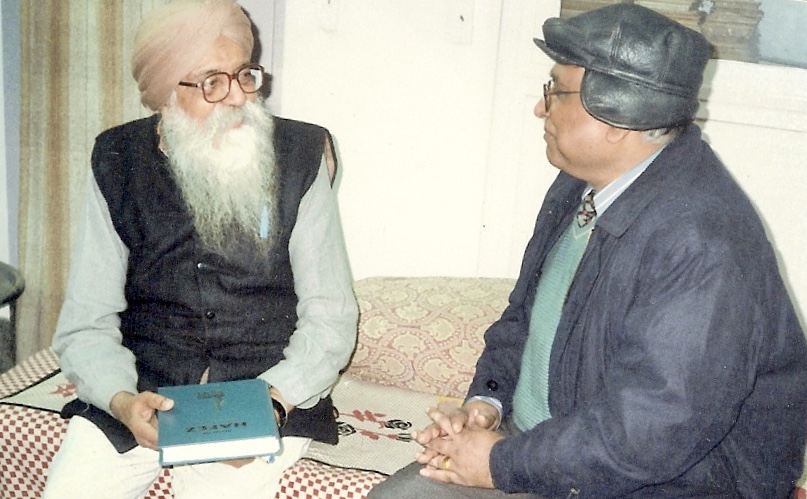
Meeting on Jan. 11, 1999 - 81st Birthday of Prof. Pritam Singh

My last meeting with Professor Pritam Singh took place in the late evening of 1st October, 2008. He appeared some what frail and time - worn but his profundity of expression, smile and laughter were indeed as intact as ever. I had presented to him 'Diwan-e-Hafiz' brought from Iran - the 'Blue book' in the picture and my write-up in Punjabi on the popular 'Chhapar Fair of Punjab' and my recent columns on Urdu poets and scholar A.J. Zaidi and Ahmad Faraz. We touched upon the current educational and cultural scene in Punjab and in the country. When I took leave of him, he persisted in walking with me the up to the main gate. I mentioned to him - at the door step - that Panth must think of establishing a museum of letters, with name, 'Zafar Namah Sahib Bhawan', inviting Punjabis all over the world to donate letters on the themes of literature and culture of Punjab - to be scientifically preserved there.

I penned my last letter to Professor Pritam Singh, on 24th of October, a day before his joining the company of the immortals, sending it care of his daughter Doctor Harshinder Kaur so that she might read it out to him. The Destiny of this letter was fated  to be different - reaching him on the address far, far beyond his earthly abode! I salute this angel of a Teacher on his birth centenary - he indeed radiated knowledge and nobility with every word spoken by him!

*     *     *


Friday, July 31, 2015

Missile Man - No more! May he rest in eternal peace

The finest product of the Syncretistic Culture of India.

I had firstly heard of Dr APJ Abdul Kalam some time in 1981 from my school time friend Dr CR Jagga who had then joined the Dept. of Chemistry, IIT Delhi.

After listening to Dr Kalam at some conference,  Dr Jagga was enthusiastically talking to me about this amazingly simple soul scientist - with a saintly serenity and a total dedication to his mission of  missile technology...

Dr Jagga - then 36+ had been simply mesmerised by an 'indefinable' magnetic charm of this 'gentleness personified' magician!

I had the privilege of 'Darshan' of this Maharishi of Vigyan from close proximity at the Republic Day reception in honour of President Putin in 2007.

At that reception I had also been privileged to talk to Marshal of Air Force Arjan Singh. Marshal had called his wife to talk to me when I had said, "Sir, on meeting you I feel as if I have met an incarnation of Arjuna of Mahabharat!"

I was also delighted to meet former Olympic hockey captain Zafar Iqbal & Swami Agnivesh the reception.

Long live an India of Kalam, Arjan, Zafar & Agnivesh !

I am glad that my letters of credentials as High Commissioner to Kiribati & Samoa - while resident in New Zealand - had been issued under President Kalam's signature.

I have the pleasure to attach a copy of the document

Salam to Kalam of India !!!
Credentials signed by Dr APJ Abdul Kalam
Links


Thursday, July 02, 2015

A Life Enshrined as a Pilgrimage of Love

This article was published in the July 2015 edition of Identity magazine.

Amrita Pritam
An enigmatically popular and proverbially ‘pretty-petite-poet’ of the partition-poisoned five rivers of the historic Punjab, Amrita Pritam - b. Aug. 31, 1919; d. Oct. 31, 2005 - had indeed enjoyed a larger than life image as one of the most prominent literary personalities of modern India. She was widely recognised as a pioneer, powerful and an authentic voice of feminine protest in expressing the horrors of the Partition of her beloved Punjab and the eternally atrocious gender discriminations in the globally patriarchal social orders.

She had subtly succeeded in cultivating and nourishing a significant constituency of readers and a large circle of influential individuals surpassing divides of languages and national boundaries. She had been conferred the most sought after honours including the Padma Vibhushan and the membership of Rajya Sabha, not to speak of Jnanpith Award and dozens of honorary Doctorates and other prestigious distinctions in India and abroad. She had indeed been deservedly hailed to have lived her life to the fullest as the ‘grand lady of letters’ - on her own terms - both in her literary accomplishments and the ultimate fulfilment of her socially unconventional love.

And, yet there were deeper perceptions among both her ardent admirers and determined detractors of an apparently vast void in her life. It was something of the agonisingly soulful kind - her wounded and bleeding feminine destiny and an unfathomable anguish over implied disapproval of her way of life among her dearest and nearest. Amrita’s life could certainly be categorised as the ‘mysteriously volcanic and an eerie dreamy stuff’ of which strange tales of romance, triumph and tragedy are made of. Her enormously large literary output - 21 anthologies of poetry, 10 collections of short stories and, surprisingly, 25 novels, not to speak of three titles of autobiographical writings, have all been hugely interpreted in terms of their excruciatingly experienced personal emotional overtones.

Amrita had indeed played a uniquely inspirational role for decades in spotting and grooming so many budding and promising Punjabi writers, providing them the forum of her popular monthly Nagmani - Serpent’s Jewel. The Punjabi Lekhak Kosh, 2003 - A Directory of Punjabi Writers, edited by the venerable scholar Prof Pritam Singh - has more than three pages of the entries of her writings in original Punjabi and translations in dozens of Indian and foreign languages.. Her abode for decades - K-25, Hauz Khas, New Delhi - had remained an extraordinary literary pilgrimage till her last for her dedicated readers, fraternity of writers, fellow travellers, sisters in sorrow - from India and abroad - and plain ‘Darshanarthis - the onlookers of her magnetically pretty looks!

I do vividly recall how, as an elementary school - child, I had chanced to read her poem - a pretty picture of her adorning it - in a Punjabi monthly ‘Veer Bhumi’, sometime in 1950. Then for a several years in the mid-1950s, her measured and soft voice as an anchor of the 15 minutes program in Punjabi on All India Radio, Delhi had become captivatingly familiar, as if in uniting the two sparring, grieving and singing Punjabs. It was, however, on 22nd November 1970 that there was an opportunity for me to listen to her live. It was during the Mushaira of the Golden Jubilee of my college - Govt. College, Ludhiana - Sahir’s own proud alma mater.

Sahir Ludhianvi
The Mushaira, compered by the legendary Kunwar Mohinder Singh Bedi, had started on a note of an absolute disaster of ‘Band-o-bast’. The restrictive arrangements of entry tickets had crumbled in no time in total chaos. Anyway, the huge and roaring audience, by then more in a rebellious mood to hoot than to listen, had consolation of having glimpses of shining star poets like Jan Nisar Akhtar, Mohan Singh and Amrita Pritam doing the empty ritual of recitation of their poems. Even Shiv Kumar Batalavi, the prince among new poets, had to be cajoled to recite her poem after an initial hooting. However, Sahir - the ‘old- boy-hero’ of the College in 1930s - had mesmerised all with his poem titled, ‘Ae Nai Nasl - O, New Generation’, dedicated to Principal Pritam Singh and addressed to all the past and present students. Sahir was indeed at his magical best when he poetically pierced into the hearts of the Ludhianvi audience with the lines:

Naam mera jahan jahan pahuncha / saath pahuncha hai iss dyaar ka naam.
Main yahan mezban bhi, mehman bhi / app jo chahen dijie mujhe naam.
Nazar karta hun in fizaon ko / apna dil, apni rooh, apna kalaam...
Kal jahan main tha, aaj tun hain vahan / Ai, Naee nassl! Tujh ko mera Salaam!
 
My golden College of that day, now named after ‘old-boy-scientist’ Satish Chandra Dhawan and with the main Hall named after Sahir, is struggling to breathe - and survive to celebrate its Centenary due in 2020!

My ‘real and historic’ Amrita moment was, however, destined to be on August 31, 1992, just on the eve of my departure for Pakistan, as India’s Deputy High Commissioner. Pandit Krishan Ashant, the poet-philosopher turned Jyotishcharya - astrologer - an intimate good old friend of my family had kindly taken me and my wife Aradhana to pay a respectful courtesy call on her. I had asked Amrita about some Pakistani writers whom I might meet.  She had mentioned a few names including some of women friends based in Lahore and short story writers Mansha Yaad and Mazhar Khan who was Director of the popular Pakistani Folk Art Museum, Virsa. Imroz, an incarnation of serenity and sincerity, was around and had kindly served us the famously mandatory magical tea. We had felt privileged that we had the good luck to preserve forever the precious memory of Mulaaqat with an iconic figure, a veritable literary queen of her time!

The love legend of Amrita, particularly her self-confessed decades-long passionate attraction for Sahir, has been one of the most written about and celebrated affair in the popular literary imagination in India. The year 1960, according to Amrita’s own account, was the saddest time of her life. She mentions how the report in the ‘Blitz’ about ‘a new flame of love in life of Sahir’ had totally devastated her, plunging her into dark despair. This development had, perhaps, as if in a rebound, made it possible for Amrita to attach her destiny of ‘life-lasting-soulful-love’ with the younger painter friend, Inderjit. He was soon assigned the metaphorically popular name, ‘Imroz’ - the Persian word meaning ‘today’. This unique ‘undefined’ partnership of ‘understanding’ lasting more than 45 years proved to be the most intensely enduring for the mutual esteem, affection and awesomely creative in terms of Amrita’s literary output and picture perfect of ‘made-for-each-other-soul-mates’. Such supposedly ‘idyllic’ life would only be waiting to be sung and celebrated about, not only in sweet, sentimental and eulogistic notes but also to be written about in a plaintive and poetic mix of fiction and reality.

Ek Janam Tumhare Lekhe
The lives of writers and artists have indeed been a source of immense fascination everywhere -  not only for readers and audience but also for fellow writers and critics and commentators. In the case of writers, ‘aside from their works, there are even autobiographies, letters, diaries, and memoirs of those who knew them best... others have taken  it a step further, painting a  portrait of a literary genius through those who knew him / her best’. Enters here, Gurbachan Singh Bhullar (b. 1937), an eminent short story writer, editor, and columnist, Sahit Academy Awardee in 2005, with roots in Malwa region of Punjab. He had been an alert insider in the various forums of the Punjabi writers since arrival in the capital in 1967 to work in the Soviet Information Department. He would have been privy to all the literary intrigues, factional feuds, scramble for awards and personal rivalries that always plague the atmosphere of community of writers and artists everywhere. He enjoys reputation as one of the select writers in Punjabi who are well read in literature of other languages and are painstakingly diligent in paying attention to the most appropriate vocabulary and idiom in Punjabi. It is indeed very interesting how my most favourite short storywriter and columnist decided to be a novelist. Please permit me to quote from his own 11-pages declaration, ‘How and Why I wrote the novel, Eh Janam Tumhare Lekhe - This Life I lay at thy Feet’:

“18 of March 2014 was my 77th birth day... this juncture of life can often make a person sad, even frightened... but I had felt full of enthusiasm. I had conceived the woof and warp of my maiden novel and had started designing, naturally, the flowers and petals and even the thorns... Friends had often advised, ‘A short story writer attains perfection only by writing a novel... you have plenty of stories and experiences of social life and an appropriate idiom to tell them, you must write a novel’.”

Gurbachan S Bhullar
Bhullar quotes at length many foreign writers and critics to highlight the subtle points of crafts of short story and the novel. He cites examples from the narrative traditions of epics of India and folk tales of love and how human life revolves around Arth — subsistence, Kaam - sexuality and Dharam - morality. The four word title of the novel, according to Bhullar, was decided at the very beginning. It is taken from the hymn of celebrated Dali poet Bhagat Ravidas in the Granth Sahib, “Bahut Janam bichhure the Madho, eh janam tumhare lekhe - Separated since several births, O lord, this birth is solely dedicated to thee”. How the characters of the novel would stand up to the test of this dictum of total surrender was going to be challenge for the novelist. Bhullar asserts that there are no conventional individual hero or heroine in the novel: the moral restraints prescribed by society at large and their clash with the feminine way of thinking about freedom constitute the crux of the thematic world of this novel.

The protagonist of the novel is Jagdeep - a poet, does not pose much of a difficulty to be identifiable as Amrita Pritam. It is also, interestingly, the name of a character in her novel, ‘Ek Savaal - A Question’ who has a shade of Amrita in losing her mother an early age. The names of poet Mohan Singh (1905-1978) and Sahir Ludhianvi (1921-1980) have been retained in the novel along with the use of their select poetry. To keep the fictional façade of Jagdeep intact, Bhullar has composed some poems himself and used some of the verses of Sukhvinder Amrit (B. 1963). The other characters - easily recognised among the ‘who is who’ of all the prominent friends - some turned foes - and relations of Amrita. They have been assigned meaningful names: Imroz as Inderjit-Charanjit-Navrang; her husband Pritam Singh becomes Gurmukh Singh; Bhapa Pritam Singh of Navyug Press is named Harprit Singh ‘Hiteshi’; Balwant Gargi is Kulwant Bani; Devinder (of AIR) as Harvinder, etc. The chapters about Editor of ‘Shamma’- name in novel ’Chiragh’- provide enjoyable comic and witty relief in enlarging character of Imroz’s earlier life. The cover design by artist Satwant Singh Sumail is indeed attractive in symbolising the theme of the novel - the feminine flutters for freedom of choices and the social constraints of moral behaviour.

It is after gap of many years that I have been able to read a novel in Punjabi running into exactly 400 pages. I had been presented the signed copy - ‘with intimate affection’ of the novel by Gurbachan Ji on March 16 and could finish it at my enjoyable pace on April 11, 2015. The seventeen parts of the novel, further subdivided into 3 / 4 chapters in each, make an engrossing reading with the ebb and flow events of a real life legend. Necessary liberties of the fictional kind have been taken here and there as required to enhance an atmosphere of verisimilitude. We get introduced to a gallery of unforgettable characters, majority of them ‘recreated’ after the real life dignitaries of Punjabi community of Delhi who had been closer to Jagdeep-Amrita!? - the protagonist of the novel. Since my first arrival in Delhi on June 16, 1969 and then 16 years - 11 of them consecutively now - of stay in Delhi, I have been witness to a procession of passing away of the pre-partition generation of so many distinguished Punjabis. They had been instrumental in shaping the contours of Punjabi literature and culture. The mindless violence for decades in Punjab; the 1984 anti-Sikh riots in Delhi and the consequently continuously ‘shrinking’ role of the present truncated Punjab in the national life has posed serious new challenges to the traditionally imagined values of Punjabi literature and culture. Amrita, a purely Punjabi phenomenon, had passed away proclaiming herself, perhaps, as more popular ‘original author of Hindi’!

Gurbachan Ji had brought to my attention on November 15, 2014 his masterly article on Amrita Pritam published in the September-December issue of prestigious Punjabi quarterly, ‘HUN’ (Now) dwelling on the touching theme of ‘The Triple Death Tragedy’ of the ‘Priestess of Love’ in Punjabi literature. Apart from the natural death after a protracted sickness and a long confinement to bed, her abode of ‘love-nest’ so artistically adorned by ‘love mate’ Imroz was soon got torn apart brick by brick by Amrita’s ‘emotionally-conflicted’ son - he had once questioned his mother if he was indeed the ‘biological’ son of Sahir! He was mercilessly murdered on September 20, 2012 in shady circumstances in the mean world of Bollywood. I did not know at all - nor could imagine - that this article was a subtle precursor - curtain raiser - to Bhullar’s ambitious maiden novel on the eternal theme of human conflict: the fate of femininity fluttering for freedom against the gravitational forces of patriarchal social order. She was born as the only child of a reclusive and religious couple and married at sixteen in a closely related orthodox Khatri Sikh family. Amrita, according to Khushwant Singh, “was a pretty girl with almond shaped eyes, fine features... petite... barely five feet tall... she became the toast of Punjabi literary circles (of Lahore), largely because of her stunning good looks... Ode to Warish Shah was her defining work. Much of the rest was sheer atmosphere”.

To quote from Bhullar’s elucidatory article, Amrita had once put, in her peculiarly poetic way, “In all, I have had one and a half love affairs - one with Sahir and half with Jeeti... but his half is equal to Sahir’s one full!” Amrita had written, in Punjabi, her autobiography - rather disjointed chapters - titled ‘Raseedi Ticket - Revenue Stamp’ in 1976 - which has run into a dozen editions - three after her passing away. The Hindi editions might be even more. The translation in English - apparently a hurried and poor job - by Krishna Gorowara may still be quoted, “Imroz is six years my junior... God grants too brief (a) period of youth to one and all; to me He has, in His greatness, granted two! Mine petered off; Imroz’s came on! After fourteen years... I have no regrets about the path chosen by us”. Further, Amrita says that “Imroz’s personality is like the flow of a river uncontrolled by locks and sluices... a relationship with him can last only so long as there is nothing to bind it. Unfortunately, in life there is not much natural freedom. There is society and there is the law... My suffering is the lesser truth when weighed against the greater truth of happiness of life with him...”

Bhullar has proclaimed in the blurb of his novel-in its 2nd edition within six months of the 1st - exactly a similar dilemma with the  heroine representing “feminine-way-of- thinking, the centrality of which is the longing, the desire and an attempt to live a life according to the dictates - full freedom - of her mind”. He further adds that, “the feminine thought process, in majority of the cases, gets reconciled to the 'circumscribing limits' accepting them as 'Destiny' and suppressing the urge to 'fly' - but in stray cases there are revolts too...According to science, the astronauts, who break the sphere of the gravity of the planet earth, undergo a process of powerful effects on their body and mind, Whether, according to psycho-processes, the women who dare break the circle of 'social gravity' also undergo a similar transformation of their bodies and mind, is the moot point of this novel”.

Long, long ago, while studying for my post-graduation in English literature, I had immensely enjoyed the recommended slim book, ‘Aspects of the Novel’ by EM Forster. Originally published in 1927, it has remained my favourite book till today. Discussing at length the aspects of Story, People, Plot, Fantasy/ Prophecy, Pattern / Rhythm, the Nobel novelist elaborates on the themes of birth, food, sleep /dreams, love / marriage and death as the essential elements of the structure and craft of novel. Forster points out that love and marriage - the most defining event of human destiny turns out to be the most unpredictable development. The modern science has been hugely impacting our entire approach to love and sex but the scientists are still wondering to know, ‘what fosters long-term attachment... what, really, is this thing called true Love.’ The much used – rather abused - terms like romance, attraction, bonding, passion would seem to defy all reason and logic - that is the unique beauty, as well as the inexplicable tragedy in as many cases, in every culture and civilization.

In 2019, the literary and academic institutions in India would be gearing up to celebrate the birth centenary of Amrita Pritam. Bhullar’s novel has lit up the first candle for a really enlightening revaluation of the literary output of this dear daughter of Punjab. The debates would need be as broad based as the human reason and imagination can be stretched in the multidimensional contexts of the era she had belonged.

Blessed with Punjabi as my mother tongue, I may conclude quoting the following lines of Amrita - they have been my favourite since I took the first fearful and hesitant step into the imagination of my youth:

Pher tainun yaad keeta, agg nuun chumian asan;
Ishq piala zehar da, ik ghutt phir mangia asan …

Your memory has descended on me again, and I have kissed the flame;
I have asked for a sip again, out of the goblet of poison of love!    


Monday, April 06, 2015

Interview with Shri Diwanaji

This interview was recorded on September 2007, during the Chhapar Fair, by eminent film maker Shri Ajay Bhardwaj. Shri Deewana, born June 15, 1922 in Maherna, has narrated his life story - a great footballer, singer, dramatist, freedom fighter, social activist. He was imprisoned in Malerkotla, Layallpore, Ludhiana knew names of all friends, police officials, satyagraha movements; had met Mahatma Gandhi, Jawaharlal Nehru, Subhash Chandra Bose and worked closely with JP, Lohia, Narender Deva, Parwardhan, Aruna Asaf Ali and other socialist leaders; resorted to hunger strike for twelve days in 1954 for an elected management for School.
      
He could still sing old patriotic songs and self composed poems. He played role of Lachhmana in Ramleela where he used to get actually fainted. He was also offered the role of Sher Dil Dakoo in the film Bhabhi.

Tek Chand Deewana is a human monument of Ahmedgarh.


Author's family with Shri Diwanaji, 1994
Author and family with Shri Diwanaji, 20-11-1994


Thursday, December 06, 2012

The Art of Living like a Lighthouse

 This article was published in the monthly magazine Identity, December 2012

It had been an inexplicable psychological complex with me for a long time whenever I had to undertake a journey from Ahmedgarh, the town of my rented tiny home during my schooling from 1951 to 1959 and my periodic stay up to 1971.Travelling towards Malerkotla, 15 Km in the south, seemed to denote as if I am taking steps towards darkness; while going towards Ludhiana, 20 km towards North, looked like pursuing the Light- in the right direction of the Pole Star and towards some dream destination! I may confess that even when I was a daily commuting student of the Intermediate classes in the Government College, Malerkotla (1959-61), this indefinable impression had somehow got even further reinforced. When in March 1960, I could afford to buy some books of my general interest from the then famous Lyall Book Depot, Ludhiana, I had penned in the inside cover of one of my most consulted books, 'English Idioms and How to Use Them' by William McMordie,“O God, I need thy Light to illuminate this dark life!”

It is, therefore, with a soulful pride that more than 52 years after praying for the guidance by the Divine Light, I am essaying to express my deeply felt thoughts about the resplendent and illuminating personality of Professor Dr S. Tarsem of Malerkotla. He has indeed been for me a personification of a unique human lighthouse in an area of darkness pointed out in the opening paragraph. Dr Tarsem has become an incarnation and a metaphor for super human determination and titanic courage in his epic struggle against the relentless infirmity of visual impairment. He has triumphantly emerged an Olympian hero as the foremost poet, critic and an extraordinary scholar-teacher of Punjabi with an encyclopedic range of knowledge of the world of literature. He intuitively reminds me of the great classical poet-scholar John Milton whose celebrated poem, 'On His Blindness' lights up  thousands of 'lamps' of memories among mine and Dr Tarsem's contemporaries when we studied it in our text book of B.A. titled 'Living Lyre', also mentioned by  Tarsem in his much celebrated a autobiography, 'Dhritrashtra'.

It was September 1984. I was on leave in India from Romania. Punjab was a picture of an uneasy calm and scary confusion in the wake of military action in the Golden Temple, Amritsar. I paid a visit to Govt. College Malerkotla to meet some lecturer friends who had been my colleagues during my own most enjoyable spell as a young lecturer. It was Prof. C.P. Singh of the Dept. of Physics who conjured up an instantaneous poetical session in the lawn near the main entrance. Prof. Tarsem and Prof, Jagdish Mohan Sharma delighted us by reciting their select poetry of Punjabi and Urdu respectively. The next day, I requested an old student friend of mine to record their fine verses for me in my tape recorder. A bond of lasing personal and literary friendship with Dr Tarsem was firmed up soon when he respond-ed, vide his loving letter dated Feb.7,1985, in his touching poetic prose, to my letter of Dec. 25,1984 from Romania. He also forwarded to me his book of stories titled, 'Paatiya Duddh - the Split (spoiled) Milk'. Some of the stories in the collection indeed impressed me for their fresh themes, genuineness of characters and the use of the typically authentic diction of our area of Malwa.  Most interestingly, I handed over the recorded cassette of 1984, still in good audio quality, to Dr Tarsem during my long cherished meeting with him at his home in Malerkotla in November 2011 after more than 27 years! He told me that Prof Jagdish Mohan had died many years back and that the cassette might, perhaps, be the only one containing his highly popular satirical poems in his own voice!!

Looking back and reflecting  over the many years of our affectionate interaction while I continued to move on to the various countries, I must say that Dr Tarsem has been one of my few friends who was always meticulous in responding to my letters and keep me informed about the goings on in the realm of Punjabi literature. It was a particular delight and instruction for me to receive when I was posted to Pakistan (1992-94), his two collections of poetry titled Kirmchi Harf Kaale Hashie and Soohi Mehk Siah Mausam. A number of Ghazals and poems had subtle poetic allusions to the extremist violence and communal fire raging in Punjab and how they were treacherously stoked from across the border. He had dared to challenge the tyrannical forces of darkness. He had skillfully employed the symbols of bombs and explosives, curfew and censure, gun and bullet when the body and soul of his beloved Punjab was being torn apart by those who had proclaimed themselves to be the custodians of the inheritance of the legendary land of five rivers. I may quote Tarsem's lines:

Jis samein ton soch ikk, aaee kiton barood kha,
agg khani tik ke ouh, behndi nahin hai, dosto!


Ever since mind was poisoned with a deadly fire,
Destruction does not seem to stop, friends!

The poem titled, 'Suneha (message), Page 67 of Soohi Mehak siah Mausam' was indeed the most insightful:

Tusin bhole ho, barhe hi bhole ho; tuhanun pata hi nahin lagan ditta ke kadon Washington te Islamabad da computer tuhadi khoprhi 'ch tika ditta giya; te tusin saare Girjhan di joon vich pai gaye, sappan di joon…hanere di joon pai gaye!

It was a touchingly nostalgic experience for me to receive from him, in 1997, when I was in Panama, an anthology titled, 'Aapne Aapne Khambh (Wings of Their Own)' containing the Ghazals by 23 poets of the ilaqa of Malerkotla. The names of Shankar Mubarakpuri (Ambrin uddiie te haase Chhirhkiye /Dharti Phulkari Bana Ke challie); Ram Lal Premi (Ethe tan vasde Sikh jan Hindu jan Musalman / Kitthon milange lok hun Nanak de naal de); ex-MP Bhan Singh Bhaura (Hanjuan sang morhda han viaz apne ishak da / peerh saari umar di lekha chukavan vaaste) and Naaz Bharati (Ai meri ham nafas; zindagi hai kashmakash) transported me to my dream-like days of the school and the circle of the intimate friends of my dervesh Comrade Chacha Shankra Nand Ji. The Sahit Sabhas, local literary associations, were indeed at the best of their creativity and dedication during those 'distant' days! The meticulously researched introduction of the book by Dr Tarsem had introduced me to the promising scholar-critic in him.

And then finally I returned as a pensioner of Bharat Sarkar in 2004 after a long innings of 'lying' abroad in the service of the nation. After completing the process of settling down in my new little nest on the bank of legendary Yamuna, I set out seriously to pursue in the sun-set years, 'what I always longed to do but could not do' i.e. to indulge full time, in a disciplined manner, in the pursuit of 'Three R's - reading, reflecting and writing'. Dr Tarsem has been quick to emerge again in my distinct category of those friends who fit into my scheme of things - ham umar, ham safar, ham khyal, ham khwab - same age, same pilgrimage, same thinking, and same dreams. He had been quick to introduce me to the Quarterly, Nazaria - Point of View - the vehicle of high quality literary expressions published under his watchful and benign guidance. All the special issues of Nazaria, I may mention among those on Lal Singh 'Dil'. Prof. Mohan Singh, Faiz, Hasan Manto, must be ranked among the collectors issues for their excellence of literary standard. They invite comparison with similar journals published by institutions with far more resources at their disposal. I have indeed been overwhelmingly impressed by his prolific literary output since his retirement: it is surely an inspiration for me, 'the Niagara of creativity often springs up and rushes forward when you become your own boss, 24x7!' We have further discovered that we, quite surprisingly, have several common inspirational individuals from my uniquely knowledgeable school guru Ashni Kumar, to the teachers'- teacher Prof. Pritam Singh and the poet-philosopher futurologist Krishan Ashant. I was simply amazed by his deeply insightful portrait of Prof. Pritam Singh in Nazaria and he was delighted to publish my review article on Ashant's swan song anthology of poetry, 'Beete nuun Aawaazan - Calling up the Past' and even couple of my personal recent letters to him.

The first public event of our  literary togetherness was destined to take place in Chandigarh in Oct 2011 when I attended the session of discussion on his recently published monumental book of 496 pages titled, 'Punjabi Ghazal Shastar'. I must admit that having long been a student of the traditional craft, modern practice and the huge popularity  of Ghazal in Urdu, Hindi and Punjabi - not to mention English Sonnet - I was genuinely impressed by this detailed compendium of research and critical appraisal of an important genre of oriental poetry. To read the book was a personal voyage of discovery in the evolution of the art of one of the most enduring forms of poetry, particularly in the background of my having lived in Iran, Saudi Arabia and Pakistan where I was privileged to listen to the finest lyricists of the south Asian countries. I had also been fortunate to enjoy an intimate friendship with one of the most respected poet and literary historian, Shri Ali Jawad Zaidi. I am confident that the importance of this scholarly work will be appropriately recognized sooner than later by the relevant institutions in India and Pakistan.

Nourishing an ambition - with the usually attendant dreams and night mares- of penning my autography, I have studied Tarsem's two volumes of autobiography, Katchi Mitti Pakka Rang (152 pages) and Dhritrashtar (308 pages), with a much deeper empathy and extra attention. Katchi Mitti first published in 1990 and as a revised edition in 2002,  covers the period of the first fifteen and a half years of Tarsem's life. The book captivates the reader with its lyrical and restrained prose style, wit, humor and pathos. The details of childhood and early youth of author's life in a semi-rural area of Malwa region are dramatically unfolded. The chapter,  'Sarbala Banan da Sawad - The Taste of being the Best Man of the Groom'- gives a hilarious account of the pleasures and perils of the marriage as they were solemnized in the romantic era in Punjab when there were no proper roads and the engines of vehicles were also quite moody in functioning. The second volume of the autobiography, 'Dhritrashtra', published in 2009, is dedicated to the loving memory of author's devoted life partner who had passed away, at 49, on the night of the Karuva Chauth, on October 8, 1998. The 40 chapters of this work of Tarsem's mature vintage might be considered highly valuable socio-cultural documents and an authentic running commentary on the cross currents of the happenings in Punjab that shaped the author's life during the five decades since 1958. The book has  indeed been of fascinating interest for someone like me who had spent his life during the most of this period in far off lands but had also remained emotionally attached to so many of those very places and people mirrored prominently in this book.

While reaching the mile stone of three scores plus ten years of his life, Dr S. Tarsem can surely look back and forth with legitimate pride and satisfaction over his constant struggle and regular success. The versatility of his literary output, his global circle of admirers, his gigantic capacity for sustained hard work and his nerves of steel in the face of any challenges make him much taller and more farsighted among all those who are luckier to know him and work with him. The title, 'Dhritrashtar' for his autobiography has itself an interesting background  when he had to contest –and he win- an election against his  much admired friend, late Gursharan Bhaji for the post of President of Kendri Punjabi Lekhak Sabha.  He has not hesitated to tell the truth about the evolving characters of his close relations and the sweet-sour realities of family life. He has described, without any streak of anger and hatred, how he and his family were subjected to serious threats to their lives and a few narrow escapes during the dark period of extremism in Punjab. The 21 year long career in Govt. College, Malerkotla, in the words of Charles Dickens, had its moments of, 'the best of time and the worst of time' for Dr Tarsem. The chapter titled, 'Wasiat - The Will, Page 301' tells how Tarsem has categorically instructed that after his passing away, his mortal remains must be donated to the Dayanand Medical College, Ludhiana, “for transplant  of any organ for the needy patients and the remains of his body should be utilized by the students for their education…I hope that my sons and inheritors would not entertain any doubt or fear in doing so…I shall not frighten any one assuming the form of a ghost-in reality, there are no ghosts…they exist only in the imagination of the sick minds…”

Dr Tarsem's intense and never ending struggle in all his life and his shining success indeed make an inspiring saga for all. The blind and visually impaired people have contributed immensely not only in the realm of music and literature of the world, from Homer to Milton to Surdas, but in ever increasing new area of human endeavors in the recent past. Dr Tarsem has been in the forefront in the forums for fighting for the rights of the blind. He has dwelt on his dream-plan to build 'Home for the Old and the Blind' in his Autobiography. The modern medical technologies have certainly scored notable successes in treating the scourge of sightlessness but India has the dubious distinction of having 15 million, with 26 percent being children out of the total of 37 million blind in the world. The national program by the Govt. of India to control blindness expects to reach its blindness elimination target of 0.3 percent by 2015, five years before the WHO deadline of 2020. The shortage of ophthalmologists and optometrists is appalling, just one eye surgeon for 100,000 people! We need many more determined soldiers of Tarsem's caliber and commitment to wage war against blindness in India in terms of cure and care.

I salute my soul mate friend, Dr S. Tarsem, on his stepping into in the club of senior citizens of seventy plus. I pray for his health and happiness and a more vigorous output of creativity and scholarship! I look forward to my next engagement of enlightened discussion on life and literature with him in Malerkotla, a city whose reputation for me appears to have been much redeemed by his lighthouse persona, his learning, his social commitment and above all his genuine fondness for friends, including me. It is another matter that the shadow of the dark and feudal values of the PEPSU, I apologize, if I hurt someone by saying so, seems to have lengthened to cover the entire Punjab -and to my dismay- Punjab has been more 'PEPSU-fied' than the vice versa during the last four decades. It requires a moral courage to make a clean breast that the further truncation of Punjab was a game of petty politics by the pigmy politicians and had nothing to do with the cause of development Punjabi and the heritage of Punjabiat. I, however, have full faith in the optimistic note in Tarsems's lines:

Koee tarshul vande,
Jan koee kirpaan lishkaae
Magar mein kol apne,
dostee di dhal rakhanga.


They may distribute tridents
or sharpen swords
I shall strongly hold my
shield of friendship

*   *   *


Thursday, September 03, 2009

Meeting with Justice A.D. Koshal

Meeting and discussions with Justice A.D. Koshal. Sharing of memories and histories - personal and regional. Took place in Ludhiana, Punjab, India on 3rd September 2009, Thursday.

The following playlist will play 5 videos in sequence, total of 51 minutes.


Further Links:


Monday, August 28, 2006

Tribute to the True Hero of Everest

 The following article appeared in the online publication South Asia Post, June 31, 2006

THE date of May 29, 1953 has got inscribed in the memory of mankind as the glorious day when man stood tallest on the planet ... See article (link expired, full article coming here soon)