Saturday, June 06, 2020

Guru Nanak's 550th Anniversary - International Conference in Chandigarh

Dear and Esteemed Colleagues,

I presume that you might be interested in the evolving contours in the recent years of Sikhism in its scholastic, spiritual, political and cross cultural dimensions. The subject has indeed assumed significant diplomatic-strategic aspects also of the 'Pilgrimacy' and role of radical elements of the Sikh Diaspora in the context of the global celebration of 550th birth anniversary of Guru Nanak (April 15, 1469 - September 22, 1539) and more particularly of Pakistan's quite unexpected coming forward for the implement - at a lightning speed indeed - of the long cherished 'Sikh psychic dream' of the 'Kartarpur Corridor'.

An institution, named interestingly, 'Centre for Research in Rural & Industrial Development (CRRID)', in Chandigarh, proclaiming its founding to Sh P.N. Haksar's inspiring motto 'ceaseless striving in search of Truth through research' hosted, co-sponsored by Govt. of Punjab and Indian Council of Social Science Research (ICSSR), an 'International Conference on Guru Nanak's Philosophy...' on 7-8 Nov 2019.

I had the pleasure to participate in this conference of eight sessions - with as many as 32 scholars / academicians making their presentations on various subjects related to the Vaani / teachings of Nanak - of the Seminar apart from the inaugural session with keynote address by Prof Murli Manohar Joshi & Presidential remarks by Sh M. Hamid Ansari. The valedictory session was addressed by Dr Manmohan Singh.

The deprivation of 'Khulle Deedaar - Unrestricted Access' to the Sikh Shrines in Pakistan has been the most agonisingly experienced psycho-spiritual wound among the faithful of the dynamic community. The matter has got incorporated in the regular Ardaas - Prayer after every formal religious function. The words are reproduced below:

ਸ੍ਰੀ ਨਨਕਾਣਾ ਸਾਹਿਬ ਤੇ ਹੋਰ ਗੁਰਦੁਆਰਿਆਂ, ਗੁਰਧਾਮਾਂ ਦੇ ਜਿਨ੍ਹਾਂ ਤੋਂ ਪੰਥ ਨੂੰ ਵਿਛੋੜਿਆ ਗਿਆ ਹੈ,
Sree Nankaanaa Sahib tae hor Gurdvaareaan’, Gur'dhaamaan’ dae jinhaan’ thon’ Panth noon’ vichhor-eaa geaa haee
ਖੁਲ੍ਹੇ ਦਰਸ਼ਨ ਦੀਦਾਰ ਤੇ ਸੇਵਾ ਸੰਭਾਲ ਦਾ ਦਾਨ, ਖ਼ਾਲਸਾ ਜੀ ਨੂੰ ਬਖ਼ਸ਼ੋ ॥
Khullhae darshan dee-daara tae sevaa san-mbhaal daa daan Khaalsa jee noon’ bakhsho.

I am taking the liberty of presenting - below - the Paper, running into about 2750 words, presented by me titled, 'Guru Nanak - Poet and prophet of Oppressed and Persecuted'. I was tempted to quote a few parts of it in this covering note - but was dissuaded by the feeling not to make it any longer - and leaving it to you to have a quick look at it - as and when you feel inclined.

Guru Nanak - Poet and Prophet of Oppressed and Persecuted

Bal Anand, Indian Foreign Service (Retired)

All those who have lived through the last five centuries in the mystically blessed and also terribly tormented ancient lands of five rivers, and areas lying beyond the adjoining north-western regions of Bharat i.e. India, have indeed been spiritually solaced and sustained by the resplendent eternal presence of Baba Guru Nanak Dev Ji (April 15, 1469 - Sept. 22, 1539 A.D.). During all these years of trials and tribulations wrought upon the people of these lands by their own innate flaws of character or inflicted upon them by the unjust rulers and rampant invaders, ‘the dhuur ki Baani-the deepest Divine discourse’ of the Guru conveyed in the soul stirring sublime poetry, in their own genuine tongue, has been burning bright for all to enlighten their lives.

2. When the toiling and harmony loving people of Guru Nanak’s beloved Punjab were brutally cut apart, amidst rivers of blood and tears - four centuries after his lifelong mission of healing the wounds of religious and social divides with Divine notes of harmony in knitting humanity together-I too had experienced shivers into morrow of my bones as an innocent child of four years, awkwardly awakening to the cruelest ways of the world, by the soul piercing song in my ‘maan-boli’, which seemed, as if, to convey it all to me, “Nanakaane vall nuun jaandia raahiaa ve, meire Pritam nuun sandesha devin jaa… O dear traveler, journeying towards Nankaana, please do convey the deepest cry of my soul to my beloved Guru…” I need not delve into details of those days of the most barbaric mass murders in history of humanity to which people of Punjab had been subjected when India was proclaimed to have awakened to the long awaited dawn of Independence.

3. While speaking to you all at this moment, ladies and gentlemen, in the city beautiful, I indeed feel acutely conscious about my own odd journey of life spanning seven decades and a half, my obvious limitations to fully fathom and understand the most pious life of the great Guru. In his relentless and epochal search until his last for the ultimate truth and an eternal moral order, more pin pointedly during the last five decades since the world had celebrated the quincentenary of the self-proclaimed ‘Saier- songster (of Supreme Creator) and ‘Neechan andar neech-the lowliest among the lowliest’, one of the most extraordinary poet-prophet of humanity has ever known..

4. Dear Friends, please permit me to start with certain basic facts to elucidate my topic of the day. Firstly, we have to begin with an honest admission that ‘no manuscript in Guru Nanak’s own hand has survived the onslaught of time’. Prof. Pritam Singh, the painstaking scholar of manuscripts, has underlined at length how the pervasive practice of writing anything in Gurmukhi or Devanagri scripts ‘without separating different syntactical units from each other’ has posed a formidable challenge and that ‘readers needed a long period of training to read such text correctly…’ Guru Nanak had, however, most thoughtfully entrusted to his toughest tested successor, Bhai Lehna elevated to be Guru Angad, the manuscripts of his own compositions and also the writings of other likeminded saint poets collated so diligently by him during his wide spread travels and intimate discussions with several of them. A total of 974 hymns - in 19 major ragas i.e. melodies of Indian classical music - attributed to Guru Nanak had been later incorporated in Sri Guru Granth Sahib (SGGS) by Guru Arjan Dev Ji, when he compiled the Granth, sixty five years later. A majority of Guru Nanak’s verse creations are in the form of quatrains and in other popular verse forms -  ‘the themes are ethical, philosophical, or devotional and in their totality make up the cosmic vision.’

5. Guru Nanak’s composition titled Japji - the Holy chant - comprising of 38 Pauris, literally 'ladders', implying poetic stanzas, has been rightly adopted as the prayer for recitation at early dawn, known in the Sikh tradition as ‘Amrit Vela-the ambrosial hour’. Japji, opening with invocation to God, has amplified the concept of Supreme Being, with a statement on the nature of God: His uniqueness, Omnipotence, Immortality, etc. and reaffirms His being both Truth and Reality. It concludes with an assertion that knowledge of God is obtained through the grace of the Guru - an enlightened individual. The prominence of this composition has been ‘recognized as such by the Fifth guru, Arjun, when he gave it the first place in the sacred anthology.’ In essence, it is a monotheistic concept of Supreme Being, known in Sikh tradition as, ‘Ek Oankar - One Sole Supreme Being’. Another composition of Guru Nanak for morning recitation is Asa Ki Var, ‘a disquisitional poem of 24 stanzas, interspersed with Slokas (groups of poetic couplets); it denounces falsehood and hypocrisy in the practice of religion in society.’ The Var Majh; in Raga Ram Kali Dakhani Onkar; Solahe (sixteen-stanza poem) in Maru Rag and Sidha-Ghoshti, again in Rag Ram Kali, Guru Nanak expresses his broader thinking over philosophical and ethical issues and points out that meditation - Naam Simran is indeed the true Yoga. The primary purpose of all these verses has been to free the minds of the ordinary people from all types of superstitions and negative social practices.

6. When we turn to the group of four poems, in Raga Asa and Telang, ‘expressing strong indignation of Guru Nanak over the barbarities perpetrated by the invading armies of Babur over the people of Punjab including large scale dishonour of the women-folk’, we come across a rare example of a man of prayer and meditation demonstrating a supreme courage of convictions in denouncing the tyrannical deeds of the ‘the Paap ki janj – marriage party - mafia of sinners coming from Kabul’. The death and destruction during the sack of Lahore for four days in the middle of January 1524 finds mention in the boastful narration in ‘Babur-nama’ by emperor Akbar’s grandfather and the forceful challenging counter narrative in the poems ’Babar-vani’ by Guru Nanak- “Bavarvani phir gayi… Babar’s sway has spread all around; even princes are roaming without food…” The painful plight of people is poignantly pictured by Nanak in another hymn: “O our Lord, our Creator, when there is such killing, such suffering, such pain, so much spilling of blood, so much shrieking, do You not feel pity for the poor!” Guru Nanak’s had felt deeply outraged with the indignities and cruelties piled upon helpless women and expressed their plight with the most graphic poetic images: “Jini siri sohani pattian, mangi paae sandhur - Women whose heads were adorned with tresses; Parting of whose hair was daubed with vermilion; Their locks are shorn with shears, their throats choked with dust… Thou art the Author of all things; Thou seest all. Strange are Thy manifestations!”

7. Guru Nanak - the indefatigable seeker of Mukti - the Salvation of the soul via the pursuit in practice of an honest living following the path of Truth and Nobility - was passionately committed to justice, equality, fraternity and fair play for all. He castigated the rich and powerful for their greed and lust and indulging in atrocities against the poor - he chose to be counted with the clans and classes of Bhai Laalo, the hardworking carpenter friend and Bhai Mardana, a soul mate lifelong musician companion, who was also dubbed to be of low caste even among followers of much acclaimed equalitarian faith of Islam. Here Guru Nanak consciously moved beyond limitations of Bhakti movement and its attendant divide of Nirgun and Sargun i.e. Formless and Formal. He equivocally challenged the hypocritical orders of the day - the caste and rituals ridden Hinduism and unjust and intolerant practices of comparatively recently arrived Islam. Guru Nanak indeed echoed Kabir, “Tu kehta kagad ki lekhi; mein kehta aakhan ki dekhi - you speak of what is written on the paper; I speak of what I have seen with my eyes,” by proclaiming, “Jiho dittha, tiho kiha - I said what I saw.” The inspiration and courage of conviction for Guru Arjan for the inclusion of the verses of the several low caste saints - Kabir, Ravidas, Nama, Sadhna, Sain, etc. - in the Granth Sahib had certainly its sacred fountain source in the integrating spiritual ground so assiduously prepared by Guru Nanak.

8. We have to understand how Guru Nanak had adopted systematic strategy to diagnose the crises of institutions of the contemporary society. He noted quite clearly how the native Hindus had become deeply demoralized and confused and were leading contradictory lives, “Antar Pooja parhi kiteba sanjum Turka Bhai… - inside home you worship (as Hindu), but outside you read other books to impress the Turks; Discard this hypocrisy! Devotion to Name will ensure liberation.” Though the ‘Nirguna’ saint poets had not hesitated to employ blatantly strong expressions to condemn caste distinctions, Nanak, in a rare poetic restraint, preferred to use touching poetic twists to ceremonial practices like the wearing of ‘janeoo - sacred thread’ saying, “Daya Kapah, santokh soot… Out of the cotton of compassion / Spin the thread of tranquility / Let continence be the knot / And virtue the twist there on. O Pandit…” Similarly, Guru Nanak sought to chastise the Muslims to follow their religion as enunciated by their saintly guides and not the sinful rulers,” Musalman kahanu muskilja hoe ta Mussalman kahave / Awwal Aaoli din kar mittha musklmana mal musaave… To be a Mussalman is not easy: only he who is one in reality, should make the claim. Follow first in the footsteps of the saintly; accept their bitter words as sweet… O Nanak, if he extends his mercy to all; treats all living beings as the same - himself a Mussalman he can proclaim.”

9. The most refreshing and relevant notes for his troubled times struck by Guru Nanak pertain to defending the dignity of the womenfolk and underlining biological and societal crucial role of women in the overall scheme of Nature. He condemned extolling of the orthodox Hindu cults of celibacy and renunciation and sought to elevate ‘Grahisatha-life of a householder’ as the noblest obligation ordained by ‘Srijanhar-Supreme Creator’ of the Universe. He was strongly critical of perverted notions among Muslims of treating women as slaves for indulging in animal lust. He emphasized that husband and wife are indeed created equal and that fidelity was enjoined on both. Guru Nanak pictured domestic bliss as a cherished ideal of life and marriage as the metaphor for consummation of love for the Divine. In the Asa ki Var, Nanak rejects the superstition of Sutak - implying that a woman giving birth to child is unclean and impure for a number of days - depending on the caste to which she belongs! In his masterly composition, Nanak says, “Impurity of the mind is greed and the impurity of the tongue is falsehood. The impurity of the eyes is to gaze upon the beauty of another man’s wife and his wealth. The impurity of the ears is to listen to the slander of others…” Nanak proclaims the eternal truth saying, “Within a woman, a man is conceived; to a woman he is engaged and married… through a woman, his future generations come… So why call her bad? From her, Kings are born.” Guru Nanak had condemned the ‘Sati-pratha - wife burning herself on pyre of dead husband’ - he says that it is nobler to live with pious memory of the departed loved one than embracing an unnatural quicker death.

10. Most esteemed friends, in the pointed context of Bharat, we must finally reckon all the reformative social and spiritual movements and their eminent apostles at the altar of the fraternity and equality of people: for their totally unalloyed belief and practice in the equality and justice for the spiritually dehumanized for ages, the so called ‘Shudras - the untouchables’: born to be treated worse than animals according to the glorified scriptures of dubious Divine Origins. Guru Nanak’s travels far and wide for interaction with the leaned scholars of various schools of spirituality including those with humbler origins but higher thinking minds indeed represented a path breaking initiative in the spiritual annals of the world. He castigated the caste distinctions as totally false and vicious man made divides, “Jaanhe jot, naa poochhe jaati - recognize the godly light in all; Braham binnd te sab utpati hoee, maati ek sagal samsaran - The Cosmic minute created it all, the entire creation has the same element.”

11. Following the path lit by Guru Nanak, the assigning of place of honor to the so called low caste Bhakats and Muslim savants in the Granth has been indeed the most admirable example in the history of the holy books of the world. The truest tribute to Baba Nanak, therefore, on the 550th anniversary of his arrival will be the sincerest pledge by all for the total rejection and purging of caste from their lives in all its ugly manifestations: the Sikhism had indeed owed its origin to equality of ‘Sangat in Pangat’ - the pious Congregation in the queue of perfect equality: enough of preaching so far, the hour of action and practical measures beacons us all from Kartarpur! The 550th anniversary of great Guru’s auspicious arrival and 70 years, 5 months and 7 days of his gracing the planet earth indeed deserve to be celebrated by everyone in the world by reflecting over all those days of his life and 974 most precious hymns composed by him to illuminate mind and soul: they are like the shining pole stars in the arduous and complex voyage by human beings in this complex world. Guru Nanak indeed exults in concluding several of his hymns, saying, “Nanak, Saier eva kahiya-thus spake, Nanak, the poet” - indeed a rare example by a spiritual master to proclaim himself a bard of Almighty! Guru Nanak was a gifted reconciler of religious and cultural differences; in a way, he foresaw the plural and multicultural destiny of India. It is no surprise why Dr BR Ambedkar had deeply admired Sikhism as a great faith practicing equality and justice and an ideal option for his people oppressed and persecuted in the name of sacred scriptures. The Nanak community has to do ‘Atam-manthan i.e. self-scrutiny to rededicate itself to eternal values of hard work, devotion, truthful living and self-sacrifice.

12. To conclude, dear friends, I may kindly be pardoned for re-striking some intimately personal notes. I recall how since my early childhood, the Gurpurab - ‘Kattak di Pooramashi, mela Nakane da’ - falling exactly a fortnight after Deepawali on Amavas, was a soul stirring festival - commemorating not any distantly mythological event but historically well documented happening of the arrival of a godly person who had no claims to any name, fame or kingdom. My pious grandmother, with always prayers on her lips, gave me ‘Gutika - a sacred booklet’ to recite, as soon as I had learnt the Gurmukhi alphabet; my initiation to Japji, Rehraas and other verses of ‘Nitnem-daily prayer’ began during years of my profound innocence. Grandfather was also not behind the scene and tried to smarter by making me soon learn ‘Hanuman Chalisa’ by heart. From a sleepy village in a small state of Muslim Nawab, the family moved to a newly emerging neighbouring town in 1951. The most impressionable first writing inscribed on a wall to be read by me was on the roadside water tank of the Gurdwara meant for animals, saying: “Sewa Kraee 500 Rupaye, His Highness Nawab Iftikhar Ali Khan Sahib of Malerkotla”. I soon understood how Guru Nanak was indeed for all faiths and all ages; children played games, shouting, “Amba Vali kothri, Anaaran Vala Vehra; Babe Nanak da Ghar Kehra?” My generation has indeed grown up shaping our sensibilities about teachings of Nanak by particularly relating them to various contours during the march of the nation since the celebration of quincentenary of his birth. Incidentally, the grand success of feature film ‘Nanak Naam Jahaj hai’ and the regular reports of excellence of the University founded in his name in Amritsar come instantaneously to my mind.

13. Esteemed Friends, exactly half a century after half the millennium of birth of Guru Nanak, our country and our world have indeed been witness to amazingly spectacular changes of the technological and socio-psychological kind. Humanity would seem to be confronted with more and more complicated challenges - including even the sheer survival of the human race on the only planet known so far to house humanity! Personally, I had never dreamt that I would be destined to trot the globe in the service of motherland, including 777 days of the ‘Tapasya-Pious Act’ of the duty in the sacred soil of the holy footprints of Nanak i.e. Nankana Sahib, Panja Sahib and 26 other ‘Guru Nanak – Dhams’ and in addition the birth place of Guru Ram Das; eight sacred spots associated with Guru Arjan and 12 with Guru Har Gobind were officially recorded by Govt. of Pakistan in 1962. I and my wife had the good fortune of roaming about in the streets of Dera Baba Nanak on March 12, 2012 - and were, by grace of Guru, luckier even in locating the long left home of birth of my wife in ‘Guru ki Nagri’. While we were having, via ‘doourbeen-telescope’, ‘Darshan-holy sight’ of Gurdwara Darbar Sahib of Kartarpur, we had not visualized that the realization of ‘historic dream’ was around the corner and that a new glorious destiny was awaiting Dera Baba Nanak and Kartarpur Sahib.

14. Guru piari Saadh sangat ji - Guru’s beloved and blessed congregation before me, lastly, let us hope and pray that in spite of various attendant odds, the Kartarpur Corridor would indeed inaugurate many new flood-lit gates for the forcibly separated people of the land of five rivers, longing for ever to live in love, peace and prosperity for all! The ‘Gurmukhs’- people of Guru’s grace - indeed look forward to the time when they would also be able to roam about as free spiritedly as their Guru had in his own epoch, singing hymns composed by him for all and for eternal Time - with ‘sarbatt ka bhala-welfare of all’ on their lips and in mind and soul!


*    *    *


Monday, June 01, 2020

Indian Diplomat's Wife - on Life and Time in Saudi Arabia

(This article was published on June 29, 1992, in newspaper Riyadh Daily, Page 2, Columns 3-8)

By Raina Abu Zafir (Special to Riyadh Daily)


OF ALL the members of the diplomatic corps there are a large number who leave an indelible mark on the social register of the place of their posting. 

Riyadh has been witness to many incoming and outgoing diplomats. There have been many whom we’ve met through these columns and have remembered long after.

Mrs. Aradhana Balanand, wife of Bal Anand, Minister at the Indian Embassy in Riyadh, though outwardly reserved and soft spoken, has a warmth and codiality of personality which has endeared her to people as much as her husband.  

The Bal Anands will soon be leaving these shores for another posting. We wish them the best. 

Please tell us something about yourself?

I was born in a town situated on the River Ravi in the Punjab. As my father was an officer in the Indian Railways, I ad opportunities from the very beginning to travel with my family to the far-flung regions of India: the lush green Assam; the ancient city of Patna in Bihar; Gorakhpur in Uttar Pradesh; the state of Rajasthan, known for their valor its people and their colorful desert life traditions. After a brief stay in Allahabad, the city Nehrus, I came with my family to New Delhi which became my home after my marriage. The most enduring memories for me are the luxuriously long travels with my brothers and sisters by train speeding through the vast stretches of villages, cities, jungles, hills, etc. and the myriad sights of Indian people on the railway platforms.

Could you tell us about your country?

As referred earlier, I have been fortunate to experience the amazing variety in India of the cultural traditions, social customs, food habits, languages, costumes, etc. This variety of living patterns has been shaped by the conditions of climate and the immediate environments.

I have, however, noticed that strains of cultural similarity and a shared destiny have always existed among the people of India who have chosen to be united by the secular and democratic political system of independent India. The genius of Indian civilization, perhaps, lies in its ability to absorb and encompass the many cultures it has come into contact with. Many races and faiths have made their home in India and have contributed to the richness of the composite culture of the land.

Islam came to India in the century of its birth and the Islamic impact on the art, literature and architecture has been inestimable.

The prismatic beauty of the cultural traditions is best exhibited during the folk festivals and fairs which are typical to every region of India. There have been systematic efforts to preserve and nourish the popular and folk dances, arts and crafts, and songs. The means of modern mass media have certainly been a great help in this. At different places of our stay, our houses had typical local fruits, flora and fauna. I have vivid memories of the fruit-laden mango trees which we would eat to our hearts' content, inviting sometimes even sickness by overeating the delicious fruit!

How would you compare your life here to that of India?

While thinking of the comparison between life in the Kingdom with that in India, I must say that there are many similarities between them, particularly the fact that the family is the pivot around which the life revolves. The city of Riyadh offers secure life with all the modern comforts. During my brief travels to different parts of the Kingdom, I have been impressed by the facilities available to the people. The Asir region which is so full of natural beauty. The modernization in terms of economic and industrial development in the Kingdom has indeed been impressive. The presence of a large number of Indians, including a significant sprinkling of highly qualified professionals, adds a special positive dimension of the stay of the Indian diplomats in the Kingdom.

What are your impressions of the different countries you have visited so far?

The duties of my husband have taken us to different countries fo the world and have found each of them beautiful and lovable in its own peculiar ways. We have been posted to Iran, Maldives, Romania and Spain before our arrival in the Kingdom. We have been blessed with the kindness and generosity of friends in all these countries.

We have been surprised and touched by the deep knowledge and genuine regard for the heritage of India of many friends though had never been to India. For example, in Romania, Rabindranath Tagore is the most popular poet and the students of Bucharest study Bengali and stage plays of Tagore. Similarly, the Spanish tourists love Rajasthan and the Himalayas. We continue our contacts with many friends in the countries of our previous postings and we hope to have a similar experience after our stay in the Kingdom.

What do people want to know the most of India?

We have found that people in the various countries are keen to know about historical heritage, composite culture and the dynamic polity of India. We have also come across many scholars of Indian philosophy and literature. Indian films are very popular in most of the countries and film personalities like the late Raj Kapoor and Nargis, Amitabh Bachchan and Hema Malini are household names in distant lands.

What would you like them to know most of India?

I feel that friends from other countries may try to understand more deeply that India is the home of such a large number of people with different religions, languages and distinct cultural identities but united with a passionate commitment to their all round development through democratic means. The vast progress made in the crucial sectors of agriculture, health and education, need be understood with a balanced approach. Naturally, I would like more friends from other countries to pay visit to India because the innate beauties of life in India with its pluses and minuses could only be understood when one mingles with the people of India. India has so much to present in terms of its historical, cultural and artistic heritage as well as the current achievements in various fields of human endeavors.

How would you compare the status and role of woman in your country to those of women elsewhere?

It may be mentioned that the constitution of India has provided full and unfettered opportunities to women to excel themselves in every field of national life. In fact, women played an important role during the freedom struggle of India. I think women in India are doing quite well and compare favorably with their sisters in other countries. One has only to look at the declaration of academic results in the Indian newspapers to find how girls are beating the boys in almost all examinations. The success of the modern Indian woman, to my mind, has been her remarkable capability to strike a harmony between her chosen profession and her traditional duties at home. I must, however, add that much more remains to be done for the welfare of women in India.

Do you meet many women here?

During my meetings with them, I have found Saudi ladies very friendly, hospitable and helpful. I had opportunities to attend a few Saudi marriages and was impressed by the spirit of gaiety and the typical traditions associated with the marriage ceremony. I think the Saudi women are doing very well to cope with the evolving environs in the Kingdom.

How do you spend your time?

I am, by nature, a home bird and I’m very happy managing the household and looking after the family. During the previous years, bringing up of our two sons was almost a full-time job. Now the younger son is with us while the elder one studies in India. We have quite a busy routine of activities with the diplomatic colleagues and local friends. There are also social and cultural events in the Indian School and the embassy.

Do you have any hobbies?

I am very fond of music, particularly of the old classical tradition. We enjoy Urdu poetry which is common to all the countries of the Indian subcontinent. We have been collecting over the years cassettes of music and songs. The poetic form of Ghazal, as you know, has been imparted a special eminence by the innovative singers like Mehdi Hassan, Jagjit Singh, Gulam Ali, and a host of the new generation of singers. I have also been an avid reader of Hindi/Urdu fiction and the novels of great writers of Bengal which are available in translations.

What are your impressions about Saudi Arabia?

We have had a very comfortable and rewarding time in the Kingdom of Saudi Arabia. The war for the liberation of Kuwait - I returned to Riyadh from India a week before the start of it - would indeed be a historical experience to remember. The city of Riyadh offers interesting opportunities for shopping and the women are compulsively drawn into this never ending game.

What do you find unique about this place?

The Kingdom of Saudi Arabia has a unique and proud heritage of its own. The utilization of the national resources for the all round development of the country and the welfare of the people has indeed impressed me the most.

Extract from Saudi Gazette on 14 July 1992:


Three receptions will be held in honour of Indian Embassy minister Bal Anand and his wife as they prepare to depart the Kingdom after three years of service at the Indian mission in Riyadh. Ambassador Ishrat Aziz and his wife will host a gathering at their residence the evening of Wednesday, July 15. The following day R.O. Wallang, first secretary at the embassy, and his wife, Dr Wesline Wallang, will hold an afternoon reception to bid the Anands good-bye. And the minister himself has scheduled a farewell reception at the Anand residence on the evening of Wednesday, July 22. Anand came to the Kingdom in 1989 after working in Spain. Anand’s wife and 12-year old son, Varoon, will accompany him to Islamabad, where he has been appointed deputy high commissioner at the Indian Embassy there. His 18-year-old son, Aditya, will begin university studies in India.

Links


* * *

Sunday, July 22, 2018

An Autobiography of Global-Warrior-Poet

Professor Doctor Ved Prakash ‘Vatuk’ (वेदप्रकाश 'वटुक'), an amazingly gifted poet and a multi-disciplinary scholar, has presented-on his 87th birth day, on April 13, 2018 - the fullest autobiographical account of his life and time to his global circle of readers and comrades. He has solemnly stated, "Dedicated with reverence to the pious memory of my ancestors and love to my descendants."  He quotes lines from Atharava Veda to emphasize and eulogize the dire necessity - like Oxygen - of ‘Freedom from Fear’ for all living species - humans above all - during their limited sojourn on this planet. A meticulously disciplined and deeply devoted artist of ‘penning words of beauty and wisdom’, he had started this magnum opus on 11th October, 2016 - the birth day of his late scholarly brother Ramniwas Vidyarthi - and completed it on 21st November, 2017 - the date of the anniversary of death of both Ram and a sister, Shanti. The reader will have to be a brave hearted and a determined seeker to complete the ‘Paath - study with reverence’ of this epochal saga of Ved’s multi-challenged early life and a continuously active participation in the struggles for justice and human dignity waged by the marginalized and discriminated people in all the countries of the world. This unique literary creation requires to be studied and meditated upon as an epic of poet’s marathon run of life in his soulful lifelong search and ceaseless struggle in quest of Freedom, Equality and Justice for the human race.  

We have to embark upon poet Vatuk’s ‘Meri Saar Gujashat-Aap-‘hadd’ (bones) Beeti i.e. An Account of my Life’ accepting an ugly and harsh truth that the entire history of humanity can be studied, analyzed and understood as an endless chronology of personal and collective travails of bloody conflicts and violence premised and disguised in the utterly false pretexts like race and religion but plainly paraphrased as crude and naked barbarity, loot and plunder. The wise philosophers of earlier civilizations; learned political thinkers of later centuries;  the modern socio-biologists and the latest breed of behavior scientists have all made ceaseless and sincere endeavors to decode deeper underlying impulses behind the mass elimination of one group of ‘naked apes’ by another of the same species - audaciously still calling itself 'homo sapiens'! The colonial imperialism created and practiced by the various European countries during the last five centuries of the world history - in the wake of the era of discoveries of the new oceanic routes - characteristically differed from the earlier versions of the empires patched up via the tough terrains of the land routes. The subjugated countries were, in the new deal of dehumanizing discrimination amounting to enslavement, to be systematically exploited for enriching the distantly lying conquering countries. The tiny tribe from the British Isles was, perhaps, to turn out to be the cleverest of all to put together the most splendid example of this model by adopting ‘nashtam-pushtam i.e. destroy and nourish’ policy in the ‘legendary ancient land of glory that was India’. 

The historic background of the emergence of the brand new nation named the United States of America was, however, peculiarly unprecedented: the consequence of the sectarian persecution in Europe - majority of them  being Anglo Saxons - creating a vast new state. The process had been preceded by a brutal decimation of the local people and their cultures. The newly contrived state then proclaimed itself to be the first in the world to craft a Constitution adopting the high and lofty ideals of governance which were, however, adroitly confined to the few people of the Caucasian race. The inspiration for the participatory democracy had surely come from the intoxicating slogans of the French Revolution of July 1789 - Liberty, Equality and Fraternity. The Iberian colonial powers - Spain and Portugal - outsmarted others in resorting to ruthless genocidal oppression in eliminating the local populace - but having no compunctions in ‘cultivating’ their women and ‘pro-creating’ a new racial dimension; and then resorting to oppression against their own blood-product!

The dawn of the twentieth century witnessed the beginning of the determined efforts by the natives in many countries to regain their freedom from the colonial powers. The long drawn - faithfully claimed to be based on 'Ahimsa - Nonviolence' - struggle in India waged by the Indian National Congress under the leadership of MK Gandhi - indeed set unimagined high moral standards for its followers to attain their political goals. It is in this overarched frame of reference that we have to study and examine the epochal autobiography of Ved Prakash ‘Vatuk’, a many splendored man - a versatile scholar-academic; a lifelong activist for equality and justice and above all a Mahankavi - a gifted prolific poet. 

This essay is an attempt at a difficult literary task - a reader friendly lucid review of the mighty work of a poet-thinker, published in Four Parts of Paper Back - running into a total 1231 pages - written in masterly Hindi of the soil of Tulsi and Rahim, aptly hailed as a ‘Historic Document disguised as an Autobiography’. The life of Ved Prakash, born on April 13, 1932 in a Gaud Brahmin family, living in a small village called Fazal Pur - meaning, ‘Full of Blessing’, located 32 km from historic city of Meerut, in its North West, indeed embraces the heart and soul of the pulsating and evolving India as well as the tumultuous and technology driven new world of the Europe, UK and the USA. How simple boy from a small place belonging to a ‘Swatantarata Senani - Soldiers of Freedom’ family of very modest means managed to beg and borrow money here and there from friends and relations for the sea fare and mustered enough courage to take the plunge - at the age of 23 - into the vast unknown to cross oceans and face all the unimagined challenges of living, learning and protesting - all indeed constitute the spinal-cord of the story of our unusual hero. He had sought to brave it all with just the inherited integrity and nobility of his personal character - and the only craft he had known: to compose poetry! 

Book 1 - भटकाव ही पथ बन गए
To get an introduction and broader understanding of this most truthful literary testament chronicling ‘toil, tears and triumph’ of our self-effacing hero, let us begin with a summarized over view of the Aatam Katha - literally, Story of the soul - I am even tempted call it ‘Vatukayan’, after the immortal Indian epic! The First Part - 67 chapters, without any headings and list of contents in the beginning, spanning 384 pages - is interestingly titled, ‘Getting Stranded: It also paved Path Ways’ describes, in the minutest details, the early life of Ved, son of Krishan Lal (b. 1886) and Kripi Devi who had been married, as per tradition, in their early teens. Ved - their 13th and the last issue, born on April 13, 1931 - had been preceded by the 1st born eldest brother, Sundar Lal (b. in 1906) and then the three sisters; the next seven male issues had not survived more than a couple of years. Most memorably, the saintly son, Sunder, is quoted consoling his mother, “Don’t worry, my dear Mom; like my three sisters, we will be three brothers too!” - P. 22. And Ved, most  memorably, records, "As if to prove this pious prediction by the noble - in the scriptural echo - son to be correct, younger brother Ram Niwas was born, 21 years later after  Sunder’s own birth and I followed four years later!" - P. 23. So deeply sadly, writes Ved with a courage of his conviction, “mother became blind after the birth of Ram - may be - because of lack of proper nursing care and had to live with the disability from age 41 till her death at 85 in 1971” - P. 30. He, however, states that lack of sight did not inhibit her life style of active routine and a fuller participation in all the affairs of the family. Ved, the Shravan son, proudly refers to her phenomenal memory - which the youngest son would seem to have inherited in equally ample measure! Vatuk’s love and devotion towards the two elder brothers - father had died in 1941, at the age of 55 - and the three sisters might seem to have been, as if, inspired straight from pages of Hindu scriptures. 

The dedicated patriot and social servant of the strictly Gandhian creed, Sunder Lal, was arrested and imprisoned six times between 1921-42, for a longer spell during the ‘Quit India Movement’ in 1942. A son, named Onkar Dutt, was born to his wife Balwanti Devi in Oct. 1942. Ved was deeply inculcating the values of self-denial, patriotism and sacrifice for the society in the rapidly expanding joint family and in the company of many elders around who were all self-sacrificing freedom fighters. He braved with the crowd - as a child of eight - to walk a distance of 10 km on a cold day of January in 1940 to have glimpse of Neta Ji Subhas Chandra Bose. The 54th Session of the Congress in Meerut on November 23-26, 1946 was indeed the most memorable - a dream come true - a life time opportunity for ‘boy-Ved’ to have,’paavan Darshan - holy sight’ of the top leaders of the freedom struggle. The witty Acharya JB Kriplani impressed him. Jawaharlal was the perfect picture of grace and people simply adored him. Ved passed his Matriculation Examination in 1948 obtaining the first position in his school. He went on to complete M.A. in Sanskrit in 1954; he had obtained special distinctions in the earlier Intermediate and B.A. Examinations, displaying a distinct aptitude and high proficiency for languages. A few sadder experiences in seeking some suitable employment and increasing disappointment with the steep decline in the Gandhian-values based politics and creeping ‘hera-pheris - unfair practices’ in the government of the Congress Party confused him-more of it is authentically detailed in later Parts. It was, however, the sudden strong urge to go abroad and the attraction ‘to see the wide world’ overpowered his mind with the idea to go abroad. An old friend Narayan’s example of doing well in London was an added inspiration. Managing to obtain the passport after several hiccups - a tough task in those days if you could not pull some high official string - and borrowing small sums from several friends and relations to purchase the ticket for journey by sea to London, Ved has given hilarious accounts of situations because of his not having lack of basic necessities like proper clothing for such a travel and ignorance about food and other amenities in the ship - he was even uncomfortable using the flush system! Anyway, braving all the odds of all kinds, he reached London (P. 296) in the morning of November 4, 1954 - a brighter day of soft sun shine; he had in his pocket 10 shillings-equivalent to Rupees Six and a half! 

Ved was guided by his friend Narayan to find his feet in the quite different life of London. He could manage to get various type of manual jobs including a stint in the mortuary to ‘care and carry’ dead bodies. He was able to find company of Indian students and enrolled himself in School of Oriental and African Studies. Soon the doors of many other eminent institutions and organizations opened for him. A chance meeting with Sylvia, an American student of Hindi, in December 1956 developed into intimacy and culminated in marriage in July 1957. They were blessed with a son, who was named Sanjay, on January 23, 1958 (To the immense delight of Ved, it was Neta Ji Subhas’s birth Day). The couple then decided to move to the USA in December 1958.  The reader will be amply rewarded to study the First Part as an authentic socio-cultural documentation of the life of that period in the region of Western Uttar Pradesh. Ved’s descriptions of the various friends in London - some of them, including Romila Thapar, Irfan Habib, RS Sharma and SC Dubey, later became iconic academicians in India - and the prestigious British institutions during his four years of stay in London are indeed deeply instructive and most enjoyable.

Book 2 - पंचवटी के खोज में
The Second Part of the Autobiography titled, 'In Search Of Panchvati' (The mythological Woodland in Ramayana) comprises of 40 Chapters covering 319 pages. The mingling with Silvia’s larger family - including her three married sisters, parents and grandparents - was full of interesting experiences for Ved in understanding the life styles and cultural contours in the USA. He could initially get job in a mental hospital as a nursing assistant. He also joined Boston University to learn Russian language where he also met Amiya Chakravarty - one time secretary to RN Tagore. A daughter Aruna, named after the Indian revolutionary in the Quit India Movement, was born in March, 1959. During this period, the American political scene was witnessing new developments surcharged with a different atmosphere in the wake of the Presidential election. Ved had felt drawn towards the comparatively liberal Democratic Party and the emergence of the candidature of youthful John F. Kennedy and his victory surely gladdened him. The movement for the Civil Rights of the Black people in the USA certainly attracted the Gandhian Ved. He was delighted on receiving the offer, in January 1962, to join University of Colorado as an Assistant Professor to train the Peace Corps Volunteers to be sent to India and Pakistan. He had an enjoyable and purposeful time in the job. The year 1963 brought many happy tidings for him - including birth of the fourth and the last child - named Jaidev; Sanjay’s finishing nursery class - and purchase of the First car! (P. 99). Then in September 1963, Ved was offered the position of Professor of Hindi by the University of California, Berkley. He accepted the appointment with a great enthusiasm. He was impressed by the cosmopolitan character of the larger place though he also missed the intimate intensity of life in smaller Colorado. The most shocking assassination of President John Kennedy and several policies of President Johnson - particularly the escalation of war in Vietnam - deeply disappointed Ved. He was inspired to join the various protest movements in the USA for Civil Right and world Peace. He had felt impressed by the struggle waged by Caesar Chavez for the rights of the farm laborers (Chapter 29). He had also to undertake intense personal struggle against the authorities of the University for their biased and racially discriminatory decisions. Meanwhile, Ved’s two major proposals for funding - to the Department of Education for - Text to Learn Hindi and to the American Institute for Indian Studies for a research Project in India - were approved. He resigned his position in the University of California. The stay in Berkeley had made him deeply involved as a lifelong crusader to highlight the sacrifices of the patriots of the Ghadar Movement - with the 19 year martyr Kartar Singh Sarabha in the forefront - operating from there in the Second decade of the Twentieth century. 

Book 3 - देश-परदेश सब बिराना है  
The Third Part of the Autobiography, evocatively titled, 'Home-land or Distant-land: All are Desert-Waste-Lands', is slightly shorter than the other three - it comprises of 24 chapters covering 272 pages. It opens with an interesting observation by Ved: "I had thought that my time in India would be spent in peace and comfort but it appears that I have not been born to lead such a life. My circumstances and ‘sanskaar - inherited instincts’, as if, would never permit that such a situation should ever occur." He narrates the course of events triggered by the movement started by Jai Prakash Narayan which culminated into the imposition of Emergency by PM Indira Gandhi on June 25, 1975. Ved‘s dearest brother ‘Poojya Agrej - His Worship, the eldest’ Master Sunder Lal Ji, a pious Gandhian and a dedicated social reforms activist had also to suffer imprisonment for 19 months under inhuman conditions. Ved felt disgusted and disappointed with many of his eminent friends and he has not felt shy to name - and shame - those who had felt too timid to stand up against the suppression of fundamental rights of the people in India. The 19 month old Emergency was over and-to the utter disbelief of the world - the Congress led by Mrs. Gandhi was routed. The JP blessed newly formed Janata Party Government, however, failed miserably to come up to the expectations of the people. It collapsed under its own dead weight of quarrels, false egos and mutual back-stabbings among its degenerated old leadership - paving the path for a roaring return to power by Mrs. Indira Gandhi in 1980. Ved had, however, been shaken completely, on the eve of the 19th anniversary of his wedding on 20th July, 1976 - by a totally unexpected ‘seismic’ personal shock.  Sylvia had written to him, “You will be as grievously sad to read this letter as I have been in writing it... we have reached a stage when we cannot live together...”, adding that he should  speak to her lawyer on the given telephone number. Ved felt shattered; children were dazed and confused; but he did not want to fight an ugly legal case. He did not make any counter legal claims in the case and divorce was legalized on December 15, 1976. 

Ved had come to India for a few months in 1977 to ‘recover’ from the shattering shock of his life. He utilized various opportunities for an extensive interaction with many top politicians in the government of the Janata Party and had deeper discussions with several eminent literary figures. He was a prominent participant in early 1980 in a Conference in Mysore on ‘Indo-American Folk Lore’. This occasion provided him a very useful opportunity to explain how the western methodologies and frame work of reference unduly dominated the approaches in India to the studies of all the social sciences. He also undertook extensive study tours of the various other southern states. Meanwhile, most mysteriously, many of Ved’s friends and relations became hyper active to propose a second marriage to him with some suitable Indian lady - ‘an American Daamad - son-in-law’ was indeed considered a prize catch; the harbinger of an, ‘American - synonymous with Heaven - Dream come true!’ How a close old friend proposed an ‘ideal match for our broken-hearted poet’ - with an amazingly appropriate name, Kalpana! She was a very pretty woman, in her 31st year; it was mentioned that she had recently become a widow, and had two daughters. Ved’s quicker paced narration details how he was tricked to marry in an indecent haste. She turned out to a personification of all the oddities and so many intrigues and dark secrets - he mentions even her ‘big appetite for sex’!

Their roller-coast time together for eighteen month could be termed an inflammable stuff with so many deceptions on the part of the lady and even her two smaller children. The short part of Ved’s life can certainly be described as the stuff fit for producing ‘heroine-vamp-double-role’ box office hit Bollywood masala film, with location shootings in the USA! This most mysterious chapter in the life of our poet-hero still awaits the formal-final-closure - she was known to have even given birth to Ved’s son!!  The third Part further extensively deals with several events in India - like the World Hindi Conference in 1983; strange twists in the lives of so many talented friends; activities of the Khalistanis and major developments in the USA including the War with Iraq over Kuwait in January 1990. He was deeply disturbed with the demolition of Babri Masjid in December 1992 and organized protests against growing communalism in India. The graduation of younger daughter Sunita with Physics and Math was a great comfort and pride for Ved, who celebrated his 60th birth day in April, 1991. Meanwhile Ved had got deeply immersed in high lighting the heritage of the Ghadar Movement by organizing regular activities not only in America and Canada but also promoting the memories of the Ghadarites in India. Incidentally, I had also got the pleasant opportunity to know him during the Ghadr Centenary Seminar organized by Guru Nanak Dev University, Amritsar in November, 2013.  

Book 4 - घर ही कारागार बन गया 
Coming to the Fourth - not yet formally called the Final - part of Autobiography, titled 'Home itself Turned into a Prison', deals with Ved’s thoughtful account of various personal, national and world events during 1995-2015. The project of bringing a group of students from the USA for a study tour in India proved a successful experience. The birth centenary of Kartar Sarabha was celebrated in 1996 with several functions in the USA. The participants included Prof. Harish Puri of the GND University Amritsar and Prof. Jagmohan Singh (son of Shahid Bhagat Singh’s sister) of the PAU, Ludhiana - Sarabha village is situated in the neighborhood of this beloved city of Sahir. Jagmohan is a prominent human rights activist (P. 18). Ved organizes a forceful front against efforts by the Khalistanis to distort its ideals and history. He had felt outraged over the increasing divisions among Indian community into the narrow sectarian and caste based groups. He was conferred, in August 1996, the award by the Hindi Institute of the Govt. of Uttar Pradesh, for his contribution to Hindi Literature as a ‘Pravasi - Non-Resident-Indian author’-his friends celebrated this recognition, more than him! Ved does not mince words to express his views against the policies of the AB Vajpayee led government. He was particularly upset and dismayed over the conduct of the Nuclear Tests by the nation calling Gandhi Ji its Father. Ved has been, personally, no admirer of Atal Bihari’s oratory and considers him a hypocrite and communalist - not a statesman but a salesman. He even campaigned against him in Lucknow in the general election in 2004. He was, however, utterly disappointed by the poor organization, political strategy and the total lack of will among the opposition parties to win the confidence of the voters. 

Meanwhile, the ‘terrorist’ attack - on September 11, 2001 - on the World Trade Centre, the iconic symbols of ‘America-God’s own country’ had changed overnight the entire global political atmosphere. Ved’s indignation over the series of bloodiest wars waged by the USA against innocent citizens in so many countries, Afghanistan and Iraq in particular - has found thoughtful expression in several of his poems - P.85-91. On the level of his personal life, the circumstances enabled Ved to spend more time with his younger children Jaidev and Sunita. Meanwhile, his larger and extended family in India with the grown up new generation was developing strains with signs of inevitable disintegration. His large circle of friends in the USA were keen to offer him any assistance in the eighth decade of his life. He shares many touching tales of friends and his sense of deep loss with passing away of several of them, "the vacuum in my heart had been growing bigger since the dawn of 21st century (P. 128)... sometimes I felt as if my heart was a huge graveyard and I have been cremating the memories of the soulmates in it since the age of nine years...” - P.163. Ved quotes a memorable shae’r, "Meri Qismat mein gham ‘gar itne thhe / dil bhi ya Rabb kaee diye hote!" He, however, also records that 20th of May, 2009 was one of the happiest days of his life - P.181. I was the day when the Centre for South Asian Studies, in the University of California, organized a function, 'Celebration of Life and Work of a Poet' to honor and felicitate him. Ved recalls with pride how, he had started a grim struggle against the policies of racial discriminatory and intellectual imperialism in the University, ‘The white supremacy of the intellectual empire lasting half a century had been decimated. I was proud that I had a hand in this transformation and that the first crucial move in that direction was mine.’ The year 2010 had brought various tensions for Ved emanating from the evolving relations among the grown up children of his clan in Meerut. He had, however, decided to return permanently to India, much against the advice of well-meaning friends both in Meerut and in the USA, 'you will get devalued the moment you return.' They pointed out that ‘not to be an American citizen’ was also a folly. But he expressed confidence that he would be able establish himself as an independent author and academician. After making suitable arrangements for his papers and books, he undertook the long travels by rail for ‘Farewell Round of the USA.’ Ved describes in memorable words how he returned for good into the lap of ‘Bharat Mata’ on March 29, 2011 - having departed from Meerut on October 13, 1954 (P. 211). The last Five chapters in this fourth part make an uncomfortable and painful reading with Ved getting deeply disgusted and disillusioned over the soul scorching quarrels in his clan - a la descendants of Lord Krishna - and atmosphere of increasing intolerance in the country! The Epilogue - two poems of exquisite beauty about the tragic juxtaposition of character and destiny - provide us ‘virat roopa - multiversal form’ of the tormented soul of our Maha Kavi.

Ved Ji - the name itself indeed invokes the mythological master creator of Mahabharata - has honestly - often deeply painfully and quite bluntly chronicled the vicissitudes in the lives of several generation of his clan - and would seem consequently suffering the fate of Bhishama in Mahabharata. The reader of today might judge him harshly for his scriptural emotional attachments and failures in striking a harmony in competing relationships. He has been very fair in assessing and accepting the changing sexual and family mores in the post-2nd World War USA. The long running commentaries on the post-Independence politics in India could be adjudged more ‘poetical’ than perceptive analysis of the complex socio-economic forces. It is to his great credit that he has not been timid to spare likes of Chaudhary Charan Singh with their ‘feudal, murderous and caste prejudiced’ mind sets. He has been careful in pointing out fault lines of electoral politics since the First General elections in 1952. He has courageously underlined the all-pervasive oppression of Dalits / Adivasis by the unscrupulous upper castes. A reader more seriously interested in this uniquely Indian societal disease to go to Vatuk’s epic poetry in ‘Uttar Ram-katha’ and ‘Abhishapat Dwapar’  for profound references to the cancerous civilizational wounds inflicted by the caste divides on the destiny of India. The solitary reference to Dr B.R. Ambedkar in the Autobiography - Part1, P. 252 - might, however, appear more to be based on some hearsay - and, factually, Dr Ambedkar had resigned as Law Minister before the 1952 General Elections and he had been himself defeated, according to some accounts, by adopting unfair practices. It would seem rather paradoxical that that the authorship of both the Mahabharata and Ramayana is attributed to so called ‘Shudras’ - Ved Vyas and Valmik! One might imagine that Ved’s next poetic epic would celebrate the titanic struggle of an ‘Untouchable icon’ relevant to Today’s India. Ved has been a shrewd and intimate witness to all the amazing - alarming too - changes in human life during his own life: it has been pointed out that that the speed of changes, with the information technology in the forefront, during the last five decades has been, perhaps, more than the last five centuries, or even more! We await and pray for more sublime poetry during the days ahead from Dr. Ved Prakash Vatuk’s mighty, beautiful and justice-loving mind!           

To sum up, I may earnestly state that it has been a deep delight and great instruction for me - and my wife, Aradhana - to study this land mark Autobiography of a heroic-poet - with his character reminding us of the many of Shakespeare’s heroes - suffering with their subtle tragic flaws - hamartia - but emanating that rare ennobling fragrance of the soul. The Four Part ‘precious life blood’ of Dr Ved Prakash ‘Vatuk’ would seem to be calling for equally heroic readers to read this major work of Indian Literature to be published in 2018.        

More about Prof. Ved Prakash 'Vatuk':
  • Kira Hall's Preface to Dr VP Vatuk writings (PDF file)
  • Book Review: Studies in Indian Folk Tradition by Dr VP Vatuk (PDF file)
  • Videos: Poet's Justice... Vatuk reciting poetry!


*   *   *


Sunday, January 28, 2018

Gajnesh Sandesh - January 2018

This is Punjabi-English magazine was published on January 2018

A publication of:
Sant Pramatmanand Academy of Creative Excellence (SPACE)
Sant Pramatmanand Rachnatmic Sreshta Sansthan

Cover of magazine
Cover Page of Magazine

Download PDF copy here

Contents
ਸੰਪਾਦਕੀ ਚਿੰਤਨ : ਪ੍ਰੇਰਣਾ ਸਰੋਤ ਤੇ ਮੂਲ ਮੰਤਵ ਬਾਲ ਆਨੰਦ 2
ਇੱਕ ਇਤਿਹਾਸਕ-ਪਰਿਵਾਰਿਕ ਪੱਤਰ ਵੈਦ ਭੂਸ਼ਨ ਪ੍ਰਮਾਤਮਾਨੰਦ ਜੀ 3
ਪੜੋਤ੍ਰੇ ਵੱਲੌੰ ਉੱਤਰ-63 ਸਾਲ ਬਾਅਦ ਬਾਲ ਆਨੰਦ 5
ਮੇਰਾ ਪਿੰਡ 'ਫਲੌੰਡ' ਤੇ ਮੇਲਾ ਲੋਹੜੀ ਦਾ ਬਾਲ ਆਨੰਦ 6
ਮਾਲ 2000 ਦੀ ਹਾਰਦਿਕ ਵਧਾਇ ਸ਼ੰਕਰਾਨੰਦ 7
ਗਾਂਧੀ ਸਕੂਲ ਦੇ ਮੇਰੇ ਅਧਿਆਪਕ ਡਾ. ਹਰਨੇਕ ਸਿੰਘ ਕੈਲੇ 8
ਸ਼ੁਭ ਕਾਮਨਾ ਸੁਮਨ ਮਾਲਾ ਪ੍ਰੋ. ਕੇ. ਐਲ. ਰਤਨ 9
ਸ਼ੰਕਰਾਨੰਦ ਜੀ ਦੀ ਕਾਵਿ ਪ੍ਰਤਿਭਾ 10
ਦੋ ਗ਼ਜ਼ਲਾਂ ਅਮਰਜੀਤ ਸਿੰਘ ਸਿੱਧੂ 10
ਸੁਥ-ਸੁਨੇਹੇ - ਪੁਸਤਕ ਰੀਵਿਊ ਬਲਬੀਰ ਮਾਧੋਪੁਰੀ 11
ਬੀਤੇ ਨੂੰ ਆਵਾਸ਼ਾਂ - ਕ੍ਰਿਸ਼ਨ ਅਸ਼ਾਂਤ ਬਾਲ ਆਨੰਦ 12
ਹਨੇਰੇ ਥਿ਼ਲਾ਼ਢ ਲੜਦਾ ਸ਼ਖ਼ਸ : ਐੱਸ.ਤਰਸੇਮ ਕੇ.ਐਲ. ਗਰਗ 14
ਓਲੰਪੀਅਨ ਡਾ. ਅਜਮੇਰ ਸਿੰਘ ਜਗਮੀਤ ਸਿੰਘ ਪੰਧੇਰ 15
I Love My 'Un-Partitioned' India Rashid Latif Ansari 17
The Journey of My Life Dr. Yogendra Pal Anand 19
Independence in My School Dr. Jaswant Singh 21
Ahmedgarh - Story of a Grain Market Town A.L. Jain 22
My Career as a Doctor Dr. D.K. Batta 23
Expressions of Freedom - Introduction Bal Anand 24
Revisiting School - Five Decades Later Bal Anand 25
My Childhood in Ahmedgarh Dr. K.K. Chexal 27
A Short Profile Bal Anand 28

Download PDF copy here

* * *

Tuesday, January 09, 2018

A Tribute to a Teachers' Teacher

Prof. Pritam Singh Ji
As a life long industrious student of the various disciplines of humanities with particular focus on world literature as my post graduation; spirituality in humanity as family heritage and International Relations as my profession, I have always deemed myself as one of the most privileged disciples of Professor Pritam Singh Ji (Jan. 11, 1918 - Nov. 25, 2008), without ever attending his formal class! He had indeed become the tall human tower - a light house in Patiala - as an  eminent teacher and an extraordinary, an encyclopedic, scholar of not only Punjabi language and literature but the entire range of the composite cultural and literary heritage of humanity.

Prof. Pritam Singh had been an inspiration for generations of students of Punjabi literature till he breathed his last. He was one of the stalwarts among teachers who had been a witness, as a bright student with the most meager means, to the best of the 'un-partitioned' - of the Five Rivers - Punjab. For me, he signified an era - that is no more - of the most enlightening literary pursuits in Punjabi. He had come to personify a rare dedication to bring alive the glory of Punjabi, cutting across all the narrow divides of the dangerous mix of religion and politics with the mother tongue of the brave Punjabis. I was indeed  singularly fortunate to be in his close contact-in the ancient Guru-Shishya tradition. He remained a 'Pole Star' of guidance for me in the matters of our deeply shared mutual interests in the global contexts of languages, literature and all the myriad faiths of the people.

I vividly recall how, as a student of B.A. in the D.A.V. College Jalandhar - some time around November, 1962 - I had the first Darshan - a face to face glimps - of Professor Pritam Singh. He was presiding over an important meeting of the Kendriya Punjabi Lekhak Sabha. The meeting had soon degenerated into an uproar of noisy shouts with even the signs of clenched fists for physical fighting- between the dominant progressive writers led by the veteran Marxist S.S. Sekhon and the silver-tongued orator Comrade Jagjit Singh Anand on the one side and the promising upcoming exponents of the new-wave-experimental Poetry including Jasbir Singh Ahluwalia and Sukhpalvir Singh Hasrat. Professor Pritam Singh, impressively attired in black achkan and chooridar, reprimanded them all in chaste Punjabi, using even typically strong phrases like 'Kanwarauli, kanjarkhana, kuttekhani', etc.  The eloquence, tactfulness and firmness displayed by the Professor from Patiala had the desired effect and it turned out to be a memorable session of lively discussions interspersed with sparkling and learned interventions of wit and humour by the Chair. I, an undergraduate student, had become an anonymous life long admirer of this Professor from Patiala for his radiant charm, scholarship and unshakeable belief in order and discipline.

It was, however,  as a student of M.A. (English) in the Government College - with no needless S.C.D. prefix then - Ludhiana, perhaps, in October 1964, that I read Balwant Gargi's pen-portrait of Professor Pritam Singh in Aarsi, then a popular Punjabi monthly, alas, has ceased publication since May, 2000. Gargi, in his inimitable style laced with subtle satire and humour, had referred to the rare qualities of Professor Pritam Singh as an 'obsessed' researcher of the old manuscripts of the Punjabi language and the evolution of the Gurmukhi script. Around the same time; Professor Pritam Singh had been transferred to the College as Head of the Punjabi Department.

Prof. Pritam had been assigned by Principal K.S. Thapar, interestingly, to deliver lectures for all the students of the College, in the main lecture hall now named after old student Sahir, on the themes of National Integration, introduced under a scheme of Government of India in the wake of war with China. Again, Professor Pritam Singh was at his best both in oration and the subject matter. One day, I gathered enough courage to speak to him requesting him to visit my home to meet my father and have a look at various hand written old books in Gurmukhi in our family.  He indeed gracefully agreed and visited our home in Ahmedgarh on Jan. 24, 1964. He had an engaging exchange of views with my father, an Ayurved practitioner and a scholar of Sanskrit and classical literature. I also arranged his meeting with my school teacher Shri Ashni Kumar, a Lahore educated reputed learned man. Professor Pritam Singh wrote to me a post-card, in English, thanking me for arranging the visit and praised my teacher as a person of, 'deep scholarship and disarming courtesy' - the last phrase was indeed an ever lasting lesson for me and made me his dedicated disciple for life.

The time rolled on, I passed my M.A. in English and was delighted to achieve my dream of becoming a lecturer, first in DAV College, Jalandhar and later on Govt. College, Bathinda. It was as a lecturer in Bathinda that my contact was re-established with Professor Pritam Singh. I had to accompany another respected scholarly personality, Professor Harmandar Singh, an eminent teacher of Political Science, who had also been transferred to Bathinda, for his meeting with Professor Pritam Singh, then Principal of Government College, Faridkot. It was in November, 1968 and the time of elections to the Punjab University Senate / Syndicate. Professor Harmander Singh was upset that Principal Pritam Singh had switched to the constituency of Registered Graduates instead of the Principals, making a clash between the two great old friends inevitable. It was a mix of tension and learning for me to be a listener to the arguments between the two of my most respected Professors. After lengthy discussions, Professor Pritam Singh appeared to have convinced Professor Harmander Singh that there was sufficient space for victory for both of them in the larger constituency of the Registered Graduates. While walking with us to the Railway Station to see us off, in the 'rush of the continued arguments', he also decided to accompany us to Bathinda. We had to speak to the Guard that, in a hurry, we could not buy the tickets. Reaching Bathinda, I went to the guard to pay him the amount of tickets. Professor Pritam Singh, with a twinkle of an eye and a trade mark smile, said to the guard, "Badshaho, Eh Jhoote Tan Hoon Tohadi Bakshish 'ch hi aouon dio – let this swing-ride be under your kingly generosity!" The guard also laughed heartily and we came out thanking him. Around the time of the dinner, I requested Professor Pritam Singh that we should go to the nearby restaurant. He replied that he had his dinner in train when he was eating the 'Chholia', i.e., the green-peas of grams, taken directly from the plants!

There was again a long interruption in our correspondence after I joined the Indian Foreign Service in 1971 and moved to Delhi and many postings abroad. It was during my posting as the Deputy High Commissioner in the neighbouring Pakistan (September, 1992 - November, 1994) that we could resume our intense interaction, particularly in the context of the preparation Punjabi Lekhak Kosh – Directory of Punjabi Writers. I could contact several Punjabi writers and activists in Lahore and Islamabad to collate information for inclusion in the Directory. Prof. Pritam Singh was gracious to mention my name in the list of the persons who helped him in compiling the book which was published in 2003. Prof. Pritam Singh always replied at length to my letters regarding my observations on the shared heritage of the Punjabis and how the bond of language could be strengthened in the face of evolving complex and challenging circumstances. He had a large circle of friends and admirers in Pakistan and his deep knowledge of Persian and Urdu languages proved an immense asset as a bridge between the two Punjabs and the national and international forums..

It was after reading my long letter, in Punjabi, 'Battan Beete Vareh dian - Matters of the Year that is past', circulated in December, 1995 to my close circle of friends that he specifically directed me that I should seriously plan to write about my experiences, in Punjabi, when I am free from the burden and worries of the Service. In view of his failing eye sight, the correspondence got restricted and confined to brief and urgent e-mails. After my retirement in 2004, I availed the privilege of speaking to him more often  whenever there was some matter of mutual interest. He would again remind me of the promise I had made with him to write in Punjabi. I once said, 'Sir, there is so of much high quality writings available to read, it becomes difficult to discipline oneself and find a time to write'. He smiled and retorted, 'that is the tragedy of Punjabi, Bal Anand Ji... those who should be writing, say they have no time from reading; but those who should be reading more, go on writing more and more!'

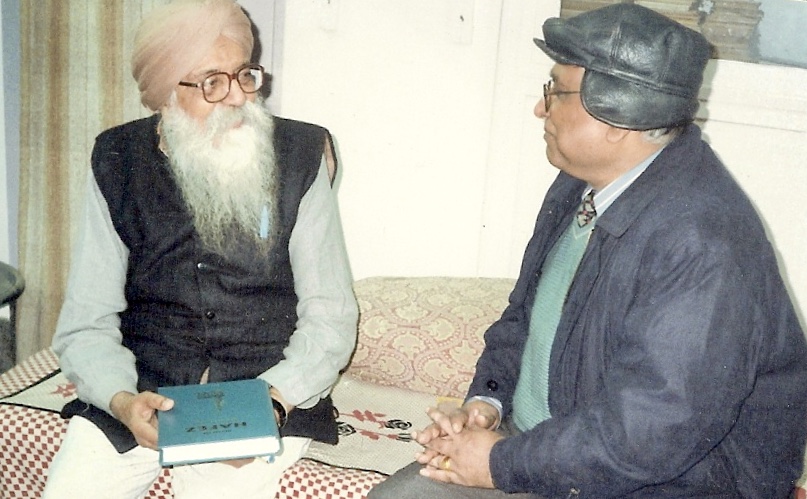
Meeting on Jan. 11, 1999 - 81st Birthday of Prof. Pritam Singh

My last meeting with Professor Pritam Singh took place in the late evening of 1st October, 2008. He appeared some what frail and time - worn but his profundity of expression, smile and laughter were indeed as intact as ever. I had presented to him 'Diwan-e-Hafiz' brought from Iran - the 'Blue book' in the picture and my write-up in Punjabi on the popular 'Chhapar Fair of Punjab' and my recent columns on Urdu poets and scholar A.J. Zaidi and Ahmad Faraz. We touched upon the current educational and cultural scene in Punjab and in the country. When I took leave of him, he persisted in walking with me the up to the main gate. I mentioned to him - at the door step - that Panth must think of establishing a museum of letters, with name, 'Zafar Namah Sahib Bhawan', inviting Punjabis all over the world to donate letters on the themes of literature and culture of Punjab - to be scientifically preserved there.

I penned my last letter to Professor Pritam Singh, on 24th of October, a day before his joining the company of the immortals, sending it care of his daughter Doctor Harshinder Kaur so that she might read it out to him. The Destiny of this letter was fated  to be different - reaching him on the address far, far beyond his earthly abode! I salute this angel of a Teacher on his birth centenary - he indeed radiated knowledge and nobility with every word spoken by him!

*     *     *


Friday, March 24, 2017

Ek Sham - Ahmedgarh ke Naam


Dear Friends,

As you know, Ahmedgarh has been my beloved place of school education - May 1951-March 1959 and my home town upto July  1971...

It was Master Ashni Kumar Ji (1916-1999) - my unique Guru-teacher - who was my anchor of life in Ahmedgarh till he breathed his last - on Saturday, Feb 16, 1999.

I had been myself so stressed and always short of time till I setlled down in retirement in 2004... after spending more than 26 years abroad - 21 of them were consecutive, from 1982-2003!

I have tried to make the best of the sun set years of life by returning - full time - to my books, rediscovering good old friends - and my love for pen and paper - rather the modern age wonder, Shriman computer-Ji!

I know how the dear friends in the tri-city beautiful have been dreaming of an evening devoted to the golden memories of childhood in our beloved Mandi... a brand new town which had sprung up from no where - in the wake Rail Revolution of India in the early twentieth century.

I am heartily grateful to the dream team of friends - Jawahar ji & Janak in particular - who conceptualized the event of the evening of Friday, 24th March to recreate the genuine spirit of love, innocence and affection dedicated to our beloved town. The inimitable Mootki - Rakesh Bhai - is indeed blessed with an abundant artistic talent and the most infectious joy in bringing to pulsating life all the beautiful memories of the sweet past...

Prof. Anu Jain was the perfect compere of the event ... the memories of his most wonderful Tayas - Amrit ji  Madan Faryadi ji - have been my most precious wealth.

I was so glad to meet many new friends and younger friends of the new generation - nasal nau - who all swear by the love of Ahmedgarh!

Brig JJ Singh Jagdev's family - we met after more than fifty years - is closely related to mine for four generations - it was his grandfather who was instrumental in persuading my family to shift to Ahmedgarh.

Sh Gobind Thukral ji has been a dear friend, philosopher and guide since we met in my retirement... 13 years ago; Dear Ashwani Gupta put in a lot of effort in managing the event in Western Court...

My sincerest thanks to all the ladies who had graced the occasion as equal & active participants... I promise to be accompanied by my 'better half' when the next such get together happens.

With my greetings & best wishes to all the dear friends,

Affectionately,
Bal Anand

PS - I am sharing three photos of the event..
Hope you would share more photos/visuals of the most joyful evening